How Should B2B Buyers Choose Fire Alarm Products?
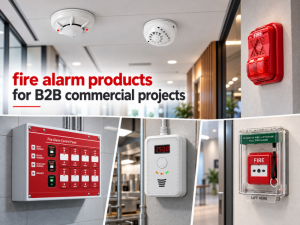
The term fire alarm products refers to the detection devices, control panels, manual activation devices, audible and visual notification equipment, cables, protective enclosures, and maintenance accessories used to support fire detection, alarm communication, and system operation.
For distributors, wholesalers, contractors, installers, system integrators, and OEM/ODM buyers, choosing the right equipment requires more than comparing individual product prices.
A commercial building may need smoke detectors, heat detectors, manual call points, a fire alarm control panel, sounders, strobes, and cables. A warehouse may require beam detectors and high-output notification devices. Outdoor installations may need additional environmental protection.
Buying fire alarm products therefore requires three important decisions:
- What equipment does the project actually need?
- How should different devices work together?
- Why do compatibility, certification, installation conditions, and manufacturer capabilities matter?
This guide explains the major product categories, technical selection factors, and procurement considerations for international B2B projects.
What Products Make Up a Complete Fire Alarm Solution?
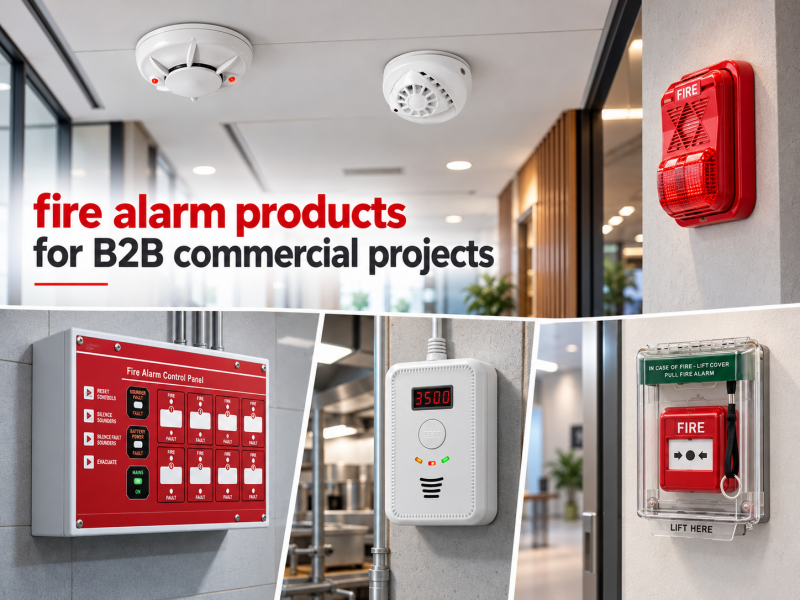
A complete fire alarm solution is built around several functional layers: detection, control, manual activation, notification, connection, protection, and maintenance.
The right fire alarm products should be selected according to each layer’s requirements rather than purchased as independent items.
| Product Category | Primary Function | Important B2B Considerations |
|---|---|---|
| Smoke Detector | Detect smoke particles | Sensor type, wiring, compatibility |
| Heat Detector | Detect abnormal temperature | Fixed-temperature or rate-of-rise |
| Gas Detector | Monitor CO or combustible gases | Gas type, threshold, alarm output |
| Beam Detector | Monitor large open spaces | Detection range, alignment, mounting |
| Fire Alarm Control Panel | Process and manage alarm signals | Zones, loops, interfaces |
| Manual Call Point | Enable manual alarm activation | Electrical interface, operation |
| IP67 Manual Call Point Cover | Protect manual activation equipment | Dimensions, IP rating, mounting |
| Fire Strobe Siren | Provide audible and visual warning | Sound output, flash, voltage |
| Fire Alarm Bell | Provide audible notification | Voltage, sound pressure |
| Horn / Sounder | Deliver warning signals | Sound coverage, power |
| Fire Alarm Cable | Transmit power or signals | Conductor, insulation, compliance |
| Remote Indicator | Display remote detector status | Compatibility and wiring |
| Smoke Detector Removal Tool | Support maintenance | Detector fit, working height |
| Smoke Detector Shell | Protect detector components | Housing material, airflow, tooling |
Other supporting products may include detector bases, mounting brackets, terminal accessories, relays, interface modules, and replacement components.
For a broader explanation of the signal sequence, see how a commercial fire alarm system works.
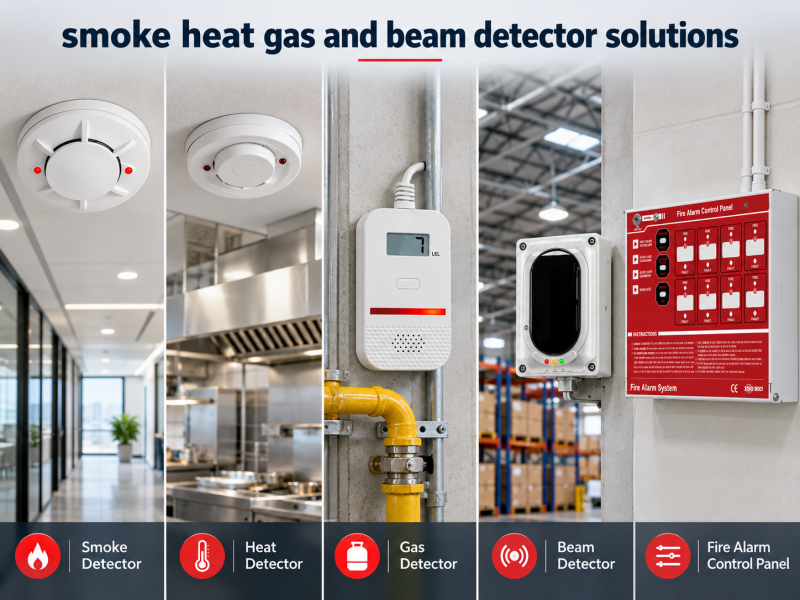
How Should Buyers Match Detection Equipment to Fire Risks?
How Do Smoke Detectors Support Early Detection?
Smoke detectors are essential fire alarm products where the approved system design requires smoke detection.
Photoelectric smoke detectors are commonly specified for buildings requiring early detection of smoke-producing fires.
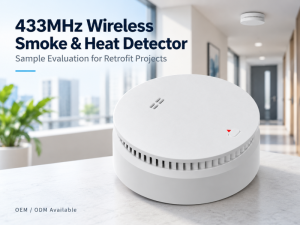
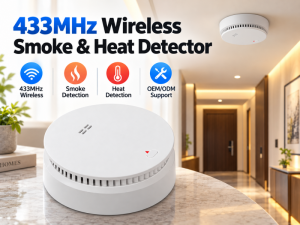
Commercial buyers should identify whether their system requires standalone alarms, conventional detectors, addressable devices, or combination smoke-and-heat models.
Important specifications include operating voltage, standby current, alarm current, sensing method, wiring configuration, mounting base, and control-panel compatibility.
For conventional projects, review how to specify a 2-wire photoelectric smoke detector before approving bulk orders.
For residential sealed-battery models, installers can consult our smoke alarm placement and commissioning guide before preparing installation drawings or approving samples.
Why Are Heat Detectors Used in Challenging Environments?
For heat detection projects, fire alarm products should be selected according to environmental conditions and applicable design requirements.
They may be appropriate for certain kitchens, garages, utility rooms, workshops, and industrial areas where dust, steam, or airborne particles affect smoke detection.
Two common types are fixed-temperature and rate-of-rise detectors.
However, heat detection is not a universal substitute for smoke detection, particularly in areas requiring early warning for sleeping occupants.
Learn more about where heat fire alarms should be installed.
What Makes Gas Detector Selection Different?
Gas detectors should be evaluated separately from general fire alarm products because gas hazards and certification requirements may differ.
Carbon monoxide detectors monitor CO exposure, while combustible gas detectors may be designed for methane, LPG, propane, or natural gas.
For B2B projects, verify:
- Target gas and detection principle
- Measurement range and alarm threshold
- Operating voltage and sensor lifetime
- Audible, visual, or display functions
- Relay, valve, or fan interface where supported
- Installation environment and applicable standards
Buyers planning hotels, apartments, boiler rooms, or other commercial projects can review how to specify a CO gas detector.
For applications requiring a compatible gas shutoff arrangement, see how a gas detector works with a solenoid valve.
When Should Projects Consider Beam Detectors?
Beam smoke detectors monitor a long optical path and are frequently considered for high-ceiling or large open spaces.
Typical applications include warehouses, factories, atriums, exhibition halls, and logistics facilities.
Buyers should evaluate detection distance, mounting height, obstructions, alignment methods, building movement, environmental interference, fault outputs, and maintenance access.
See how B2B buyers should choose a beam smoke detector for detailed project selection factors.
Selecting fire alarm products according to the actual hazard helps avoid unsuitable equipment combinations and unnecessary installation changes.
Why Is the Fire Alarm Control Panel Critical to System Compatibility?
System-compatible fire alarm products help reduce faults and simplify commissioning across conventional or addressable installations.
The fire alarm control panel, also called the FACP, receives signals from compatible initiating devices, identifies system conditions, and activates configured notification or control outputs.
It also supports fault supervision, status indication, and system maintenance.
Commercial projects commonly use conventional or addressable architectures.
A conventional system typically identifies the affected zone, while an addressable system can identify an individual compatible device.
When comparing fire alarm products, the control panel should be considered early because its electrical and communication requirements influence the entire installation.
Buyers should confirm:
- Conventional or addressable system architecture
- Zone or loop capacity
- Detector and manual call point compatibility
- Operating voltage and circuit loading
- Alarm, fault, and supervisory functions
- Sounder, strobe, and relay outputs
- Backup power requirements
- Required project documentation
For a more detailed explanation, read what a fire alarm control panel is and how it works.
How Do Manual Call Points and Protective Covers Work Together?
Manual call points allow occupants to initiate an alarm when they identify a fire-related emergency.
They remain important because automatic detection cannot replace every form of human observation.
For commercial procurement, manual call point selection should address electrical compatibility, activation method, resetting, mounting type, visibility, accessibility, and environmental exposure.
See how to select fire alarm manual call points for commercial projects.
Why Consider an IP67 Waterproof Manual Call Point Cover?
Exposed manual call points may face accidental contact, dust, water, physical impact, or repeated interaction in public areas.
An appropriately designed protective cover can provide additional environmental and mechanical protection while preserving visibility and emergency access.
However, an IP67-rated cover does not automatically make every enclosed manual call point installation IP67-rated. The final assembly, mounting, sealing, and access requirements must be evaluated.
For public-access sites, exposed fire alarm products may require additional protection without restricting emergency operation.
For B2B buyers, the main considerations include:
- Internal width, height, and usable depth
- Manual call point and back-box dimensions
- Transparent polycarbonate construction
- Buzzer or non-buzzer configuration
- Mounting and sealing method
- Required operating clearance
- Custom text, labels, and packaging
- OEM/ODM tooling requirements
A small dimensional mismatch can cause substantial installation problems across a large project.
For detailed selection criteria, read how to select an IP67 protective cover for manual call points.
What Notification Devices Should Commercial Projects Include?
Detection is only effective when the system communicates the alarm appropriately.
Depending on occupancy and project design, notification equipment may include fire strobe sirens, bells, horns, sounders, and visual indicators.
Fire Strobe Sirens
A fire strobe siren combines audible warning with visual notification.
Buyers should evaluate sound output, visual performance, operating voltage, current consumption, environmental rating, and panel output compatibility.
Fire Alarm Bells
Alarm bells provide audible notification in suitable conventional and other approved alarm applications.
The correct bell depends on voltage, current draw, sound requirements, mounting conditions, and the system design.
See what a fire alarm bell is.
Horns and Sounders
Horns may be selected where suitable audible coverage is required, including some industrial and outdoor applications.
However, the highest sound-pressure rating is not necessarily the best choice.
Building acoustics, background noise, occupant requirements, sound distribution, and electrical loading all affect selection.
The effectiveness of fire alarm products depends on selecting detection and notification equipment that meets the overall system specification.
Why Are Cables, Indicators, Detector Shells, and Maintenance Tools Important?
Supporting accessories may represent a smaller portion of the project budget, but they can influence installation reliability, servicing time, and replacement costs.
Fire Alarm Cable
Fire alarm cable connects compatible system components and supports power or signal transmission.
Buyers should consider conductor construction, cable length, voltage drop, insulation, fire-performance requirements, installation environment, and local electrical codes.
Read how B2B buyers should choose fire alarm cable.
Remote Indicator
A remote indicator displays the status of a compatible detector at a more visible location.
Such devices may be specified where the detector itself is difficult to observe.
Electrical compatibility, installation location, and wiring requirements should be confirmed before procurement.
Smoke Detector Removal Tool
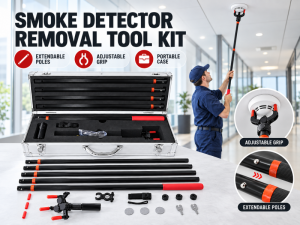
Maintenance tools help technicians access, remove, and reinstall compatible ceiling-mounted detectors.
An appropriate tool should match detector dimensions, mounting structure, working height, and maintenance procedures.
See how to choose a smoke detector removal tool kit.
Smoke Detector Shell
The smoke detector shell houses and supports internal components.
For OEM and ODM projects, enclosure material, optical chamber design, airflow, circuit-board positioning, indicator visibility, mounting structure, and tooling precision can affect the finished device.
Custom enclosure changes should be reviewed for their impact on detector operation, testing, and certification.
How Should B2B Buyers Choose Equipment for Different Projects?
Different commercial environments create different fire detection, notification, installation, and maintenance requirements.
Choosing fire alarm products according to project conditions is more effective than using one fixed equipment package for every application.
| Project Application | Equipment to Evaluate | Main Selection Concern |
|---|---|---|
| Office Buildings | Smoke detectors, FACP, MCP, strobes | System compatibility and zoning |
| Hotels and Apartments | Smoke/heat detection, CO alarms where required, notification | Occupant warning and maintenance |
| Warehouses | Beam detectors, MCP, horns, panels | Ceiling height and environmental conditions |
| Factories | Heat/smoke detection, sounders, protected MCP | Dust, temperature, industrial noise |
| Commercial Kitchens | Appropriate heat and gas detection | Hazard type and equipment interfaces |
| Outdoor Areas | Protected MCP, weather-rated sounders | Water, dust, mounting and access |
| Retrofit Projects | Compatible replacement devices and accessories | Existing wiring and control equipment |
These are application examples rather than universal installation specifications. Final device placement and system design should follow the applicable project code and qualified engineering assessment.
How Can Buyers Verify Compatibility Before Bulk Purchasing?
A low unit price offers little value if the supplied devices cannot operate correctly within the intended system.
Compatibility verification should include three areas.
Electrical compatibility: operating voltage, current, wiring, signaling, supervision, and reset requirements.
Mechanical compatibility: device dimensions, detector bases, covers, installation depth, cable entries, and fixing positions.
Functional compatibility: alarm response, fault signaling, panel communication, notification behavior, and maintenance procedures.
A practical approval process begins with reviewing documentation, confirming the intended configuration, inspecting samples, and testing the equipment under representative project conditions.
Sample approval should happen before large-scale purchasing whenever practical.
What Certifications Should International Buyers Check?
Certification requirements depend on the destination country, building type, product category, and project specification.
Not all fire alarm products carry the same approvals, even when produced by the same manufacturer.
Common requirements may involve:
- EN 54 for relevant fire detection and alarm components
- EN 14604 for applicable smoke alarm devices
- UL standards where specified
- LPCB or other third-party approvals
- CE and RoHS requirements where applicable
- ISO 9001 for manufacturer quality management
Certified fire alarm products should be checked by exact model number, target market, and applicable standard.
Buyers should request model-specific certificates, test reports, technical datasheets, installation manuals, and declarations where required.
A manufacturer’s ISO 9001 certification does not replace product certification.
Similarly, an approval for one detector model should not be assumed to cover a different model or customized version.
In jurisdictions adopting NFPA requirements, buyers should consult the applicable edition of NFPA 72, National Fire Alarm and Signaling Code, together with local requirements.
Final compliance should be verified with the responsible project professionals and authorities.
Why Does OEM and ODM Manufacturing Capability Matter?
For distributors, importers, and private-label brands, purchasing equipment is often part of building a long-term product portfolio.
OEM and ODM services can help adapt a product to market positioning and project requirements.
What Can OEM Services Include?
OEM cooperation may involve:
- Private-label branding
- Customized product labels
- Retail or project packaging
- Multilingual instructions
- Approved color or appearance options
What Can ODM Services Include?
ODM projects may involve deeper engineering work, including:
- Housing and mechanical modifications
- Custom tooling
- Circuit-board adjustments
- Power configuration
- Selected functional changes
- Interface or accessory development
Custom fire alarm products require careful change control because modifications can affect safety performance, system compatibility, production testing, and existing approvals.
Buyers should confirm engineering feasibility, sample approval, tooling ownership, MOQ, certification responsibility, and production schedules before proceeding.
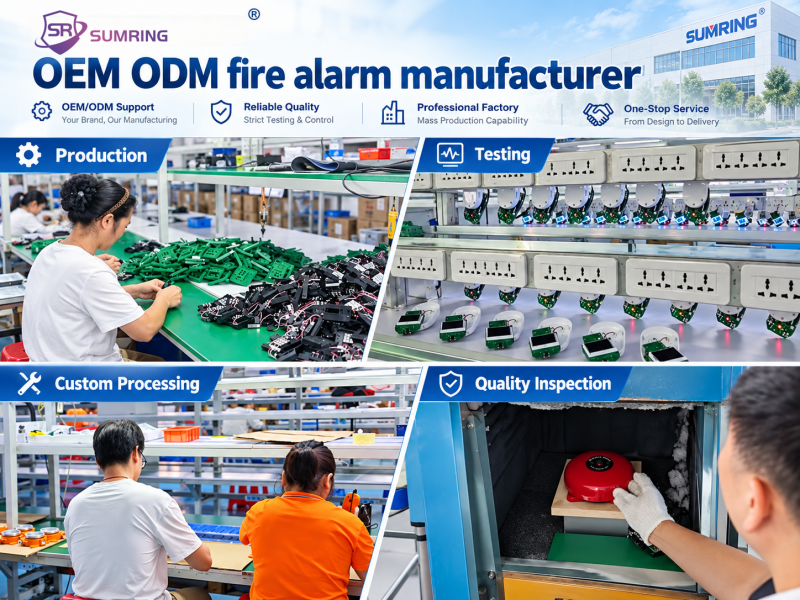
How Should Buyers Evaluate a Fire Alarm Manufacturer?
A suitable B2B supplier should provide more than a competitive quotation.
The manufacturer should also support technical communication, production quality, documentation, and predictable delivery.
Important evaluation factors include product development capability, manufacturing processes, incoming material inspection, functional testing, quality management, customization options, technical support, and after-sales communication.
B2B buyers should distinguish between a supplier’s general company capabilities and the documented capabilities of each individual product.
A strong sourcing relationship is built on technical transparency, consistent production, and realistic project commitments.
What Information Should a B2B RFQ Include?
A complete RFQ for fire alarm products should identify the project location, system type, intended application, and certification needs.
| RFQ Field | Information Required |
|---|---|
| Target Market | Country and applicable standards |
| Project Type | Hotel, factory, warehouse, etc. |
| Product Categories | Detectors, panels, covers, accessories |
| System Architecture | Conventional, addressable, standalone |
| Existing Equipment | Panel brand/model and wiring |
| Electrical Requirements | Voltage, current, outputs |
| Mechanical Requirements | Dimensions, mounting, protection |
| Estimated Quantity | Samples, pilot order, bulk order |
| Certification | Required model-specific approvals |
| Customization | Logo, packaging, tooling, functions |
| Documentation | Datasheets, drawings, certificates |
| Delivery | Sample and production schedule |
This information makes quotations more accurate and helps prevent unnecessary redesign or incorrect product selection.
Why Consider SUMRING for B2B Fire Alarm Projects?
SUMRING is a Shenzhen-based manufacturer focused on fire alarm, gas detection, security alarm, and related protective equipment.
Its portfolio covers manual call point covers, smoke and heat detection, gas detectors, conventional fire alarm control equipment, manual call points, notification devices, and related accessories.
For international distributors, wholesalers, contractors, importers, installers, and OEM/ODM brands, SUMRING supports product selection discussions, samples, customization requirements, and project-based supply coordination.
Learn more about SUMRING’s manufacturing and solution capabilities.
The appropriate product configuration, available customization, certification scope, and production schedule should always be confirmed for the specific model and order.
FAQs
1. What are the main fire alarm products used in commercial buildings?
Typical equipment includes smoke detectors, heat detectors, manual call points, control panels, bells, sounders, strobes, cables, and supporting accessories. Beam detectors, gas detectors, remote indicators, and protective enclosures may also be relevant depending on the project.
2. How do I choose between a smoke detector and a heat detector?
Smoke detectors sense combustion particles and are commonly used where early smoke detection is required. Heat detectors respond to temperature and may be appropriate for environments where dust, steam, or similar conditions make smoke detection unsuitable. Selection must follow the applicable design requirements.
3. Why is fire alarm control panel compatibility important?
The panel determines which initiating devices, notification circuits, and signaling methods it supports. Incompatible components can cause incorrect alarm behavior, trouble signals, or commissioning problems.
4. What is the benefit of an IP67 manual call point cover?
An appropriate IP67-rated enclosure can provide protection against dust and water exposure under its rated conditions. Buyers must also verify dimensions, installation method, accessibility, and suitability for the underlying device.
5. When should a project use a beam smoke detector?
Beam detectors may be considered for large, high-ceiling spaces such as warehouses, factories, and atriums. Ceiling geometry, optical alignment, obstructions, and environmental conditions must be evaluated.
6. What is the difference between OEM and ODM fire alarm manufacturing?
OEM typically focuses on branding or adapting an existing product platform, while ODM can involve deeper product development, mechanical design, electronics, tooling, or functional modifications. The actual scope depends on the manufacturer and project.
7. How can distributors verify product certification?
Request certificates and reports corresponding to the exact model. Check the issuing body, covered standards, validity, model identification, and destination-market requirements before approving a purchase.
8. Can one supplier provide a complete fire alarm product portfolio?
A manufacturer may supply or coordinate several related categories, including detectors, control panels, notification equipment, and accessories. However, technical compatibility, certification, availability, and manufacturing scope should be confirmed separately for each category.
Conclusion
Choosing fire alarm products for commercial and industrial projects requires a practical, system-level approach.
Start by identifying the building risk and application environment. Then define the control-panel architecture, detector requirements, notification equipment, wiring, protective enclosures, and maintenance accessories.
Evaluate compatibility, certification, installation requirements, manufacturer capabilities, and long-term support before approving bulk procurement.
For B2B distributors, contractors, installers, system integrators, wholesalers, and private-label brands, SUMRING offers a broad fire alarm and safety product portfolio with OEM/ODM cooperation options.
Planning a new project or expanding your product range?
Send SUMRING your target country, required product categories, quantities, technical specifications, and customization needs.
Our team can help review suitable configurations, documentation requirements, sample arrangements, and quotation details.