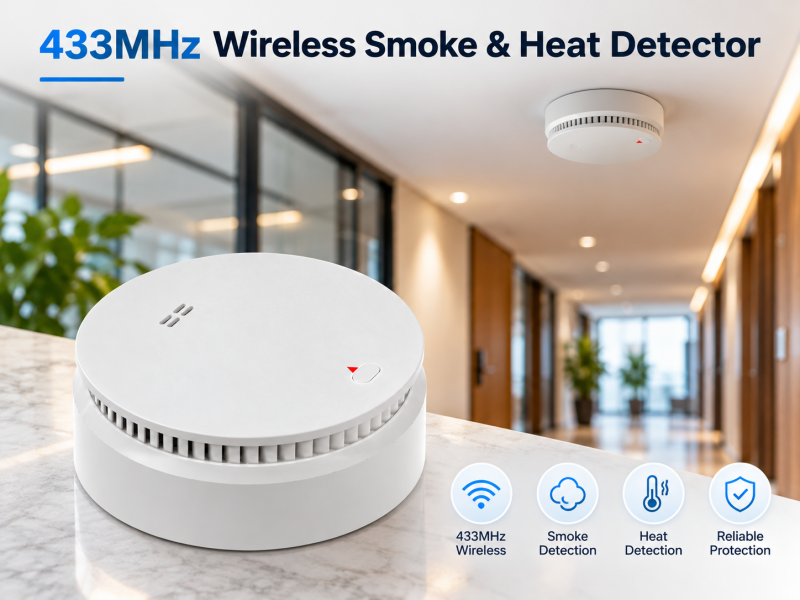
How Should B2B Buyers Evaluate a 433MHz Wireless Smoke & Heat Detector Manufacturer?
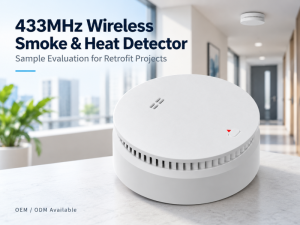
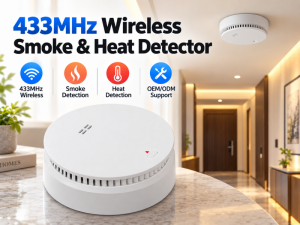
A 433MHz Wireless Smoke & Heat Detector is a battery-operated fire alarm device that combines photoelectric smoke sensing, fixed-temperature heat detection, local audible and visual warnings, and a radio-frequency alarm output in a 433MHz configuration. For distributors, installers, contractors, and private-label brands, choosing one requires more than comparing appearance and unit price.
Purchase decisions require documented specifications, RF compatibility, compliance evidence, and a production plan—especially when replacing an older model.
Which Technical Details Should Buyers Confirm First?
The supplied combination photoelectric smoke and heat alarm manual provides a useful starting point. Its specifications describe an optical sensing chamber that detects smoke-related infrared light scattering and a heat sensing element with an alarm temperature of 57°C ± 2.7°C.
| Specification | Manual reference |
|---|---|
| Smoke detection | Infrared photoelectric sensing |
| Heat alarm point | 57°C ± 2.7°C |
| Wireless output | 315MHz or 433MHz variant |
| Power | Two 1.5V batteries |
| Sound warning | 85dB stated; verify measurement distance |
| Alarm indications | Sound and flashing red LED |
| Working temperature | -10°C to +55°C |
| Relative humidity | Below 95% RH |
| Dimensions | Diameter 105 × 43mm |
| Reference detecting area | 20m² stated in manual |
These are manual-reported values, not independent test evidence. Verify the production revision; follow local rules for coverage and mounting.
For a 433MHz Wireless Smoke & Heat Detector, request the exact battery format, sound measurement condition, and low-battery indication in writing.
Why Must Wireless Compatibility Be Tested Separately?
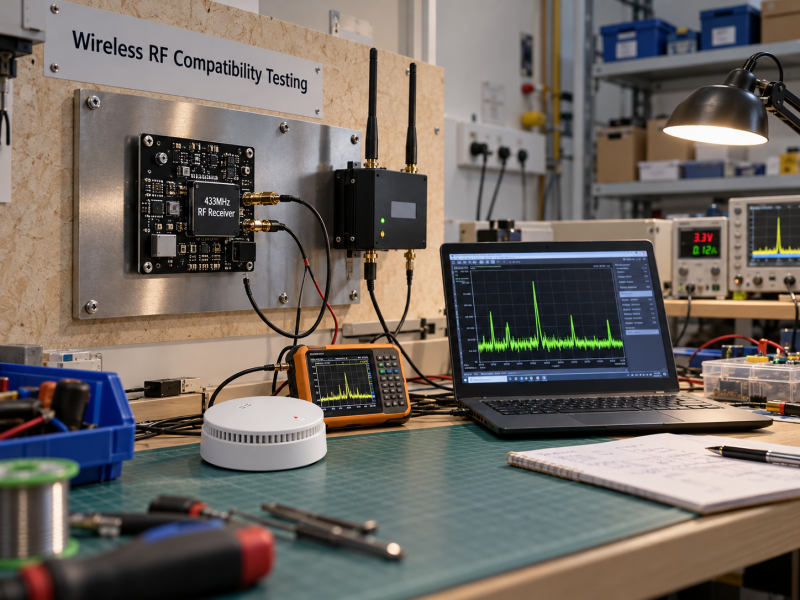
A 433MHz carrier frequency alone does not establish interoperability. Two devices can transmit on the same frequency while using different modulation, coding, message formats, or pairing rules. A receiver may fail to recognize an alarm even though the radio frequency matches.
Before approving a 433MHz Wireless Smoke & Heat Detector, ask the supplier to confirm its supported receiver or alarm host, coding method, enrollment procedure, alarm transmission behavior, and communication test results. Also confirm whether it sends a signal to a host, triggers compatible peer alarms, or only provides standalone local warning. Those functions are not interchangeable.
For mixed-brand projects, 433MHz fire alarm sensor compatibility requires an acceptance test. Perform pairing and alarm-response tests using the actual host model and firmware.
How Should Buyers Handle a Discontinued Model?
Replacement sourcing becomes more complicated when older wireless detectors are no longer produced. SUMRING has published a discontinuation notice for the SR-820DHR and introduced another wireless 433 smoke-and-heat option for new inquiries.
However, a new 433MHz Wireless Smoke & Heat Detector should not be marketed as a direct drop-in replacement until its RF protocol, enclosure dimensions, mounting base, battery configuration, warning behavior, and documentation have been checked.
Compare the installed model with proposed samples, record differences, and obtain project-owner or integrator approval before procurement.
For the site-by-site decision process, use our 433MHz smoke and heat detector replacement guide to document host compatibility, pilot results, and approval before a partial or phased replacement.
For background, read SUMRING’s replacement for discontinued wireless smoke detectors notice.
Which Sample Tests Matter Before an OEM Order?
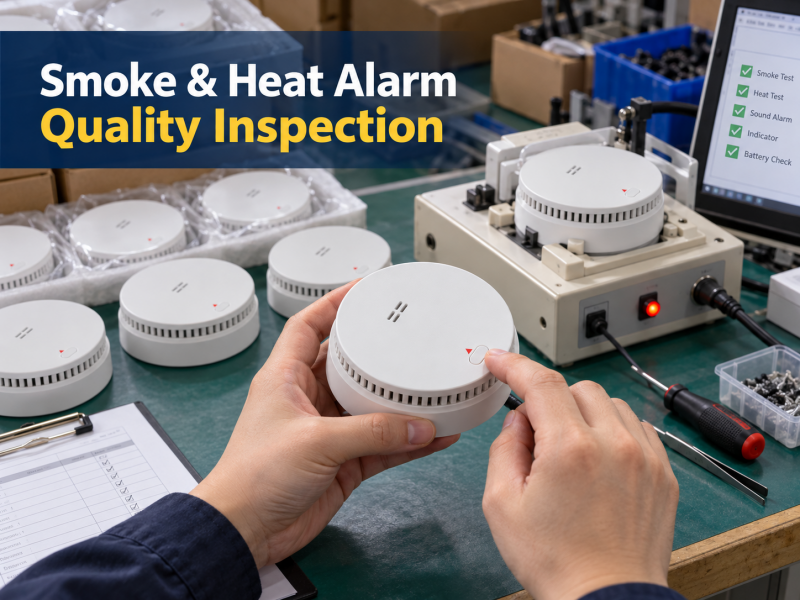
Before placing a bulk order, arrange a controlled sample evaluation. Check power-up and mounting, test-button operation, smoke and heat response under appropriate controlled test conditions, local sound and LED warnings, and reception by the specified wireless host. Do not use improvised fire tests.
An effective review of a 433MHz Wireless Smoke & Heat Detector also includes low-battery behavior, repeat alarm messages, reset or hush functions if supported, and practical radio performance at the intended installation site. Building materials and interference can affect signal reception; do not infer usable range from frequency alone.
The manual recommends weekly testing and periodic cleaning. Include current maintenance instructions in translated manuals.
What Makes an OEM/ODM Manufacturer Suitable for B2B Supply?
Buyers should assess technical communication and change management alongside price. Request a version-controlled specification, sample approval procedure, inspection criteria, traceable labeling, and a process for notifying customers of hardware or firmware changes.
For private-label projects, discuss logo placement, carton artwork, multilingual manuals, barcode formats, and packaging requirements. Additional hardware or RF changes may require engineering evaluation and fresh testing, not simply a revised label.
SUMRING offers OEM/ODM cooperation across its fire-alarm product portfolio. Buyers can review SUMRING’s fire alarm manufacturing and OEM/ODM capabilities before sharing their product requirements. For a wireless smoke and heat detector OEM manufacturer inquiry, include the destination market, host model, expected order quantity, and required customization.
Which Certification Documents Should Importers Request?
The supplied manual mentions GB20517-2006, EN14604, and UL217 as referenced standards. That wording does not establish that the offered SKU has a valid certificate or listing under each standard.
For a 433MHz Wireless Smoke & Heat Detector, ask for applicable test reports, certificates or listing records, issuing bodies, model numbers, validity details, and any radio-compliance documentation required by the destination market. Confirm that a wireless option, enclosure revision, or OEM label is covered by the relevant documents.
Do not advertise a product as UL listed or EN14604 certified unless the evidence explicitly supports the exact configuration. Importers and project engineers should confirm requirements with their local authority or certification adviser.
How Can Wholesale Buyers Plan Delivery and After-Sales Support?
An RFQ should define annual demand, initial batch size, sample deadline, packaging, shipment destination, and spare-unit policy. Ask the manufacturer to quote the MOQ, production lead time, price breaks, inspection arrangements, warranty terms, and replacement availability rather than assuming these are fixed.
For distributors, a 433MHz Wireless Smoke & Heat Detector needs clear installation guides and consistent labels. For contractors, tested host compatibility prevents commissioning problems.
If sourcing other alarm categories together, SUMRING’s building fire alarm system components guide provides useful system-level context.
FAQs
1. Does 433MHz mean that different brands will connect?
No. Frequency alone cannot verify protocol, message coding, or receiver support. Test with the intended host and firmware before ordering.
2. Does the device detect both smoke and heat?
The supplied manual describes a photoelectric smoke sensing chamber and a fixed-temperature heat element rated at 57°C ± 2.7°C.
3. Does the alarm work without a control panel?
The manual describes a local audible and flashing warning. External wireless monitoring depends on a compatible receiving device and verified configuration.
4. Is this a Wi-Fi or Tuya smoke alarm?
Not according to the supplied manual. A 433MHz RF output is not the same as Wi-Fi or an app connection. Any gateway integration needs separate confirmation.
5. What batteries does the unit use?
The manual specifies two 1.5V batteries. Confirm the required battery size, chemistry, and expected replacement interval for the actual shipment.
6. Can it replace an older SR-820DHR?
It may be considered for evaluation, but direct compatibility must be established through sample testing and approval. Matching 433MHz is insufficient.
7. Is a 433MHz Wireless Smoke & Heat Detector automatically certified for export?
No. Obtain valid, model-specific compliance evidence for each destination and the actual OEM configuration before making certification claims.
8. What information is needed for an OEM quotation?
Share destination country, target standards, host information, sample quantity, forecast volume, branding details, packaging, and desired delivery schedule.
Conclusion
A 433MHz Wireless Smoke & Heat Detector can be a practical option for a distributor portfolio or a carefully assessed wireless replacement project. The strongest buying decision connects technical evidence, RF host testing, product documentation, and reliable OEM supply.
SUMRING supports B2B buyers with fire alarm product selection and OEM/ODM discussions. Contact SUMRING for sample evaluation and bulk-order requirements, including your target market and compatible host details.