
BLOG
30
2026-09
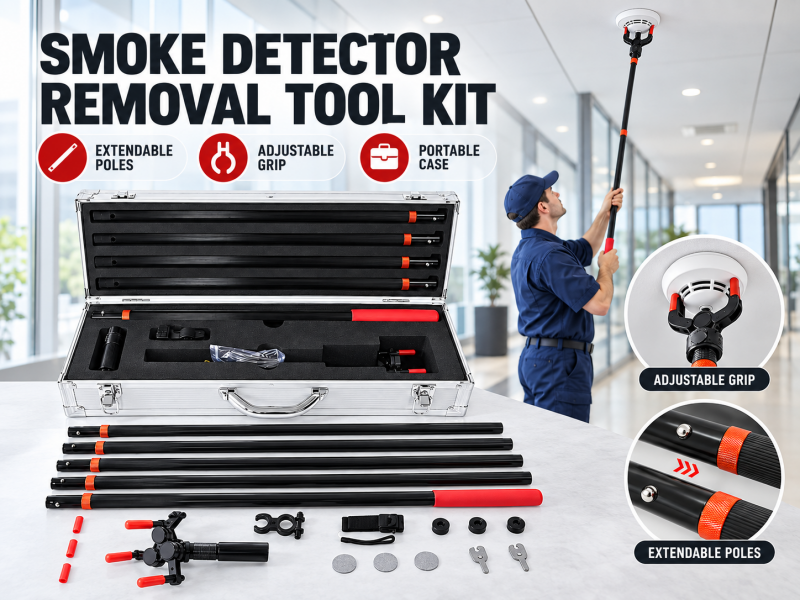
How Should Buyers Choose a Smoke Detector Removal Tool Kit?
A smoke detector removal tool kit is a maintenance accessory set used to grip, rotate, remove, and reinstall compatible ceiling-mounted smoke detectors with an access pole. It supports planned inspection, cleaning, replacement, and commissioning when detectors use a compatible mounting structure and can be safely reached from floor level. For fire alarm contractors, facility maintenance companies, distributors, and OEM buyers, reach is only one consideration. Detector compatibility, grip stability, pole structure, working height, replacement parts, packaging, and sample verification all affect whether the tool can perform reliably in a real project. Why Do Commercial Projects Need a Detector Removal Tool? Smoke detectors are commonly installed on ceilings in offices, hotels, warehouses, schools, hospitals, shopping centers, and industrial facilities. Routine servicing may require technicians to remove multiple detectors across a large building. In suitable locations, a smoke detector removal tool kit can reduce repeated ladder or scaffold setup, shorten routine service time, and reduce disruption to building occupants. It may also help technicians control the detector more steadily when removing it from its base. However, an access-pole tool does not eliminate every working-at-height risk. Stairwells, atriums, obstructed ceilings, unusually high areas, and damaged detectors may still require an approved ladder, platform,......
29
2026-09
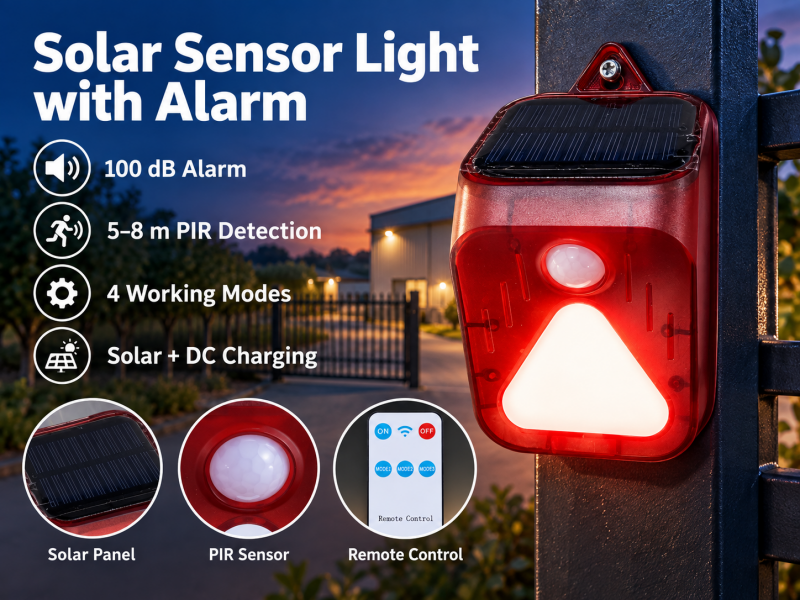
How Should B2B Buyers Choose a Solar Sensor Light with Alarm?
A Solar sensor light with alarm is an outdoor security device that combines solar charging, passive infrared motion detection, a flashing warning light and an audible siren. When the PIR sensor detects movement within its coverage area, the device activates the selected warning mode without requiring permanent mains wiring. For distributors, security installers, agricultural suppliers and private-label buyers, the purchasing decision should not depend only on alarm volume or housing appearance. PIR coverage, charging performance, battery capacity, working modes, mounting position, weather resistance and OEM documentation all affect the product’s performance in a real project. How Does the Solar-Powered Alarm Work? The operating process follows a simple signal path: Sunlight → Solar panel → Rechargeable battery → PIR sensor → Controller → Siren and warning light The 5V, 60mA polycrystalline solar panel charges the internal 3.7V, 1200mAh 18650 lithium battery during daylight. When the product enters its active state, the PIR module monitors the selected area for human movement. Once movement is detected, the Solar sensor light with alarm activates sound, light or both according to the selected operating mode. The supplied information states that the alarm can continue while movement remains within the sensing area and stop approximately 30......
28
2026-09
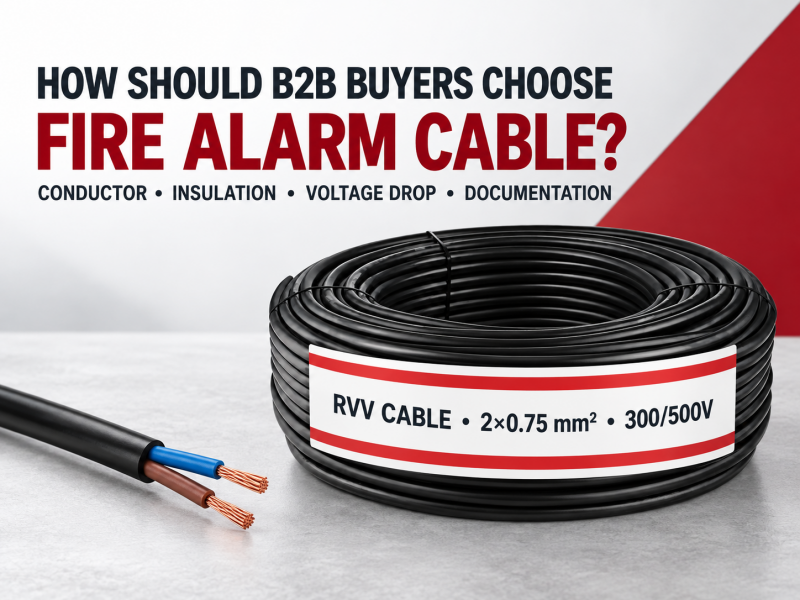
How Should B2B Buyers Choose Fire Alarm Cable?
Fire alarm cable is an insulated conductor assembly used to carry power, alarm signals, control signals, or notification outputs between compatible fire-system components. For B2B buyers, selection requires more than comparing conductor size and price. Voltage drop, insulation, flame performance, installation route, local code, and system approval must be evaluated together. The supplied approval sheet identifies this product as 60227 IEC 53 (RVV) 2×0.75 mm², with two stranded bare-copper conductors, PVC insulation, and a black PVC VW-1 jacket. It references GB/T 5023.5-2008 / IEC 60227-5:2003. This guide explains what B2B buyers should verify before procurement. What Does the 2×0.75 mm² Specification Mean? “2×0.75 mm²” means that the product contains two insulated conductors, each with a nominal cross-sectional area of 0.75 mm². The approval sheet specifies blue and brown cores. Each conductor consists of 24 strands of 0.20 mm bare copper, with a stated bundle diameter of 1.13 mm. Stranded construction can simplify routing and termination in suitable indoor installations. A fire alarm cable intended for continuous movement, outdoor exposure, direct burial, wet locations, plenums, or circuit-survival applications may require a different construction and separate approvals. Key Technical Parameters for B2B Procurement Item Supplied specification Construction 60227 IEC 53 (RVV), 2×0.75......
21
2026-09
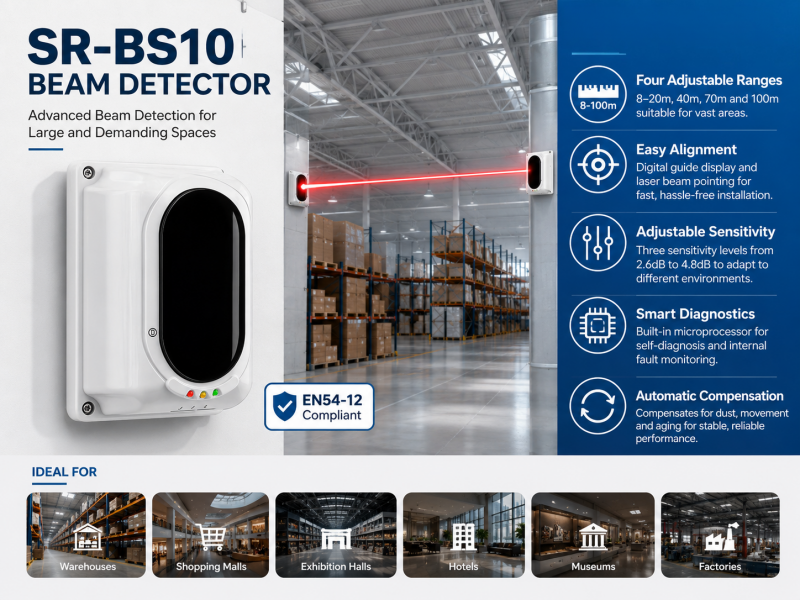
How Should B2B Buyers Choose a Beam Smoke Detector?
A Beam Smoke Detector is a line-type fire detection device that sends an optical or infrared beam across a large open space and monitors how smoke reduces or changes the received light signal. Instead of sampling smoke at only one ceiling point, it supervises a long optical path, making it suitable for warehouses, factories, shopping malls, exhibition halls, hotel atriums, museums, and other high-ceiling buildings. For B2B buyers, the correct detector is not simply the model with the longest range. Selection should match the ceiling geometry, optical path, fire alarm control panel, mounting conditions, certification requirements, commissioning method, and maintenance plan. The SR-BS10 conventional reflective beam detector in the supplied material is a useful example of the points buyers should verify before project approval. Beam detection is only one part of a complete fire protection architecture. B2B buyers planning an integrated project can first review the main components of a building fire alarm system to understand how detection devices, control panels, manual call points, and notification appliances work together. Why Is Beam Detection Suitable for High-Ceiling Spaces? A conventional point smoke detector monitors smoke near one sensing chamber. A Beam Smoke Detector uses a long optical path, so a correctly......
18
2026-09
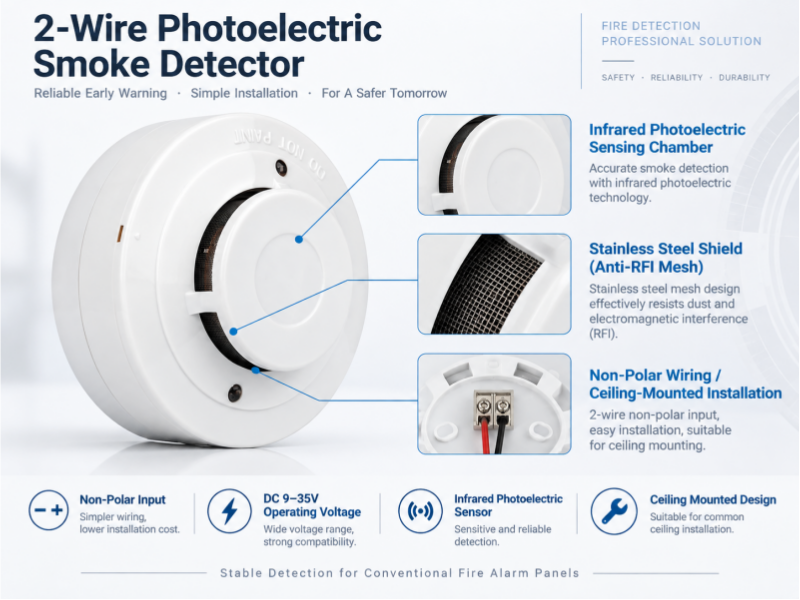
How Should B2B Buyers Choose a 2-Wire Photoelectric Smoke Detector?
A 2-Wire Photoelectric Smoke Detector is a conventional fire detection device that receives power and communicates an alarm condition through the same pair of zone wires connected to a compatible fire alarm control panel. For B2B buyers, selection should focus on electrical compatibility, sensing performance, installation conditions, and commissioning—not appearance alone. This matters for distributors, system integrators, contractors, and OEM buyers. Two detectors can share a similar voltage range but still behave differently on a real conventional zone. A good procurement specification therefore starts with the panel and project requirements. In practice, a 2-Wire Photoelectric Smoke Detector should be approved as part of the complete zone circuit rather than treated as an isolated device. Why Does Panel Compatibility Come First? A 2-Wire Photoelectric Smoke Detector shares power and alarm signaling through one zone circuit. The detector and panel must therefore operate as a matched electrical system. Check the panel’s normal loop voltage, standby-current allowance, alarm-current range, reset method, end-of-line supervision, maximum detector quantity per zone, and remote-indicator requirements. A wide detector voltage range does not automatically mean universal compatibility. For bulk orders, buyers should confirm the detector against the intended panel model before production. Sample testing on the actual panel......
16
2026-09
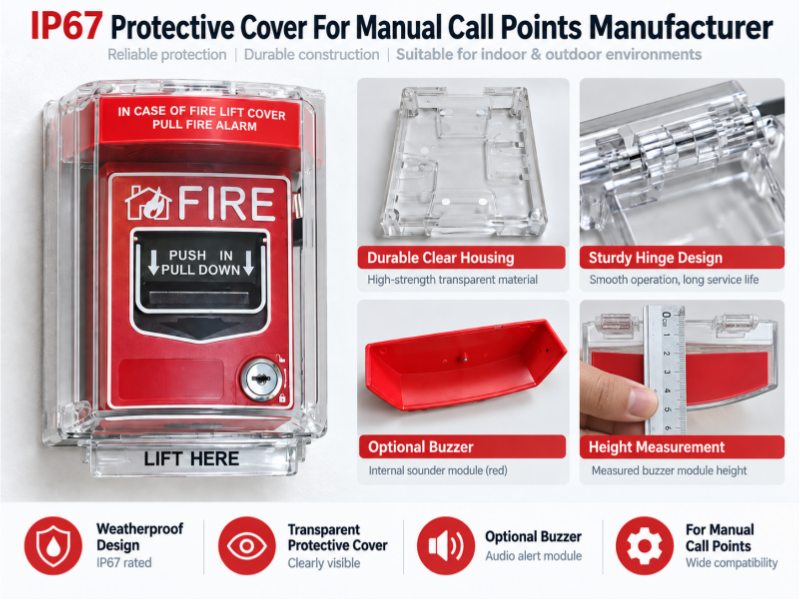
How to Select an IP67 Protective Cover For Manual Call Points Manufacturer for B2B Projects?
An IP67 Protective Cover For Manual Call Points is a protective enclosure placed around a manual fire alarm call point to reduce exposure to dust, water, accidental contact, and physical damage while keeping the device visible and accessible. For a B2B buyer, however, choosing the cover itself is only half the job. The harder question is this: Can the manufacturer supply a cover that actually fits your manual call point, installation method, project environment, and order plan? That matters when you are buying 500, 5,000, or even more units. A few millimeters of missing depth may look harmless on a drawing. On site, it can turn into hundreds of covers that cannot close. So, when choosing an IP67 Protective Cover For Manual Call Points manufacturer, buyers should look beyond unit price. Size, depth, material, IP documentation, buzzer options, mounting base, sample testing, MOQ, and OEM/ODM ability should all be checked before bulk production. Here is a practical way to do it. 1. Start With Manual Call Point Size—Not the Cover Catalogue A supplier may say its IP67 Protective Cover For Manual Call Points fits “most standard manual call points.” That sounds reassuring. It is not enough. Manual call points from......
14
2026-09
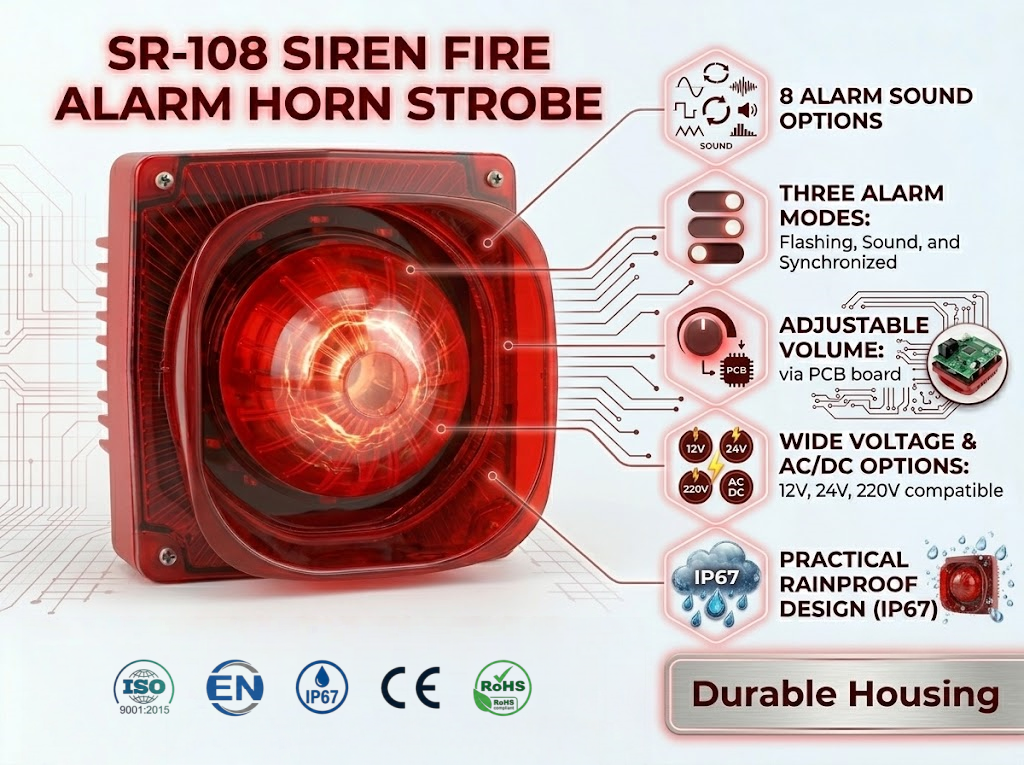
How to Choose an Outdoor Fire Alarm Horn Strobe for B2B Projects?
An outdoor fire alarm horn strobe is an audible and visual warning device that uses sound, flashing light, or both to alert people during a fire, security event, or other danger condition. For distributors, contractors and system integrators, selecting the right unit requires more than comparing appearance or sound level. Voltage, alarm current, output mode, environmental conditions and system compatibility all matter. The SR-108 is designed around these project requirements. According to its product specifications, it provides three warning modes: sound alarm, flashing alarm, and sound-plus-light alarm. This makes it suitable for buyers who need one alarm platform for different commercial or industrial applications. What Should Buyers Check When Selecting an Outdoor Fire Alarm Horn Strobe? The first question should be electrical compatibility. The SR-108 specification lists 24V and 220V operating-voltage options. For procurement purposes, buyers should confirm which voltage version is required rather than assuming that one unit automatically supports both inputs. The alarm current also changes according to the operating mode. SR-108 Specification Details Model SR-108 Material ABS Operating Voltage 24V / 220V options Sound + Flash Current Approx. 40mA Sound-Only Current Approx. 25mA Flash-Only Current Approx. 15mA Sound Pressure 85dB, customizable Operating Temperature -10°C to 60°C Environmental......
11
2026-09
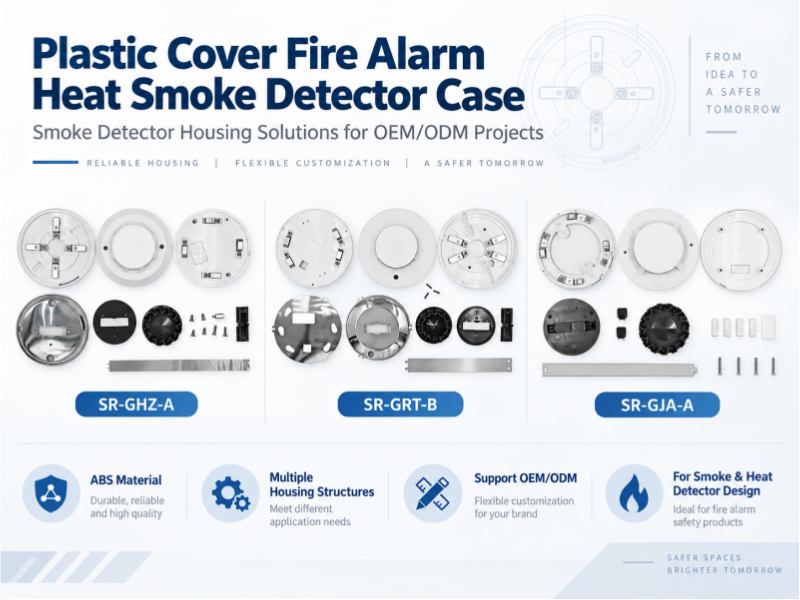
How to Choose a Plastic Cover Fire Alarm Heat Smoke Detector Case?
A Plastic Cover Fire Alarm Heat Smoke Detector Case is the outer housing and support structure used to protect and position the electronic, sensing, and mounting components of a smoke or heat detector. For distributors, fire alarm manufacturers, OEM brands, and engineering suppliers, choosing the right Plastic Cover Fire Alarm Heat Smoke Detector Case requires more than comparing appearance or price. Vent design, internal space, mounting structure, sensor-chamber position, material, and tooling accuracy can all influence assembly and finished-product development. 7 Key Factors When Buying a Plastic Cover Fire Alarm Heat Smoke Detector Case? Before purchasing a Plastic Cover Fire Alarm Heat Smoke Detector Case, B2B buyers should evaluate seven practical factors: detector type, PCB compatibility, sensing-chamber structure, mounting method, housing material, customization requirements, and finished-product compliance. A housing must match the PCB dimensions, optical or heat sensing structure, buzzer location, LED position, test mechanism, terminal arrangement, and mounting method. A visually similar cover can still require different internal posts, screw positions, chamber clearances, or base structures. The second question is detector architecture. Conventional 2-wire or 4-wire detectors, standalone battery alarms, and smoke-and-heat detectors may use different layouts. Buyers should therefore specify the complete application before selecting a shell. The......
07
2026-09
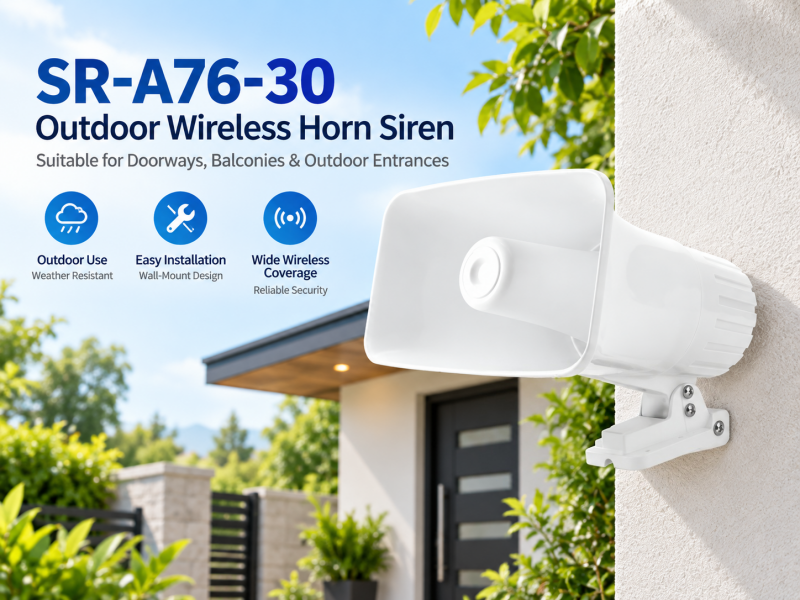
Outdoor Wireless Horn Siren: How to Choose the Best One? 7 Key Factors
An outdoor wireless horn siren is an external audible alarm device designed to receive wireless alarm signals and produce a high-output warning sound across outdoor or large-area security applications. For installers, security distributors and system integrators, choosing a siren is not simply about finding the highest dB number. Wireless range, sound projection, backup power, environmental resistance, installation method and system compatibility all affect whether the device will work reliably in a real project. The SR-A76-30 is designed around these practical requirements. According to its listed specifications, it combines 433 MHz wireless communication, an open-area wireless distance of 100–200 meters, AC power with backup battery support, and a horn-type acoustic structure intended for long-distance warning. What Is an Outdoor Wireless Horn Siren Used For? An outdoor wireless horn siren extends the audible alarm coverage of a security or warning system. Instead of relying only on an indoor control panel buzzer, a horn siren can be positioned where sound needs to reach a larger area. Typical applications may include: Warehouses Factory compounds Commercial buildings Construction facilities Equipment yards Farms Perimeter security systems Remote buildings Industrial sites For B2B projects, the main objective is usually clear: when an alarm event occurs, people across......
04
2026-09
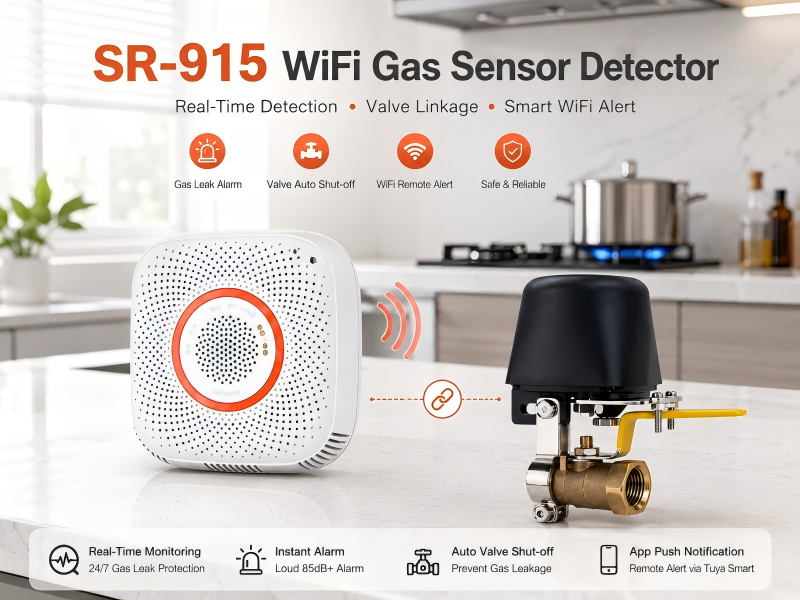
SR-915 Smart WiFi Gas Detector vs Traditional Gas Alarm: What Is the Difference?
The SR-915 Smart WiFi Gas Detector is an indoor combustible gas detector designed for CH4 monitoring, local gas warnings, 2.4GHz WiFi communication, Tuya App notifications, and remote device monitoring. For wholesalers, distributors, smart-home suppliers, and engineering contractors, however, the real question is not simply, “Which one has more features?” It is this: Which gas detector gives the project the functions customers will actually use without adding unnecessary cost? Let’s make that decision easier. SR-915 Smart WiFi Gas Detector vs Traditional Gas Alarm: The main difference is connectivity. A traditional gas alarm normally detects gas and activates an audible or visual warning at the installation site. A smart WiFi gas detector adds a communication layer. It can send information through a WiFi network to an app, so authorized users can receive warnings or check device status away from the detector. The SR-915 Smart WiFi Gas Detector supports 2.4GHz WiFi and Tuya App communication. The current SR-915 specification also lists AC100–240V power, CH4 combustible gas detection, a 6%LEL alarm concentration, approximately three minutes of warm-up time, and alarm sound pressure of at least 70dB at one meter. So, smart does not mean the traditional alarm suddenly becomes useless. It means buyers have......
02
2026-09
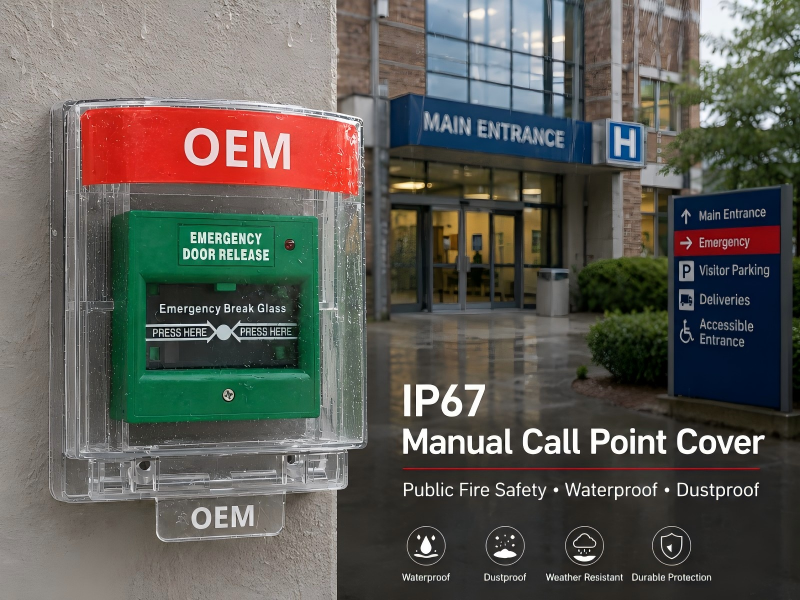
IP54 vs IP65 vs IP67: Which Protection Level Is Better for Manual Call Points?
IP54 vs IP65 vs IP67 describes three enclosure protection levels used to indicate how well electrical equipment is protected against solid particles and water under defined test conditions. If you are buying manual call points or protective covers for a fire alarm project, the obvious question is simple: should you choose IP54, IP65, or IP67? The answer is slightly less obvious. IP67 is not automatically the best choice for every manual call point. A clean hotel corridor has very different risks from an outdoor warehouse gate, a dusty factory, or a loading bay washed with water. For wholesalers and fire alarm contractors, choosing IP54 vs IP65 vs IP67 is really about matching the protection level to the site. That saves money. More importantly, it helps avoid specifying the wrong product for the environment. IEC 60529 is the international standard that classifies degrees of protection provided by electrical enclosures using the familiar IP Code. IP54 vs IP65 vs IP67: What Do the Numbers Mean? The IP code contains two digits. The first digit describes protection against solid objects and dust. The second digit describes protection against water. That makes the difference between IP54 vs IP65 vs IP67 easier to understand: Rating......
31
2026-08
What Is a Conventional Control Panel? 7 Key SR-P01 Features
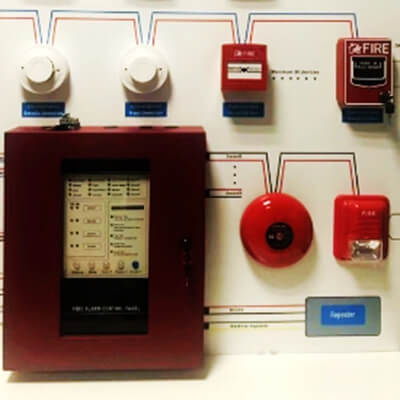
A conventional control panel is a fire alarm control unit that organizes detectors, manual call points, and notification devices into monitored zones, allowing the system to identify the area where an alarm, trouble, or supervisory condition occurs. For small and medium-sized commercial fire alarm projects, system integrators often need a panel that is straightforward to install, easy to maintain, and flexible enough for different project sizes. The SR-P01 Series is a 4-, 8-, or 16-zone Class B conventional fire alarm control panel designed around these requirements. With programmable zone functions, notification appliance circuits, relay outputs, DC24V auxiliary power, battery backup capability, and optional RS485 communication, the SR-P01 gives contractors a practical platform for conventional fire alarm applications without introducing unnecessary system complexity. What Is a Conventional Control Panel? A conventional control panel receives signals from initiating devices connected to individual fire alarm zones. Devices within the same zone share an initiating device circuit, so the panel normally identifies the affected zone rather than the exact individual detector. For example, a commercial building may assign separate zones to offices, storage areas, corridors, and utility rooms. When a smoke detector or manual call point operates, the panel indicates which zone has entered......
Let's Discuss Your Project
Contact us for suitable solution, and to meet your needs with maximum efficiency!
1. How can I become a SUMRING distributor?
We welcome global partners for fire alarm system distribution.You can apply for:Regional distributor rights,OEM branding cooperation,Project-based supply agreements,Long-term B2B partnership,Contact us to discuss your target market and business plan.
2. Why choose SUMRING fire alarm systems?
Our Key advantages include:Factory-direct fire alarm manufacturer pricing;Fast delivery for urgent engineering projects;Complete fire detection product portfolio;OEM/ODM customization capability;Stable quality control under ISO9001 system;Suitable for global mid-tier fire protection projects.
3. Do you provide technical support for fire alarm systems?
Yes, we provide full technical support including:Fire alarm system installation guidance,Wiring and configuration support,Troubleshooting assistance,Project-based consultation for distributors and contractors.
4. What shipping methods are available for fire alarm products?
We offer global logistics solutions:Sea freight (main export via Shenzhen / Hong Kong ports),Air freight,Express delivery (DHL, FedEx, UPS, TNT),China-Europe Railway Express (for EU markets).