How Do Addressable Fire Alarm System Devices Work Together?
How Do Addressable Fire Alarm System Devices Work Together?
An Addressable fire alarm system is a network of compatible fire detection, manual activation, interface and notification devices that communicate with a control panel using individual device identities. The panel can identify an initiating device and display its programmed location, helping personnel investigate alarms and faults.
For contractors and integrators, the question is whether each device communicates correctly, triggers the intended response and remains serviceable.
What Do the Six Devices in the Product Photograph Represent?
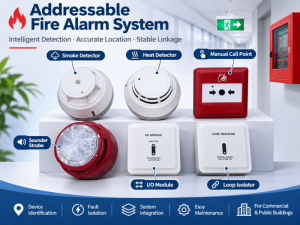
The photograph shows two detector housings, a manual call point, sounder-strobe style unit, I/O module and loop isolator. No control panel or readable model number appears. Detector sensing types cannot be confirmed visually.
| Visible component | Function or point to verify |
|---|---|
| Addressable heat detector | Sensing technology and compatible base |
| Addressable smoke detector | Detector type, protocol and operating limits |
| Addressable manual call point | Manual alarm initiation and reset method |
| Addressable sounder-beacon | Audible/visual output and circuit requirements |
| Addressable input/output module | Monitored inputs, controlled outputs and ratings |
| Addressable short-circuit isolator | Short-circuit isolation and placement rules |
This six-device view is useful for discussing an Addressable fire alarm system, but the photograph alone does not prove that all six products share a compatible protocol or carry any particular certification.

How Does the Control Panel Coordinate the Devices?
A fire alarm control panel supervises supported circuits, recognizes incoming events and applies the programmed cause-and-effect logic. It may display an address, a device description and a building location, such as a corridor or equipment room. It also manages supported fault and supervisory indications.
In an Addressable fire alarm system, panel capacity must be checked against the proposed number of loops, supported addresses, communication protocol and power requirements. Similar-looking detectors may use incompatible protocols. Written compatibility evidence matters more than matching voltage.
The U.S. Fire Administration explains the distinction between zone identification and individual device identification in its fire alarm plans-review training manual.
What Roles Do Detection, Manual Activation and Notification Play?
Detector units. Automatic detectors respond to their designated physical conditions, which may involve smoke or heat depending on the verified sensing technology. Before selecting a device, confirm the intended environment, compatible base, maintenance instructions and the relevant performance approval.
Manual call point. A person can activate the alarm without waiting for automatic detection. Confirm reset method, access and panel interface.
Sounder-strobe. Audible and visual notification helps communicate an emergency to occupants. However, a sounder-strobe is not necessarily an addressable loop device. It may require a dedicated notification circuit, approved interface or compatible loop driver. Coverage must meet the approved design.
A correctly specified Addressable fire alarm system connects these functions through approved control logic, rather than treating each product as an independent alarm.
Why Are I/O Modules Important for Building Integration?
An input/output module allows a compatible panel to monitor specified external signals or operate approved outputs. Interfaces may monitor equipment status or support approved building controls.
For Addressable fire alarm system integration, ask for the exact input type, contact rating, supervision method, output behavior and programming limitations. A module label does not prove load suitability. Critical connections need engineered design and documented testing.
This is especially relevant to projects needing an addressable fire alarm I/O module integration review before procurement.
What Does a Loop Isolator Protect?
A short-circuit fault on a signaling loop can interrupt communication. A compatible isolator is designed to separate a faulty segment so that other portions of a correctly designed circuit may continue to operate. Its effectiveness depends on system topology, spacing, device compatibility and manufacturer instructions.
In an Addressable fire alarm system, isolator positions should be reviewed during engineering, not added casually after installation. It does not repair faults or guarantee every device remains operational.
An addressable fire alarm loop isolator should therefore be assessed alongside wiring diagrams and the complete fault-management strategy.
Which Checks Should B2B Buyers Complete Before Ordering?
Every Addressable fire alarm system proposal should include a device schedule and a control-panel compatibility matrix. The evaluation should cover:
- Protocol: written confirmation that detectors, manual call points and modules work with the intended panel.
- Capacity: loop limits, device addresses, electrical loading and future expansion allowances.
- Outputs: sounder-strobe supply, I/O module contact ratings and monitored circuit requirements.
- Compliance: applicable national codes, model-specific certificates and authority requirements.
- Support: configuration files, programming guides, replacement policy and commissioning assistance.
For broader supplier evaluation, consult SUMRING’s fire alarm products selection guide for B2B buyers. It explains how system architecture affects sourcing decisions across several product categories.
An effective commercial addressable fire alarm commissioning checklist should also record device identity, location text, tested response, communication faults, isolator behavior and approved handover documents.
How Should a Project Team Verify the System Before Handover?
Before accepting an Addressable fire alarm system, the commissioning team should test the approved configuration against the project cause-and-effect matrix. Each required input, notification output, fault indication and interface should be verified under a documented procedure. Qualified personnel must also check labeling, as-built drawings, standby-power calculations and local acceptance requirements.
For an Addressable fire alarm system, OEM or ODM buyers should check whether housing, electronics, firmware or label changes affect approvals. Never assume that a certificate for one configuration automatically covers a customized variant.
FAQ
1. What is the main benefit of an addressable fire alarm network?
It can identify the individual initiating device, helping authorized personnel locate an event and diagnose faults more precisely than a system that only reports a broad zone.
2. Are all detectors compatible with every addressable panel?
No. Communication protocols, supported device lists, electrical limits and programming requirements vary. Obtain explicit panel-to-device compatibility confirmation.
3. Can a conventional manual call point be used?
Sometimes, through an appropriate listed or approved interface where the panel and project design permit it. Direct interchangeability should never be assumed.
4. Does a sounder-strobe need its own address?
Not always. Some notification devices are addressable; others operate through compatible notification circuits or interface modules. Check the actual system architecture.
5. What happens when a signaling loop has a short circuit?
The system may isolate the affected section and report a fault; remaining operation depends on circuit design.
6. Why is an I/O module needed?
It provides a defined, supervised connection between a compatible fire alarm panel and specified external inputs or outputs, subject to its documented ratings and programming.
7. Which certifications should importers request?
Request approvals applicable to the destination market and exact product configuration, including relevant EN 54 or UL documentation where required. Local approval rules also apply.
8. Can buyers order the pictured equipment as one compatible kit?
No. Confirm actual models, protocols, panel compatibility, documentation and sample testing first.
Conclusion
An Addressable fire alarm system succeeds when detection, manual activation, alarm notification, I/O interfaces, fault isolation and panel programming operate as one verified design. For commercial buyers, the most useful purchasing documents are the compatibility matrix, device schedule, approved certificates and commissioning plan.
SUMRING welcomes project-specific discussions about fire alarm product sourcing and potential OEM/ODM requirements. Share the destination market, panel specification and device list so availability and technical suitability can be reviewed before quotation.