How Should Buyers Choose an Exit Indicator Light for Commercial Buildings?
How Should Buyers Choose an Exit Indicator Light for Commercial Buildings?
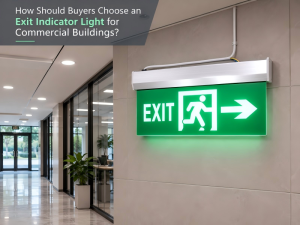
An exit indicator light is an illuminated sign designed to identify a designated exit or show the direction of escape. When fitted with a suitable battery-backup system, it can continue displaying that message during a power interruption. Its primary job is wayfinding; it does not replace emergency lighting that illuminates corridors, stairs, or obstacles.
For importers, distributors, contractors, and system integrators, buying an exit indicator light requires more than choosing a green sign. Sign visibility, emergency duration, operating voltage, environmental protection, and destination-market rules determine whether a product is appropriate.
Why Does Exit Sign Visibility Matter More Than Appearance?
People unfamiliar with a building should be able to recognize the designated exit without guessing. An exit indicator light should be placed where the approved evacuation design requires it, with a clear sightline from approaching corridors and decision points.
For hotels, shopping centers, offices, schools, and warehouses, consider viewing distance, mounting height, obstructions, background lighting, and language or pictogram requirements. Different countries accept different sign formats. A green EXIT display shown in a catalog is not automatically acceptable for every jurisdiction.
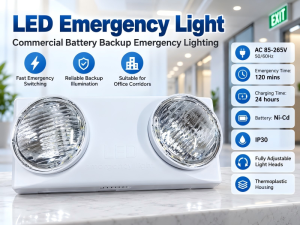
A sign identifies the route; other emergency lighting equipment may be needed to illuminate the route itself. Keeping these functions distinct helps buyers prepare accurate specifications.
Which Technical Specifications Should Buyers Compare?
Before selecting an exit indicator light, compare the light source, input rating, battery, charging time, emergency duration, housing materials, and physical dimensions. A broader AC input range may help with regional sourcing, but the electrical installation and compliance requirements still need confirmation.
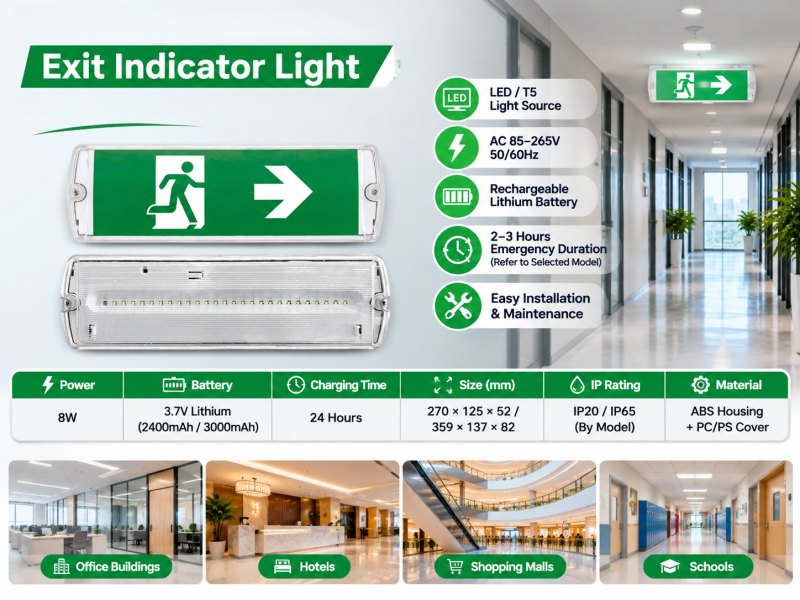
The following details are transcribed from the supplied product images. Shared series data does not establish the exact combination available for every variant.
| Model | Light Source and Input | Battery and Backup | Housing, Size and Brochure Claims |
|---|---|---|---|
| SR-S205 | LED SMD2835; AC 85–265V, 50/60Hz; 8W | Lithium 3.7V, 2400mAh; 24-hour charging; 2–3-hour stated duration | ABS housing + PC cover; 270 × 125 × 52mm; IP20/IP65 options indicated; CB, CE, EMC, RoHS claimed |
| SR-S207LED / SR-S207 / SR-S207S | LED SMD2835 or T5 fluorescent lamp; AC 85–265V, 50/60Hz; 8W | Lithium 3.7V, 2400/3000mAh; 24-hour charging; 2- or 3-hour duration listed; separate “up to 6 hours” claim requires clarification | ABS housing + PS cover; 359 × 137 × 82mm; CB, CE, EMC claimed |
These are brochure figures, not independently verified performance results. Before approving a sign for a tender, request the current model-specific datasheet, runtime test, certification documents, mounting drawing, and confirmation of which battery belongs to each configuration. A claimed patent or conformity mark should also be checked against its supporting records.
How Should Battery Backup and Light Sources Be Evaluated?
A rechargeable exit sign with battery backup must maintain adequate sign visibility for the duration required by the applicable project code. The exit indicator light brochure lists lithium battery options and a 24-hour charging period, but battery capacity alone cannot prove emergency runtime.
Ask for a complete-unit discharge test showing the light remains legible at the end of its rated emergency period. Confirm whether the sign operates continuously while mains power is present, switches to battery mode on failure, and provides a suitable charging or test arrangement. Do not assume those functions from a photograph.
LED versions use SMD light sources, while the larger series also lists T5 fluorescent alternatives. Compare replacement availability, maintenance needs, actual energy consumption, and lifetime evidence rather than assuming all light-source variants perform identically.
What Do IP Ratings Mean for Exit Sign Selection?
An exit indicator light designed for a clean indoor corridor faces different exposure from a sign installed in a damp or dusty service area.
IP20 and IP65 are not interchangeable. The brochure indicates both ratings for one family without identifying the exact construction of each version.
Request the relevant ingress-protection test report and installation conditions before selecting a higher-rated option.
Which Exit Sign Regulations Should International Buyers Check?
U.S. buyers must check sign dimensions carefully.
OSHA’s exit route lighting and marking requirements specify EXIT letters at least six inches (152mm) high for covered workplaces.
The overall heights listed in this brochure are below that figure, so these pictured configurations must not be presented as meeting that U.S. lettering requirement.
Other markets may use different sign conventions and approvals.
A CE marking or CB reference does not by itself demonstrate suitability for a particular U.S. installation. Project-specific approval must be established through the applicable code, product documentation, and responsible authority.
Where Should Commercial Projects Install Illuminated Exit Signs?
Specify each exit indicator light according to the approved evacuation layout, not simply at regular intervals. Typical review points include final exits, corridor intersections, stair access, and changes of direction where wayfinding is required.
For emergency exit signage for hotels and warehouses, verify mounting access, sign visibility under normal and emergency conditions, and protection from accidental obstruction. Installation teams should confirm wiring, fixing details, power isolation, and commissioning requirements against the manufacturer’s instructions.
Exit signage is one part of a wider life-safety plan. For related equipment categories and procurement considerations, see SUMRING’s commercial fire alarm products selection guide.
How Can OEM and ODM Buyers Reduce Procurement Risk?
For a private-label exit indicator light order, clarify the intended market before selecting a face design, logo, battery, or packaging format. Custom branding and battery configurations are advertised in the supplied catalog, but proposed changes still need engineering review and may affect applicable approvals.
A useful request for quotation identifies the destination country, required sign format, indoor or exposed location, battery duration, order quantity, packaging language, and documentation expectations. Seek a pre-production sample, agreed inspection criteria, and written approval of the final bill of materials.
This method helps distributors compare offers on verifiable requirements instead of headline prices or broad certification claims.
FAQs
1. What is the purpose of an exit indicator light?
An exit indicator light identifies an approved exit or route direction with an illuminated message. It complements, rather than replaces, emergency luminaires used to illuminate the path of travel.
2. How long should a battery-backed exit sign operate?
The required duration depends on local regulations and the project specification. Catalog runtime claims should be verified with complete-unit testing under the relevant operating conditions.
3. Is LED always better than a fluorescent exit sign?
LED options may offer maintenance advantages, but buyers should compare tested performance, replacement parts, efficiency, and the actual product configuration rather than relying on the light-source label alone.
4. Can an IP20 exit sign be installed outdoors?
IP20 does not indicate water protection. Choose a version documented for the expected exposure and follow the manufacturer’s installation requirements.
5. Does a CE mark mean an exit sign is approved worldwide?
No. Market acceptance depends on relevant regulations, the applicable conformity procedure, supporting documents, and any local listing or approval requirements.
6. What is a maintained exit sign?
A maintained sign stays illuminated during normal power and remains illuminated during its designed backup operation. Confirm the actual operating mode and changeover behavior in the model’s instructions.
7. Can buyers customize the logo and battery?
The supplied catalog advertises both options. Buyers should confirm feasibility, minimum quantity, safety evaluation, labeling, and whether modifications change the certification scope.
8. Which documents should a distributor request?
Request a model-specific datasheet, wiring and mounting instructions, emergency-duration test evidence, battery information, applicable approval records, warranty details, and sample-approval documents.
Conclusion
The right exit indicator light is selected through visibility, verified battery performance, appropriate environmental protection, correct sign format, and documented compliance. A brochure is a useful starting point, not the final acceptance standard.
For bulk procurement, SUMRING can discuss available configurations, OEM/ODM branding, samples, and the documents required to evaluate suitability for the destination market.