How Can B2B Buyers Evaluate a 4-in-1 CO and Natural Gas Detector?
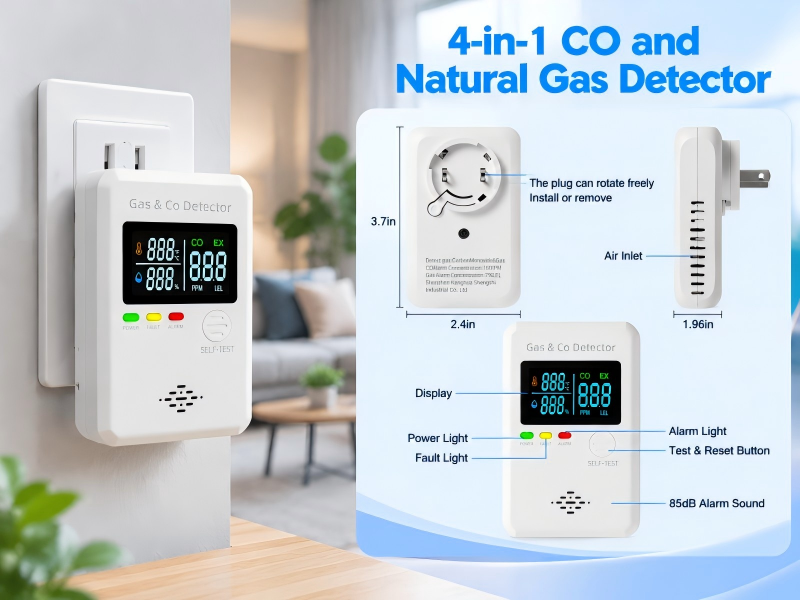
A 4-in-1 CO and Natural Gas Detector is an indoor safety device that monitors carbon monoxide (CO), methane-based natural gas, ambient temperature, and relative humidity in one unit. Its two gas-monitoring functions address different hazards; temperature and humidity readings provide additional environmental information rather than replacing a dedicated fire or environmental-control system.
For importers, distributors, and OEM brands, selection starts with verifiable performance, not display icons. A 4-in-1 CO and Natural Gas Detector such as SUMRING SR-910 provides seven practical checks for a sound purchasing decision.
1. What Exactly Does the Detector Monitor?
A 4-in-1 CO and Natural Gas Detector combines four measurements, but that does not necessarily mean four independent hazard alarms. CO can accumulate when fuel-burning equipment operates improperly, while methane can escape from natural gas connections or appliances. The SR-910 is specified to issue audible warnings for these gas hazards.
Its display also presents temperature and humidity readings, useful when buyers want a compact visual overview of an indoor environment. Before advertising additional temperature or humidity alarms, request specific evidence: the supplied manual does not define separate warning thresholds for either environmental measurement.
For product catalogues, describe the device as a dual-gas alarm with temperature and humidity display. It avoids suggesting that every reading triggers an alarm.
2. How Should Buyers Assess CO Alarm Response Times?
A critical distinction is the difference between displaying CO concentration and sounding the alarm. The SR-910 manual specifies the following responses:
| Displayed CO concentration | Stated alarm response |
|---|---|
| 50 ppm | Within 60–90 minutes |
| 100 ppm | Within 10–40 minutes |
| ≥200 ppm | Within 1 minute |
These are manufacturer-stated response windows, not independent proof of compliance with a particular national standard. When assessing a 4-in-1 CO and Natural Gas Detector, request a model-specific test report showing the applied method, environmental conditions, and pass/fail results.
Confirm that readings, alarm timing, and applicable performance standards were evaluated together. Demonstrations cannot replace documentation.
For a deeper technical explanation, see how B2B buyers compare CO alarm thresholds and response times.
3. Why Does the 5% LEL Methane Threshold Matter?
The SR-910 manual states that its methane alarm activates when the displayed concentration reaches at least 5% LEL. LEL means lower explosive limit; a reading expressed as a percentage of LEL is not the same as an equal percentage of methane by volume.
For technical terminology, see OSHA’s definition of the lower explosive limit (LEL).This reference explains LEL but does not validate SR-910 performance.
This distinction matters when suppliers describe a 4-in-1 CO and Natural Gas Detector as a combustible-gas monitor. Buyers should verify the target gas, calibration basis, alarm tolerance, and permitted installation conditions rather than assuming that every flammable gas receives the same response.
The supplied instructions identify methane/natural gas. They do not independently establish LPG detection capability. Distributors planning propane or LPG applications should request a separate supported configuration and supporting documentation.
4. How Do Power and Installation Requirements Affect Project Fit?
The published SR-910 specification lists an AC110–220V supply, indoor use, operating temperature from −20°C to +50°C, and a compact 62 × 97 × 52 mm body. Its plug-in design can simplify deployment where a suitable power outlet exists.
After connection, the manual requires approximately 180 seconds of preheating before normal operation. A 4-in-1 CO and Natural Gas Detector should therefore be evaluated as an electrically powered safety device, not presumed to have battery backup or operation during an outage.
For apartments, hotels, or managed rental properties, confirm the destination plug type, power availability, access for routine checks, and site-specific installation rules. A combined unit cannot automatically replace separately located alarms required by local codes. Follow approved installation instructions and local authorities.
5. What Should a Sample Inspection Cover?
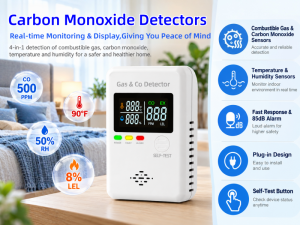
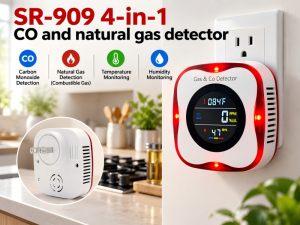
The SR-910 product images show a digital screen, a green POWER indicator, a yellow FAULT indicator, a red ALARM indicator, and a SELF-TEST button. The manual specifies an audible output of at least 85 dB and indicates that the power light remains green after warm-up.
The U.S. Consumer Product Safety Commissionexplains that an alarm’s test button checks circuitry, not sensor accuracy.For procurement, request separate model-specific gas-response evidence.
During a sample review, check screen legibility, identification of CO and gas readings, LED labels, plug fit, and the behavior of the self-test control. The instructions say a self-test activates the sounder and indicators and shows “000”; they recommend testing weekly.
For a 4-in-1 CO and Natural Gas Detector, distinguish visible display ranges from independently confirmed measurement specifications. Artwork mentions 0–2000 ppm CO, 0–10% LEL, and wider environmental ranges, but the manual does not verify their measurement accuracy.
6. Which Documents Should Be Checked Before Approval?
A purchasing file should contain a current product datasheet, matching sample identification, user instructions, applicable test reports, warranty terms, and conformity documentation required in the destination country. A testing laboratory’s accreditation certificate is not itself a product certificate.
When sourcing a 4-in-1 CO and Natural Gas Detector, confirm that every report names the relevant model or an officially documented equivalent. Confirm the standard, report date, laboratory, tested configuration, and certification status.
Laboratory accreditation must be current and cover the relevant testing scope. Request recent, SR-910-specific evidence rather than relying on a generic laboratory certificate.
7. How Can OEM and ODM Buyers Write a Better RFQ?
For wholesale or private-label orders, specify the destination market, anticipated annual volume, order quantity, supply voltage, plug configuration, language requirements, and expected packaging format. Request confirmation of branding options, approved technical changes, production lead time, sample approval process, and after-sales responsibilities.
A 4-in-1 CO and Natural Gas Detector may fit a broader residential gas-safety catalogue, but modifications to sensors, electronics, firmware, or enclosures must be assessed for testing and certification impact. Logo or packaging changes should also be reviewed against labeling and traceability rules.
SUMRING offers OEM and ODM cooperation across its fire-safety product range. Buyers can review the SUMRING gas detector product range and compare the SR-909 four-function CO and natural gas model before choosing which configuration to sample.
FAQs
1. Does SR-910 detect both CO and natural gas?
Yes. The manual identifies carbon monoxide and methane-based natural gas as its two gas-detection targets.
2. Does “4-in-1” mean four alarm functions?
No. The documented gas alarm functions cover CO and methane; temperature and humidity are additional displayed measurements.
3. Can SR-910 detect propane or LPG?
LPG detection is not confirmed by the supplied SR-910 instructions. Request evidence for an applicable LPG-capable model.
4. What is the SR-910 natural gas alarm threshold?
The stated methane activation level is at least 5% LEL, subject to verification against the required destination-market standard.
5. Is the SR-910 suitable for AC110V or AC220V markets?
The stated supply range is AC110–220V. Buyers should also confirm the approved plug format and local electrical requirements.
6. Does the device keep working during a power outage?
The supplied manual describes AC operation and does not confirm battery backup. Do not advertise outage protection without evidence.
7. Is CNAS accreditation proof of SR-910 certification?
No. Laboratory accreditation and product certification are different. Request current, model-specific documents for the intended market.
8. What should OEM buyers verify before ordering?
Confirm samples, gas targets, alarm behavior, plug type, labeling, compliance documents, lead time, customization scope, and warranty in writing.
Conclusion
Choosing a 4-in-1 CO and Natural Gas Detector requires more than comparing displays or supplier quotations. The strongest buying process verifies CO response, methane alarm logic, electrical fit, on-device indications, documentation, and custom-order requirements before approving a bulk shipment.
Explore the SR-910 plug-in CO and natural gas detector for wholesale projects for model details, then contact SUMRING to request the latest specification and an application-specific quotation.