How to Replace a Discontinued 433MHz Smoke and Heat Detector?
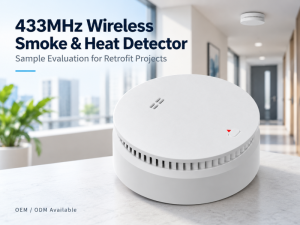
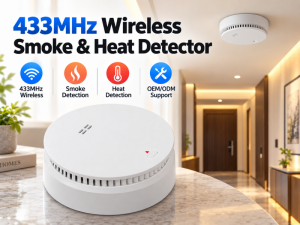
A 433MHz smoke and heat detector replacement is the process of selecting and approving a new wireless device for an installed or planned fire alarm application after the original smoke and heat detector is discontinued. It involves more than finding another detector that operates at 433MHz: the receiving equipment, alarm behavior, installation method, documentation, and project requirements must also be checked.
For wholesalers, installers, contractors, and trading companies, a discontinued model can affect open quotations, spare-parts commitments, and customers with equipment already installed. This guide provides a practical migration process, using SUMRING’s discontinued SR-820DHR as an example. SUMRING has announced a current wireless 433 smoke and heat option for new inquiries, while advising buyers to verify compatibility before approval.
What Should Buyers Record Before Choosing a Replacement?
Start with the existing project, not the proposed product. Ask the installer or system integrator for the detector model and revision, receiving host model and firmware, installation drawings, quantities, and the functions the customer expects.
Separate the demand into three groups: spare units for an existing installation, detectors for a project already specified but not yet installed, and products for a new OEM sales program. Each group may need a different approval route. A limited stock of the original model might support an urgent service order, but buyers should request a current stock confirmation before committing to customers.
For a 433MHz smoke and heat detector replacement, create a comparison sheet covering smoke and heat detection, local alarm, RF transmission, battery configuration, mounting dimensions, warning signals, and labeling. Mark every unverified item “pending” rather than assuming that similar product descriptions indicate equivalent performance.
Does Matching 433MHz Confirm Wireless Compatibility?
No. The frequency describes the radio band; it does not establish that a receiver can interpret the detector’s messages. Coding, pairing procedures, alarm messages, and the receiving equipment may differ. SUMRING’s existing product guide likewise advises testing the proposed detector with the actual host and firmware.
For a 433MHz smoke and heat detector replacement, obtain written answers to four questions:
- Which host models and versions have been tested?
- How is the detector enrolled, and what happens after a battery change or reset?
- Which events reach the host: fire alarm, fault, low battery, or other supported signals?
- Does the detector activate other compatible alarms, or only provide its own local warning?
Record the answers in a compatibility matrix. If the supplier cannot confirm the installed host, order samples and arrange a witnessed test before approving a bulk purchase. An alarm sounding at the detector does not, by itself, prove that the receiving system responded.
How Should Installers Run a Pilot Test?
Choose a small, representative group of locations. Include the intended host, the normal installation distance, and any areas where building materials could affect reception. Have the responsible project engineer define the test procedure and acceptance criteria.
A pilot for a 433MHz smoke and heat detector replacement should confirm physical mounting, power-up, pairing, local alarm indication, host reception, reset, and supported low-battery or fault behavior. Check whether the host displays the correct device identity and whether the documented alarm sequence matches the project design. Use appropriate approved test methods; do not improvise a fire test.
Keep a record of the host model and firmware, detector sample revision, test date, location, result, and any unresolved difference. This record gives distributors and contractors a defensible basis for customer approval and later troubleshooting.

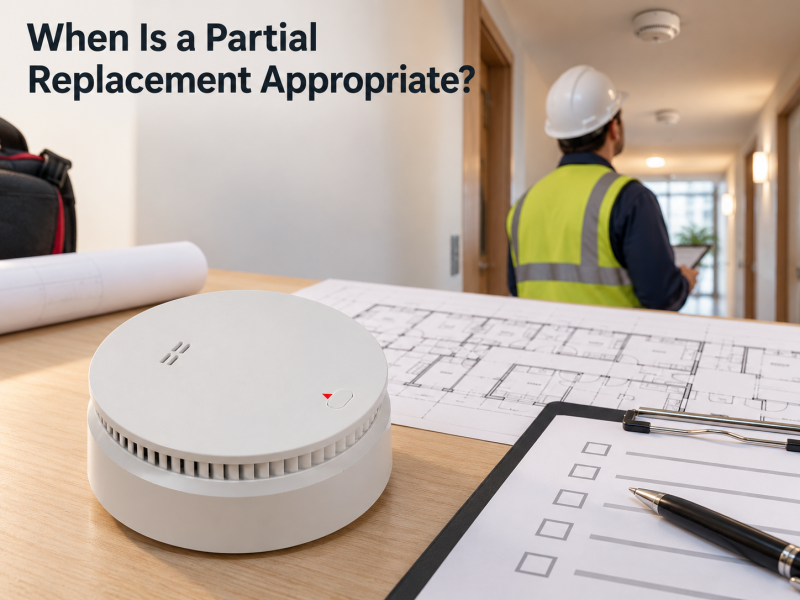
When Is a Partial Replacement Appropriate?
Replacing one failed unit can seem economical, but a mixed installation needs careful review. First confirm whether the new detector can coexist with the old units, whether all required alarm paths still work, and whether spare parts and instructions remain understandable to maintenance staff.
A 433MHz smoke and heat detector replacement may need a phased rollout if several sites use different hosts or if one customer manages multiple detector revisions. Group installations by confirmed configuration. Test one group, obtain approval, then repeat the process for the next. Do not describe an untested new device as a direct substitute in a quotation or installation guide.
Check the applicable project specification and local requirements when deciding which equipment must be changed together. For residential smoke alarms, NFPA recommends interconnected alarms so that activation of one causes the others to sound, and advises replacement at the applicable service age. Those residential recommendations do not replace the rules for a specific commercial project or country. nfpa.org
What Documents Should Procurement Request?
Before signing off a 433MHz smoke and heat detector replacement, ask for a current datasheet and installation manual for the exact offered configuration. Request a sample identification record, wiring or pairing instructions where relevant, maintenance guidance, and a written description of supported host functions.
Importers should also request the certificates, test reports, or listing records required for their destination market and confirm that the exact model and configuration are covered. A standard mentioned in a manual is not proof that the supplied SKU holds that certification. OEM artwork, radio changes, or component revisions may require additional review.
For repeat orders, agree on how the supplier will identify production revisions and notify buyers of changes that could affect compatibility. This is particularly useful when a distributor must support detectors sold over several years.
How Can OEM Buyers Protect Their Product Transition?
Private-label buyers should treat the transition as a controlled product change. Keep the old and new model numbers distinct in catalogues, cartons, manuals, and customer records. Give sales teams a short explanation of what has been verified and which applications still require a host test.
A 433MHz smoke and heat detector replacement quotation should specify the target country, annual volume, first order quantity, required host, approved sample revision, packaging language, branding, and delivery schedule. Ask separately about sample lead time, mass-production lead time, warranty handling, and the availability of future replacement units.
For related sourcing context, see SUMRING’s 433MHz wireless detector manufacturer evaluation guide and building fire alarm system components guide. These pages address product assessment and wider system planning; this article concentrates on the migration decision.
FAQs
1.Can the new detector replace the SR-820DHR without testing?
No direct interchangeability has been established by the discontinuation notice. A 433MHz smoke and heat detector replacement should be tested against the specified host, mounting conditions, and project requirements before approval.
2.Should buyers purchase the remaining old-model stock?
Only after confirming live availability, the exact order quantity, and the customer’s intended use. Consider the future maintenance requirement as well as the immediate purchase.
3.Can two 433MHz detectors from different brands communicate?
Possibly, but matching frequency alone cannot establish it. Ask for documented host support and verify alarm reception using the intended equipment.
4.What if the new detector sounds locally but the host remains silent?
Treat that result as a failed system compatibility check. Review enrollment, message format, host settings, and the supplier’s supported-host information before installation.
5.Is a new mounting base always necessary?
That depends on the approved sample and existing installation. Compare mounting dimensions and instructions; never assume that a similar-looking housing uses the same base.
6.Can an OEM logo be added immediately?
Confirm artwork, labeling, and documentation requirements with the supplier. Check whether the proposed private-label configuration is covered by the evidence required in the destination market.
7.What should installers give the project owner after a pilot?
Provide the tested model and revision, host details, locations, results, unresolved issues, and the approved installation instructions.
8.Where should buyers start an RFQ?
Send the existing model, host details, target market, required quantity, and project schedule. SUMRING’s discontinued wireless smoke detector replacement notice explains the product transition, and its contact page accepts project inquiries.
Conclusion
A 433MHz smoke and heat detector replacement succeeds when the installed host, detector functions, compliance evidence, and maintenance plan have all been checked. Build the migration around a documented pilot and written customer approval, especially when old and new devices may operate at the same site.
For sample evaluation or an OEM quotation, contact SUMRING about a wireless smoke and heat detector project with your host model, destination country, quantity, and required delivery date.