
How Should Buyers Choose a Smoke Detector Removal Tool Kit?
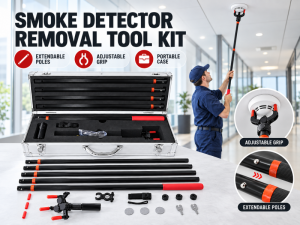
A smoke detector removal tool kit is a maintenance accessory set used to grip, rotate, remove, and reinstall compatible ceiling-mounted smoke detectors with an access pole. It supports planned inspection, cleaning, replacement, and commissioning when detectors use a compatible mounting structure and can be safely reached from floor level.
For fire alarm contractors, facility maintenance companies, distributors, and OEM buyers, reach is only one consideration. Detector compatibility, grip stability, pole structure, working height, replacement parts, packaging, and sample verification all affect whether the tool can perform reliably in a real project.
Why Do Commercial Projects Need a Detector Removal Tool?
Smoke detectors are commonly installed on ceilings in offices, hotels, warehouses, schools, hospitals, shopping centers, and industrial facilities. Routine servicing may require technicians to remove multiple detectors across a large building.
In suitable locations, a smoke detector removal tool kit can reduce repeated ladder or scaffold setup, shorten routine service time, and reduce disruption to building occupants. It may also help technicians control the detector more steadily when removing it from its base.
However, an access-pole tool does not eliminate every working-at-height risk. Stairwells, atriums, obstructed ceilings, unusually high areas, and damaged detectors may still require an approved ladder, platform, or powered access system.
How Does a Smoke Detector Removal Tool Work?
Many ceiling-mounted detectors connect to their bases through a rotating or bayonet-style mounting. A compatible removal head grips the detector body, while the access pole allows the technician to apply controlled rotation from below.
Once released, the detector remains held by the tool head and can be lowered for inspection. After cleaning, testing, or replacement, the process is reversed to reinstall the detector.
Before removal, technicians should identify the device, follow the approved fire alarm impairment procedure, notify responsible personnel, and isolate the relevant circuit or zone when required. Never force a detector that does not rotate normally.
How Should B2B Buyers Choose the Right Kit?
When evaluating a smoke detector removal tool kit, buyers should check the following seven factors.
1. Detector Shape and Mounting Compatibility
“Universal” should not be interpreted as compatible with every detector. Compare the removal head with the detector’s:
- External diameter
- Housing height and profile
- Vent arrangement
- LED or test-button position
- Base-locking structure
- Required rotation direction
- Surface material
Send the supplier detector model numbers, dimensional drawings, and clear photos before ordering. Testing with actual samples is more reliable than selecting from diameter alone.
Buyers sourcing related detection devices can also review how to choose a 2-wire photoelectric smoke detector before building a complete maintenance package.
2. Required Working Height
Calculate the actual ceiling height, operator reach, pole length, and clearance around the detector. Do not select a pole based only on the nominal building height.
Buyers should ask the supplier to confirm:
- Minimum and maximum assembled length
- Number of pole sections
- Section-locking method
- Allowable tool-head load
- Pole deflection at maximum extension
- Transport length
The current product page does not publish these figures for ABS-C208, so they should be confirmed through the latest datasheet or quotation.
3. Grip Stability and Housing Protection
The removal head should hold the detector securely without crushing vents, scratching the enclosure, or pressing a test button unintentionally. It should also retain the detector after it separates from the ceiling base.
Projects involving different detector shells should review how to choose a plastic fire alarm heat smoke detector case because housing diameter, vent geometry, and surface structure can affect tool compatibility.
4. Pole Connection and Locking Structure
Check how the head connects to the access pole and whether the joint remains stable during rotation. A loose connection may make alignment difficult or allow the head to turn independently of the pole.
Ask whether replacement connectors, pole sections, or tool heads can be ordered separately.
5. Complete Kit Contents
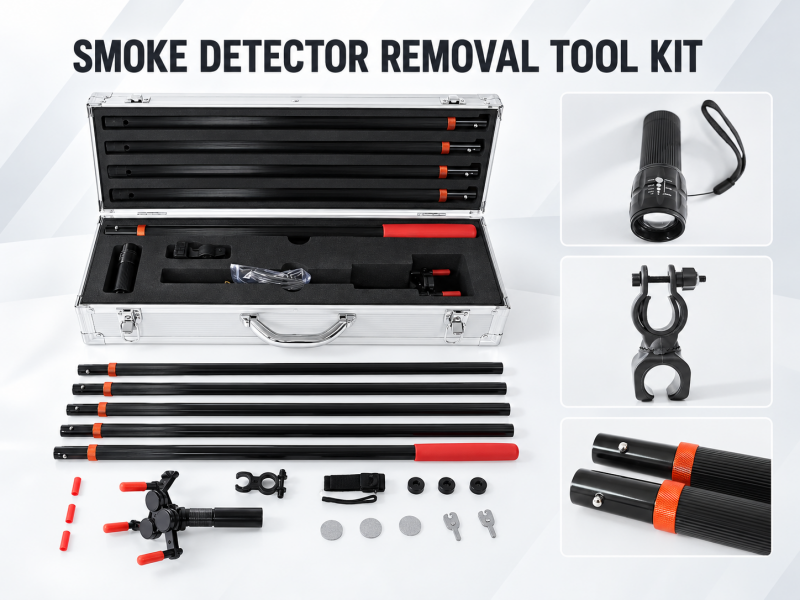
A product photo may show several components without confirming that all are included. The purchase order should identify the exact supply scope, such as:
- Detector removal head
- Access-pole sections
- Head adaptor
- Extension components
- Carrying or storage case
- Instructions
- Spare gripping parts
A procurement specification for a smoke detector removal tool kit should list every included component rather than relying only on the product name.
6. Packaging and Transport
Long poles and shaped removal heads need packaging that limits bending, impact, and lost components during international transport. Buyers should confirm carton dimensions, gross weight, inner protection, units per carton, and spare-part packaging.
7. Sample Validation
Before a bulk order, test the tool with every detector family named in the project. Record whether it can grip, rotate, retain, lower, and reinstall each detector without visible damage.
A sample that fits one round detector should not automatically be approved for the entire project.
What Information Is Published for Sumring ABS-C208?
The current Sumring ABS-C208 product page presents the model as a smoke detector removal tool kit for detector removal and replacement using a specialist tool and an access pole.
| Item | Published information |
|---|---|
| Model | ABS-C208 |
| Place of origin | Shenzhen, Guangdong |
| Warranty | 2 years |
| Selling unit | Single item |
| Package size | 64 × 14.5 × 19.5 cm |
| Single gross weight | 5 kg |
| Primary application | Removing and replacing compatible detectors |
Maximum reach, removal-head dimensions, pole material, detector-size range, and exact package contents are not stated on the page. Buyers should request written confirmation of these details before quotation approval.
Where Can the Tool Be Used?
Potential applications include offices, hotels, shopping centers, schools, warehouses, apartment buildings, hospitals, and factories with serviceable ceiling-mounted detectors.
Tool selection should remain part of the wider fire alarm maintenance plan. Buyers can review how a fire alarm system works in commercial buildings to understand the relationship between detectors, initiating circuits, control panels, and notification equipment.
For conventional systems, also read what a fire alarm control panel does before removing, replacing, or testing connected devices.
What Is a Safe Maintenance Workflow?
Use the smoke detector removal tool kit within a controlled procedure:
- Review drawings and identify the detector.
- Notify the facility manager and monitoring personnel.
- Follow the approved isolation or impairment procedure.
- Inspect the pole, joints, adaptor, and removal head.
- Establish a controlled area below the detector.
- Align the head and apply only the required rotation.
- Lower, label, inspect, clean, or replace the device.
- Reinstall the correct detector on the correct base.
- Restore the system and perform an approved functional test.
- Record the result in the maintenance log.
Only trained personnel should service life-safety equipment. Local codes, project procedures, detector instructions, and control-panel requirements take priority over general guidance.
What Should B2B Buyers Include in an RFQ?
A procurement-ready smoke detector removal tool kit should be evaluated using a clear RFQ containing:
- Detector brands and model numbers
- Detector photos and dimensions
- Ceiling-height range
- Required pole reach
- Estimated order quantity
- Required kit contents
- Spare-part quantities
- Packaging requirements
- Target market
- Manual language
- Logo or private-label requirements
- Sample-testing plan
- Required delivery date
For OEM and ODM projects, confirm which branding, packaging, color, accessory, and instruction-manual options are technically available. Product customization should never change the detector-gripping structure without renewed compatibility testing.
FAQ
1.Is one removal kit compatible with every smoke detector?
No. Detector diameter, housing profile, vent position, surface finish, and base structure vary. Compatibility should be confirmed by model and physical sample.
2.Does the tool completely replace ladders and access equipment?
No. It can reduce ladder use in suitable locations, but complex ceilings, obstructions, damaged devices, and high-risk areas may still require approved access equipment.
3.Can it remove every bayonet-mounted detector?
Not automatically. Two detectors may both use rotating bases but have different body shapes, diameters, locking features, or required torque.
4.Can the same tool remove heat detectors?
Possibly, if the heat detector’s housing and mounting structure are compatible. Buyers can first review how to choose a heat detector for fire alarm projects and then submit the exact model for testing.
5.What information should buyers send to the supplier?
Provide detector model numbers, front and side photos, housing dimensions, ceiling height, required quantity, and a description of the mounting base.
6.What warranty is published for ABS-C208?
The current product page lists a two-year warranty. Buyers should confirm the warranty scope and applicable conditions in the formal quotation.
7.How should a sample be accepted?
The smoke detector removal tool kit should pass grip, rotation, retention, lowering, reinstallation, and visual-damage checks with every intended detector model.
8.Can Sumring support OEM or ODM orders?
Sumring supports OEM and ODM cooperation for fire alarm products and accessories. Buyers should send branding, packaging, manual-language, quantity, and technical requirements for feasibility review.
Conclusion
Choosing a smoke detector removal tool kit requires more than comparing pole length or unit price. Detector compatibility, stable gripping, working height, complete kit contents, sample testing, packaging, and spare-part availability should all be confirmed before bulk purchasing.
Sumring can support distributors, fire alarm contractors, facility maintenance suppliers, and OEM/ODM buyers with ABS-C208 product evaluation and project-based sourcing. Send us your detector models, ceiling heights, required quantities, target market, and customization requirements to begin compatibility review and quotation.