How Should B2B Buyers Choose a Solar Sensor Light with Alarm?
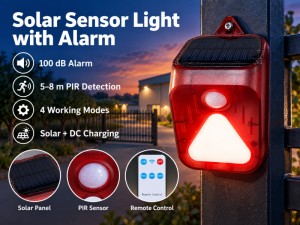
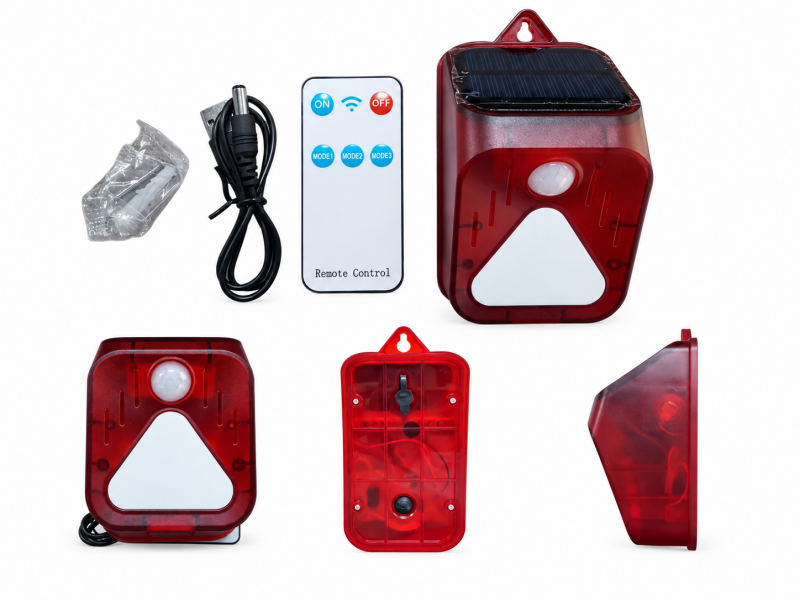
A Solar sensor light with alarm is an outdoor security device that combines solar charging, passive infrared motion detection, a flashing warning light and an audible siren. When the PIR sensor detects movement within its coverage area, the device activates the selected warning mode without requiring permanent mains wiring.
For distributors, security installers, agricultural suppliers and private-label buyers, the purchasing decision should not depend only on alarm volume or housing appearance. PIR coverage, charging performance, battery capacity, working modes, mounting position, weather resistance and OEM documentation all affect the product’s performance in a real project.
How Does the Solar-Powered Alarm Work?
The operating process follows a simple signal path:
Sunlight → Solar panel → Rechargeable battery → PIR sensor → Controller → Siren and warning light
The 5V, 60mA polycrystalline solar panel charges the internal 3.7V, 1200mAh 18650 lithium battery during daylight. When the product enters its active state, the PIR module monitors the selected area for human movement.
Once movement is detected, the Solar sensor light with alarm activates sound, light or both according to the selected operating mode. The supplied information states that the alarm can continue while movement remains within the sensing area and stop approximately 30 seconds after the person leaves.
After changing a mode, buyers should allow approximately 30 seconds for the unit to enter its active state.
What Are the Four Working Modes?
The retail packaging lists Four working modes triggered by infrared motion detection:
- 24-Hour Sound and Light Alarm
Motion activates the 100dB siren and flashing warning light during both daytime and nighttime. - 24-Hour Light-Only Silent Alarm
Motion activates the warning light without an audible siren. This mode may suit locations where visible deterrence is required without continuous noise. - Night Sound and Light Alarm
The audible and visual warnings operate at night when movement is detected. This setting can reduce unnecessary daytime activation. - SOS Mode
The packaging describes this as a 24-hour silent and light-free SOS mode. Because this description does not explain what external notification or output is produced, B2B buyers should confirm the exact SOS behavior through sample testing and an approved English manual before resale.
The Solar sensor light with alarm should therefore be evaluated using all four operating modes—not only its loudest setting. Importers should also ensure that the buttons on the remote control match the final English manual and packaging.
Is It the Same as a Fire Alarm Horn Strobe?
No. This solar product is primarily designed as a motion-triggered outdoor security warning device. Projects requiring panel-controlled fire notification should evaluate a certified outdoor fire alarm horn strobe for B2B projects. The two products may both produce sound and flashing light, but their triggering methods, system functions and compliance requirements are different.
Which Specifications Matter to B2B Buyers?
| Specification | Listed value | B2B evaluation point |
|---|---|---|
| Solar panel | 5V, 60mA | Check outdoor charging performance |
| Battery | 3.7V, 1200mAh 18650 | Confirm replaceability and cycle life |
| Solar charging time | 8–10 hours | Verify under realistic sunlight |
| DC charging | DC 5V, under 3 hours | Confirm charging interface and cable |
| PIR distance | 5–8 meters | Test at the intended mounting height |
| Detection angle | 120° stated | Verify because the diagram also shows 60° |
| Alarm sound | 100dB | Confirm measurement distance |
| Remote distance | Under 12 meters | Based on unobstructed conditions |
| Recommended height | Below 4 meters | Conduct a walk test after mounting |
| Arming delay | About 30 seconds | Explain clearly in the user manual |
Published range figures should be treated as reference values. Temperature, mounting height, walking direction, walls, vegetation and direct sunlight may change practical PIR performance.
Where Can It Be Deployed?
A Solar sensor light with alarm is most suitable for locations where installing signal and power cables is difficult or uneconomical.
Farms and Orchards
The unit can provide local movement warnings near gates, tool storage areas, livestock zones or orchard access points. Installers should avoid branches and vegetation that may move inside the PIR detection area.
For farms, orchards and other large outdoor sites that require longer-distance audible coverage, buyers can also compare an outdoor wireless horn siren for large-area warning. Unlike a compact solar motion alarm, a wireless horn siren is designed to extend audible warning coverage across larger areas.
Warehouses and Storage Areas
It may be positioned near secondary doors, loading areas or detached storage buildings as a local deterrent. It should not be presented as a replacement for a certified intrusion or fire alarm system.
Construction Sites
Temporary construction projects often need warning devices that can be installed and relocated quickly. Solar charging reduces the need for permanent electrical work.
Residential Outdoor Areas
Possible locations include garden gates, sheds, driveways and side entrances. Installers should consider neighbors and local noise restrictions before enabling the 24-hour siren mode.
Remote Buildings and Equipment Areas
The product may support basic local warning around detached equipment rooms or utility structures. However, it does not provide remote app monitoring unless that capability is specifically added to the product.
How Should Installers Position the Device?
Correct installation is essential to the performance of the Solar sensor light with alarm.
Mount the device below approximately four meters and aim the solar panel toward an area receiving sufficient direct sunlight. Avoid installing it under deep eaves, behind glass or in continuous shade.
Position the PIR sensor so people move across its field of view rather than directly toward it. Cross-direction movement is normally easier for a PIR sensor to detect.
Keep the detection zone away from:
- Moving tree branches
- Heated ventilation outlets
- Reflective metal surfaces
- Busy roads
- Strong artificial heat sources
- Areas frequently crossed by animals
After installation, perform walk tests at different distances and directions. Test every operating mode, the remote control and the 30-second activation delay.
What Should Buyers Test Before a Bulk Order?
Before approving a Solar sensor light with alarm, distributors and OEM customers should conduct sample testing covering:
- Charging under strong, weak and intermittent sunlight
- Battery standby performance
- DC 5V charging time
- PIR detection at 3, 5 and 8 meters
- Detection from the center and edges
- Day-and-night mode switching
- Siren sound-pressure measurement conditions
- Warning-light visibility at night
- Remote-control distance through common obstacles
- False activations caused by heat, plants or animals
- Housing performance in rain, dust and sunlight
- Mode memory after low battery or shutdown
The packaging displays a CE mark, but buyers should request the relevant declaration, reports and applicable standards instead of treating a printed logo as sufficient compliance evidence.
What OEM and ODM Details Should Be Confirmed?
For private-label projects, the Solar sensor light with alarm can be evaluated for customized branding, packaging, instructions, warning labels and selected functional requirements.
Before quotation, buyers should specify:
- Target country and sales channel
- Required housing color
- Logo and label design
- Packaging language
- Alarm tone and sound level
- Four-mode definitions
- Remote-control button layout
- Battery and charging configuration
- Required ingress-protection level
- Certification and test-document requirements
- Sample quantity and forecast order volume
If the product will be sold as an outdoor device, the supplier should confirm a tested IP rating. “Outdoor,” “waterproof” and “weather-resistant” should not be used as substitutes for verified ingress-protection documentation.
FAQ
1. Does the product require mains power?
No permanent mains connection is required for normal solar operation. It also supports DC 5V charging according to the supplied specifications.
2. How far can its PIR sensor detect movement?
The listed sensing range is approximately 5–8 meters, but temperature, installation height and the surrounding environment can affect the result.
3. How loud is the alarm?
The packaging and manual list a 100dB alarm. Buyers should confirm the measurement distance and test method.
4. Does it have four working modes?
Yes. The packaging lists four modes: 24-hour sound and light, 24-hour light-only, night sound and light, and SOS mode.
5. How long does solar charging take?
The listed solar charging time is approximately 8–10 hours under suitable sunlight.
6. Can the alarm be controlled remotely?
Yes. The listed remote-control distance is below 12 meters in an unobstructed environment.
7. Is it suitable for regulated fire alarm applications?
No such approval is shown in the supplied materials. It should be positioned as a motion-triggered outdoor security warning device unless relevant fire-system certification is provided.
8. Can Sumring supply OEM packaging?
OEM and ODM requirements such as branding, packaging, manuals and functional configuration can be evaluated according to order quantity and technical feasibility.
Conclusion
Selecting a Solar sensor light with alarm requires more than comparing siren volume. Professional buyers should evaluate solar charging, battery performance, PIR coverage, Four working modes, environmental resistance, remote operation and documentation before approving mass production.
Buyers developing private-label security products can learn more about Sumring’s professional alarm OEM and ODM services, including sample evaluation, customized branding, packaging development and technical support. Contact Sumring with your destination market, required quantity, application environment and certification requirements for a project-based quotation.