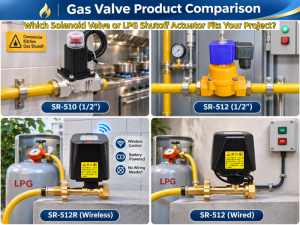

Which Solenoid Valve or LPG Shutoff Actuator Fits Your Project?
Which Solenoid Valve or LPG Shutoff Actuator Fits Your Project?
A Solenoid valve is an electrically controlled device that opens or closes a fluid or gas passage. In gas safety systems, it can work with a compatible detector to isolate the gas supply after an alarm. However, not every automatic gas shutoff device is a true solenoid-operated valve. Some products instead use a motorized manipulator to turn an existing LPG cylinder valve.
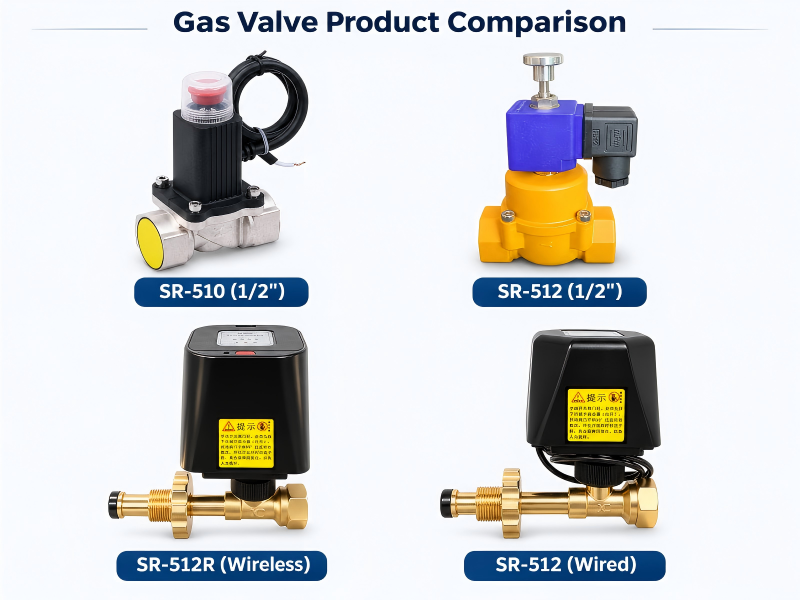
For wholesalers, contractors, and OEM buyers, this distinction matters more than appearance. Four SUMRING product configurations cover wired cylinder control, battery-powered wireless cylinder control, direct-AC pipeline shutoff, and detector-triggered pipeline shutoff.
Why Are Cylinder Actuators Different From Pipeline Valves?
A cylinder manipulator turns the existing valve handle. It does not replace the valve body or become part of the gas pipe. An inline Solenoid valve, by contrast, controls flow inside its own valve body and is selected for the specified pipeline.
These mechanisms have different installation requirements, response times, power needs, and maintenance obligations. A product suitable for a bottled-LPG cooking station is not automatically suitable for a piped natural-gas system.
How Do the Four Gas Shutoff Configurations Compare?
A Solenoid valve comparison should distinguish electrical control from the mechanism that physically stops gas flow.
| Product / Model | Power and Linkage | Published Specifications | Typical Selection |
|---|---|---|---|
| Wired LPG cylinder manipulator — SR-512 | 12V DC; wired alarm connection | Brass body; 6–10 s operation; Ex marking stated | Cylinder sites with planned wiring |
| Wireless LPG cylinder manipulator — SR-512R | 4.5V battery; 433MHz RF; 30–40 m in open space | Brass body; 6–10 s operation; Ex marking stated | Cylinder retrofits where wiring is difficult |
| Direct-AC inline gas valve — SR-512 (1/2 in) | 220V AC direct input; verify control interface | Brass; DN15 listed; up to 100 kPa; closing under 0.3 s | Specified AC-powered pipeline applications |
| Detector-triggered inline gas valve — SR-510 (1/2 in) / SR-510 (1/2 in)B | DC pulse trigger; manual reopening; confirm required pulse rating | Aluminum-alloy or brass variants; closing under 0.3 s | Detector-linked natural-gas or LPG piping |
Specifications are taken from the supplied product listings. Certification documents, port dimensions, electrical interfaces, and regional approvals must be confirmed for the exact order.
When Is a Wired LPG Cylinder Manipulator Appropriate?
The wired cylinder option suits new-build kitchens and managed facilities where the alarm circuit and power supply can be planned together. The specified 12V DC linkage does not depend on an RF path, and its published six-to-ten-second operating time refers to the manipulator’s movement rather than the response of a pipeline valve.
Before procurement, confirm the cylinder-valve geometry, detector output, cable routing, and permitted installation environment. A wired Solenoid valve alternative should not be assumed interchangeable with a handle-turning actuator.
Why Consider a Battery-Powered Wireless Cylinder Actuator?
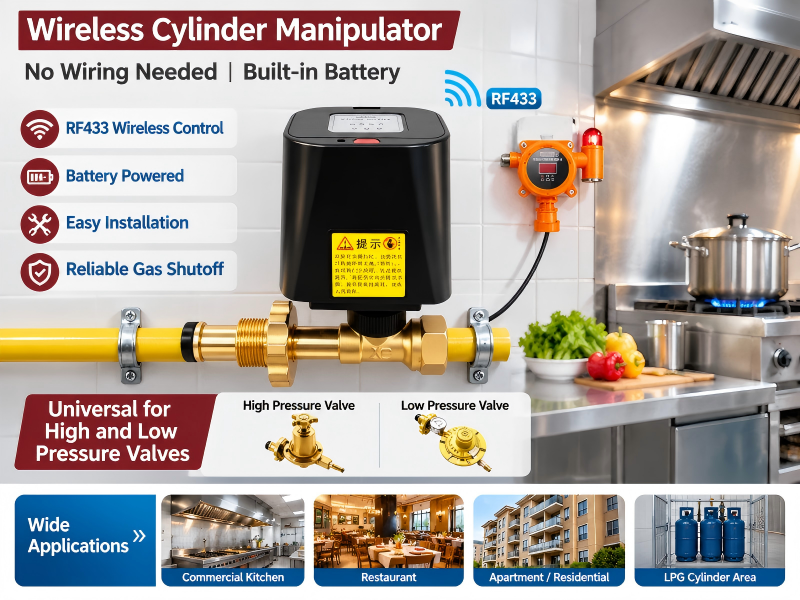
A battery-operated cylinder controller can reduce cabling work in existing restaurants, small kitchens, or dispersed LPG-cylinder locations. The listed wireless version uses 4.5V battery power and a 433MHz link, with a published open-space communication distance of 30–40 meters.
Unlike an inline Solenoid valve, this device turns an existing cylinder valve handle. That distance is not a guaranteed indoor range. Walls, metal cabinets, interference, and the approved detector pairing all require review.
Purchasers should also request battery-life data, low-battery behavior, and a documented testing schedule. Wireless convenience cannot replace a sound alarm-response plan.
Which Pipeline Option Fits a Gas Detector System?
Where the specification calls for an inline Solenoid valve, the two pipeline products serve different procurement requirements. One listing identifies direct 220V AC operation and a brass body. The other describes a detector-triggered DC pulse, manual reopening, and aluminum-alloy or brass construction.
For either type, buyers must establish the gas medium, pressure, nominal size, flow capacity, control signal, and closing behavior.
The advertised sub-0.3-second closing time is a device specification, not a promise that the entire detection-and-shutoff system will respond within that interval.
What Should Buyers Verify Before Ordering?
Start with the fuel supply. Bottled LPG with an accessible cylinder valve points toward a compatible manipulator; piped natural gas or LPG may require an approved inline valve.
Next, check the operating voltage and whether the alarm provides a relay contact, voltage output, or dedicated pulse.
A Solenoid valve should never be selected from voltage alone. Ask for drawings, wiring-interface specifications, gas and pressure ratings, reset logic, and traceable test records.
One online listing describes both direct AC power and impulse closing; the final electrical control arrangement therefore needs explicit confirmation.
For integration planning, see SUMRING’s CO and combustible gas detector with optional valve output.
Only the appropriate detector configuration can be evaluated for shutoff linkage; not every detector version offers the same output.
How Do Standards Affect an OEM or Engineering Project?
A Solenoid valve used in a gas installation must be assessed against the rules applying to the destination market and the complete assembly.
Published claims concerning CE marking or explosion protection are starting points for document review, not proof that every configuration is approved everywhere.
For US project context, consult the NFPA 54 National Fuel Gas Code.
Applicable editions and local requirements depend on the authority having jurisdiction. Qualified gas professionals should determine installation, testing, and commissioning procedures.
OEM/ODM sourcing should also define labeling, packaging language, inspection criteria, and replacement-part support before samples are approved.
FAQ
1. Is every automatic gas shutoff device a solenoid valve?
No. A cylinder manipulator mechanically turns an existing hand valve, while an inline Solenoid valve regulates flow through its own body.
2. Which option is battery powered?
The wireless cylinder actuator is listed with a 4.5V battery supply and 433MHz communication. Other listed configurations use wired electrical control.
3. Can a valve detect a gas leak independently?
No. These products need a compatible detection or control system to trigger automatic shutoff; the shutoff device itself is not the gas sensor.
4. Is wireless control always better than wired control?
No. Wireless may simplify a retrofit, while wired control avoids dependence on an RF link. Site conditions and system requirements decide.
5. Does a faster closing time mean a safer complete system?
Not necessarily. Detector response, signaling, actuator operation, installation suitability, and maintenance all affect overall safety.
6. Can a pipeline valve replace a cylinder manipulator?
Not directly. They use different mechanical arrangements and require separate engineering assessment for the gas supply.
7. Are CE or explosion-proof claims enough for export approval?
No. Buyers should verify actual certificates, their scope, applicable standards, and local acceptance for the purchased variant.
8. Can SUMRING support OEM and ODM procurement?
SUMRING can discuss project requirements, branding, and matching accessories. Custom options, technical feasibility, and documentation should be confirmed before ordering.
Conclusion
The best Solenoid valve selection begins with the fuel system, not a product photo.
A battery-powered wireless cylinder actuator may suit a retrofit, a wired actuator may suit planned cylinder installations, and an inline valve may fit a defined piping project.
For an accurate quotation, provide the gas type, installation market, detector interface, required supply voltage, and expected order quantity.
This gives suppliers and project engineers a practical basis for selecting compatible components without confusing cylinder manipulators with electromagnetic pipeline valves.