How Can Buyers Verify a 5-in-1 Natural Gas and Carbon Monoxide Alarm During Power Outages?
A 5-in-1 Natural Gas and Carbon Monoxide Alarm is a plug-in safety device that combines carbon monoxide (CO) monitoring, combustible-gas monitoring, temperature display, humidity display, and audible/visual warnings. It does not measure five different gases. For importers and contractors, the purchasing priority is whether monitoring and backup-power claims suit the intended installation and have supporting evidence.
What Are the Five Functions—and Which Ones Trigger an Alarm?
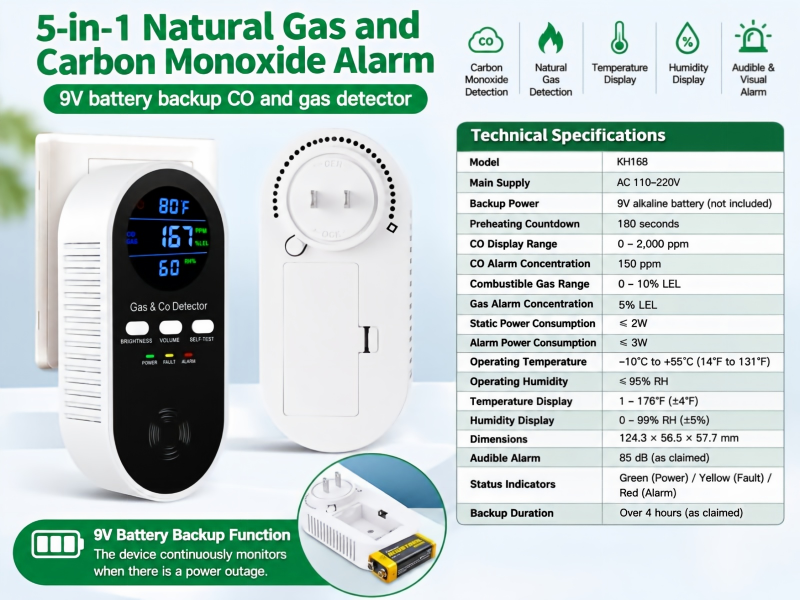
The 5-in-1 Natural Gas and Carbon Monoxide Alarm presents two gas measurements on a digital screen, alongside ambient temperature and relative humidity. Local sound and light signals make up the fifth advertised function. Its front panel has self-test, brightness, and volume controls plus three status indicators.
This distinction matters in wholesale listings. The manual specifies no separate temperature or humidity alarm thresholds. Similarly, a natural-gas application must not be advertised as universal detection of propane, LPG, or every combustible gas without gas-specific documentation.
Can the Backup Battery Support Monitoring During an Outage?
Unlike an AC-only device, the 5-in-1 Natural Gas and Carbon Monoxide Alarm includes a compartment for a 9V alkaline backup battery. It normally uses AC 110–220V. The manual claims backup operation for more than four hours during an outage. The promotional image also specifies that the 9V battery is not included.
Battery type, temperature, and alarm-duty test conditions are not specified. Treat the stated period as a manufacturer claim requiring sample verification—not a guaranteed runtime in every site. Verify that gas sensing and alarms remain active on battery, including low-battery warnings.
Which Published Specifications Matter Most?
For the 5-in-1 Natural Gas and Carbon Monoxide Alarm, a four-column comparison sheet helps purchasing teams distinguish documented parameters from items that still need evidence.
| Parameter | Published Specification | Parameter | Published Specification |
|---|---|---|---|
| Model | KH168 | Main Supply | AC 110–220V |
| Backup Power | 9V alkaline battery | Preheating Countdown | 180 seconds |
| CO Display Range | 0–2,000 ppm | CO Alarm Concentration | 150 ppm |
| Combustible Gas Range | 0–10% LEL | Gas Alarm Concentration | 5% LEL |
| Static Power Consumption | ≤2W | Alarm Power Consumption | ≤3W |
| Operating Temperature | −10°C to +55°C | Operating Humidity | ≤95% RH |
| Temperature Display | 1–176°F (±4°F), as printed | Humidity Display | 0–99% RH (±5%), as printed |
| Dimensions | 124.3 × 56.5 × 57.7 mm | Status Indicators | Green, yellow and red |
| Audible Alarm | 85 dB claimed in product image; measurement conditions unstated | Backup Duration | Over 4 hours claimed in manual; test conditions unstated |
These are manufacturer-stated figures, not certification results. Clarify unusual display-range wording before approval.
How Should Buyers Interpret CO PPM and Gas %LEL?
The 5-in-1 Natural Gas and Carbon Monoxide Alarm uses different units for different hazards. CO concentration is expressed in parts per million (ppm). Combustible-gas concentration is expressed as a percentage of the lower explosive limit (%LEL). A 5% LEL gas indication is not equivalent to 5% gas by volume, nor is it comparable to a CO reading in ppm.
A published CO alarm concentration of 150 ppm does not establish the complete time-to-alarm response. Request response curves, test methods, and gas-specific calibration evidence. The manual’s gas-alarm description contains inconsistent terminology, so the precise natural-gas calibration should be verified in writing before sales materials are finalized.
What Should Installers Expect After Plugging It In?
A 5-in-1 Natural Gas and Carbon Monoxide Alarm is not intended to be evaluated by looking at its screen immediately after power-up. The manual describes a 180-second preheating countdown before the display settles into normal operation. Allow about 30 minutes for temperature and humidity readings to stabilize, as instructed.
The user can then operate the self-test button and adjust brightness or volume. A successful button test demonstrates the supported local check sequence; it does not, by itself, establish sensor accuracy or regulatory compliance. Installers should use the manufacturer-approved commissioning and maintenance procedures instead of improvised gas exposure tests.
How Can Buyers Evaluate the Warning Interface?
A 5-in-1 Natural Gas and Carbon Monoxide Alarm combines numerical readings and status indicators on one panel. The supplied image advertises an 85 dB sound alarm and three-level adjustments. The manual confirms brightness and volume controls but does not document the sound-level test distance or adjustment increments.
During sample approval, confirm LED meanings, low-battery behavior, and sound requirements. Check that markings remain readable and that consumer-facing warnings are not hidden by customized branding. A button test cannot replace model-specific evidence.
Where Is a Plug-In Combination Alarm Appropriate?
A 5-in-1 Natural Gas and Carbon Monoxide Alarm may be considered for suitable indoor residential or apartment projects where the outlet position allows compliant gas sensing. Convenience alone does not determine installation suitability. Carbon monoxide alarm placement and natural-gas detector placement can involve different requirements, and an existing socket may be unsuitable for one or both.
For consumer guidance, the U.S. Consumer Product Safety Commission’s carbon monoxide fact sheet recommends following the manufacturer’s installation instructions and explains that the test button does not verify sensor accuracy. It is general safety guidance, not certification of this product.
What Should OEM and Wholesale Buyers Request?
Before launching a 5-in-1 Natural Gas and Carbon Monoxide Alarm, collect an approved sample, current manual, electrical ratings, target-gas information, alarm-response test data, battery-backup verification, and destination-market compliance records. Request proof for the exact factory configuration rather than relying on a generic certificate or a similar product’s report.
For a buyer preparing an OEM dual gas alarm sourcing checklist, specify the destination, plug standard, packaging language, brand artwork, quantity, servicing expectations, and required certifications. Changes to plugs, labels, or electronics may affect compliance. To review the documented device and request project details, visit the 9V battery backup CO and gas detector specifications.
FAQs
1. Does five-in-one mean five independent gas sensors?
No. The advertised functions comprise CO sensing, combustible-gas sensing, temperature display, humidity display, and audible/visual alarms.
2. Will the alarm operate without a 9V battery?
Yes. It operates on AC power; the 9V alkaline backup battery is sold separately, according to the image.
3. How long does the backup power last?
The manual claims more than four hours with a suitable battery installed, but it does not provide controlled test conditions. Verify runtime during sampling.
4. Does this detector also detect LPG or propane?
Do not assume so. Obtain written confirmation of the target combustible gas, calibration, and applicable test reports.
5. Why is a 180-second countdown required?
The manual specifies a preheating sequence before normal operation. Follow its startup instructions rather than treating the initial display as a stabilized reading.
6. Is 150 ppm proof that the CO alarm meets a safety standard?
No. A concentration figure alone does not show alarm response timing, compliance, or independent certification.
7. Can the sound volume and display brightness be adjusted?
Yes. Both controls are shown in the manual. Confirm that the selected settings satisfy local alarm audibility requirements.
8. Can buyers request custom packaging and labeling?
OEM/ODM packaging, labeling, and documentation needs can be discussed with SUMRING. Confirm availability and whether changes require updated compliance evidence.
Conclusion
Battery backup matters only when runtime, alarm operation, placement, and evidence have been checked. Distributors and contractors should prioritize a verified sample, clear installation instructions, and market-specific compliance over broad multifunction claims. SUMRING welcomes project inquiries with the target country, intended gas application, required approvals, order volume, and private-label requirements.