What Is a Flame Retardant Cable and Why Does It Matter?
A Flame Retardant Cable is an electrical cable designed to limit flame propagation under specified test conditions. Its insulation or sheath can still ignite, produce smoke, and suffer damage. The critical distinction is not whether fire can touch the cable, but whether combustion is likely to continue spreading after the ignition source is removed.
For B2B distributors, fire alarm contractors, system integrators, and project buyers, this difference matters when specifying wiring for buildings, equipment, and fire-safety systems.
What Is the Difference Between Flame Retardant Cable and Ordinary Cable?
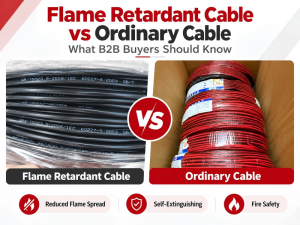
An ordinary cable and a Flame Retardant Cable may look similar, yet their insulation materials and verified fire performance can differ. Neither jacket color nor cable thickness proves its classification.
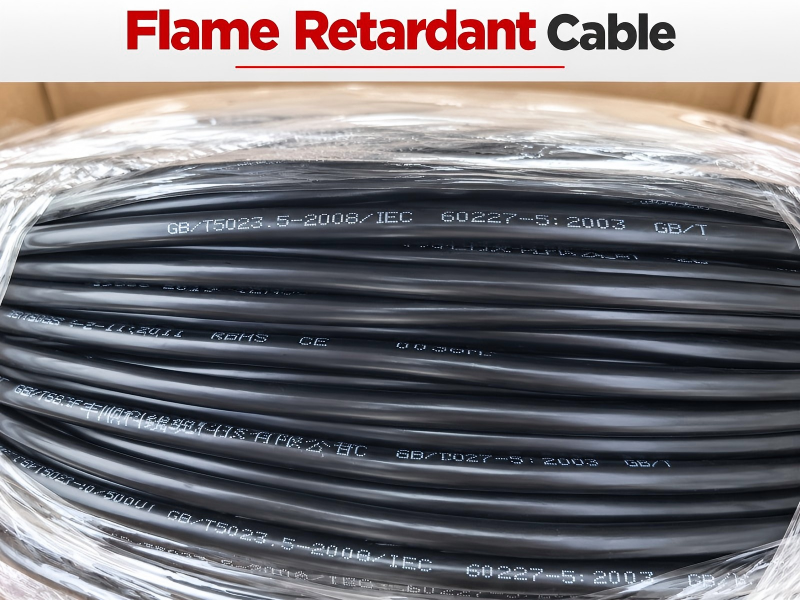
The first reference photo shows red-and-black ordinary insulated wire supplied in coils. The second shows black-jacketed cable with printed markings. These photos illustrate different products; they do not establish either product’s fire-test result.
Under certain conditions, an ordinary non-flame-retardant cable may keep burning or allow flames to advance along its polymer covering after the external heat source disappears. A suitably tested flame-retardant product is designed to reduce that propagation. Actual behavior depends on the cable construction, heat exposure, arrangement, and installation environment.
For conductor dimensions and circuit suitability, see SUMRING’s fire alarm cable selection guide.
How Does Flame Retardant Cable Limit Fire Spread?
A Flame Retardant Cable generally uses insulation, sheathing, or other construction materials selected to resist sustained flame propagation. Some formulations promote protective char formation; others reduce the material’s tendency to support combustion.
During exposure to a flame, the cable’s polymer layers may soften, char, smoke, or ignite. When the ignition source is removed, flames may die out rather than continue travelling along the tested specimen. That behavior is conditional, not an unconditional promise of immediate self-extinguishing.
A simple buying principle is: a cable can ignite, yet still be designed to limit continued flame spread.
Importantly, Flame Retardant Cable does not mean non-combustible cable. Prolonged or severe fire exposure can destroy insulation and compromise the electrical system. Never attempt an informal flame test at home or on a job site. Fire performance should be assessed through appropriate professional laboratory evidence.
Why Is Flame Retardant Cable Important in Fire Alarm Projects?
Cables link detectors, manual call points, control panels, and audible or visual notification devices. Cable selection therefore affects both electrical operation and the risk of fire spreading along wiring routes.
For commercial buildings, Flame Retardant Cable may be specified to reduce flame propagation through suitable cable installations. However, a flame-spread rating alone cannot establish whether a circuit will keep operating during a fire.
A designer must also consider circuit voltage, conductor resistance, voltage drop, cable routing, mechanical protection, and the applicable local code.
To understand how devices connect across a project, read how wired fire alarm systems use multiple circuits.
Which Standards Explain Cable Flame Retardancy?
Test methods are essential because descriptions such as “self-extinguishing” are incomplete without a defined evaluation.
IEC 60332-1-2:2025 addresses vertical flame propagation of an individual insulated wire or cable. The IEC explicitly cautions that this result does not demonstrate equivalent performance when cables are grouped together.
Official Source: IEC 60332-1-2:2025 — International Electrotechnical Commission.
The IEC 60332-3-24:2018 addresses vertically arranged bunched cables under defined conditions. For instance, IEC 60332-3-24 describes a Category C evaluation. Buyers should match the claimed category, tested configuration, and report to the actual cable.
Official Source: IEC 60332-3-24:2018 — International Electrotechnical Commission.
In Chinese specifications, GB/T 19666-2019 uses designations such as ZA, ZB, ZC, and ZD for bunched flame-retardant categories. ZA is assessed under a more demanding specified test arrangement than ZB or ZC, but these designations should not be treated as universal guarantees for every installation or automatically equated with classifications in other countries.
For a Flame Retardant Cable, ask which exact standard and edition support its advertised claim. A generic “passed fire test” statement is insufficient.
Is Flame-Retardant the Same as Fire-Resistant?
No. These terms describe different performance objectives.
- Flame-retardant: Limits flame propagation under specified test conditions.
- Fire-resistant or fire-survival: Designed and tested to maintain electrical circuit integrity for a defined period and exposure.
- Low-smoke or halogen-free: Addresses separate smoke or material characteristics; neither property alone proves circuit survival.
The IEC 60331 series deals with circuit integrity under fire conditions, which is different from IEC 60332 flame-spread testing.
A Flame Retardant Cable should not be sold as a fire-resistant cable unless its particular construction has separate supporting evidence. This distinction is particularly important for life-safety circuits where continued operation may be required by the project specification.
How Should B2B Buyers Verify Cable Claims Before Ordering?
A procurement decision should be based on traceable documents rather than jacket color, supplier slogans, or short promotional videos.
First, request the complete cable designation, manufacturer, conductor size, voltage rating, insulation materials, and intended application. Next, request a fire-test report identifying the test method, tested construction, and result. Compare the certificate or report with the sample, package, and printed jacket legend.
For a Flame Retardant Cable, confirm whether the stated result applies to one cable or a group. Also check if separate smoke, halogen, or circuit-integrity evidence is needed.
Before bulk ordering, ask the contractor or responsible engineer to approve the cable against national regulations and project requirements. The broader fire alarm product selection guide can help connect cable specifications with system-level requirements.
How Can OEM and ODM Buyers Reduce Purchasing Risks?
For distributors ordering Flame Retardant Cable, OEM requirements may include verified jacket printing, branded labels, coil length, packaging, and inspection documentation. More substantial material or construction changes require engineering review and potentially new testing.
Agree on an approved sample, technical specification, inspection criteria, and responsibility for compliance documents before committing to volume. Do not transfer the test claims of one construction to another merely because the appearance is similar.
FAQs
1. Can flame-retardant cables catch fire?
Yes. Insulation and jacketing may ignite or smoke during exposure. Flame retardancy concerns limiting propagation under specified conditions, not immunity to fire.
2. Will the flame always go out when the heat source is removed?
No. Self-extinguishing behavior depends on exposure, construction, and test conditions. An uncontrolled building fire can overwhelm a cable’s intended performance.
3. Do ordinary electrical wires always keep burning?
No. Ordinary cables vary in formulation and behavior. Without comparable test results, no individual wire should automatically be classified as continuously burning.
4. Does IEC 60332-1-2 prove safety for bundled wiring?
No. Single-cable performance cannot automatically be extended to bundled installations; check the appropriate bunched-cable requirements.
5. Are ZA, ZB, and ZC internationally interchangeable ratings?
No. They are category designations within a defined Chinese standards framework. Verify local acceptance and the relevant test report.
6. Does a flame-retardant jacket guarantee low smoke?
No. Smoke performance needs its own relevant criteria and supporting test evidence.
7. Can these cables be used in fire alarm systems?
Possibly, if electrical properties, installation conditions, fire-performance requirements, and local approvals fit the specific project.
8. Can buyers verify flame retardancy by burning a sample themselves?
No. Improvised burning creates fire and injury hazards and is not a valid substitute for professional testing and documented results.
Conclusion
The purpose of Flame Retardant Cable is to limit flame spread under defined conditions—not to remain unaffected by fire. For B2B purchasing, the safest approach is to distinguish flame propagation from circuit survival, verify applicable reports, and match the approved construction to the installation.
SUMRING welcomes discussions with distributors, contractors, and OEM/ODM partners about fire alarm system wiring requirements and supporting product selection. Share your target market, project standards, circuit details, and documented cable requirements when requesting a quotation.