How Should B2B Buyers Choose Fire Alarm Cable?
Fire alarm cable is an insulated conductor assembly used to carry power, alarm signals, control signals, or notification outputs between compatible fire-system components. For B2B buyers, selection requires more than comparing conductor size and price. Voltage drop, insulation, flame performance, installation route, local code, and system approval must be evaluated together.
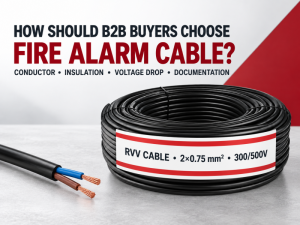
The supplied approval sheet identifies this product as 60227 IEC 53 (RVV) 2×0.75 mm², with two stranded bare-copper conductors, PVC insulation, and a black PVC VW-1 jacket. It references GB/T 5023.5-2008 / IEC 60227-5:2003. This guide explains what B2B buyers should verify before procurement.
What Does the 2×0.75 mm² Specification Mean?
“2×0.75 mm²” means that the product contains two insulated conductors, each with a nominal cross-sectional area of 0.75 mm². The approval sheet specifies blue and brown cores. Each conductor consists of 24 strands of 0.20 mm bare copper, with a stated bundle diameter of 1.13 mm.
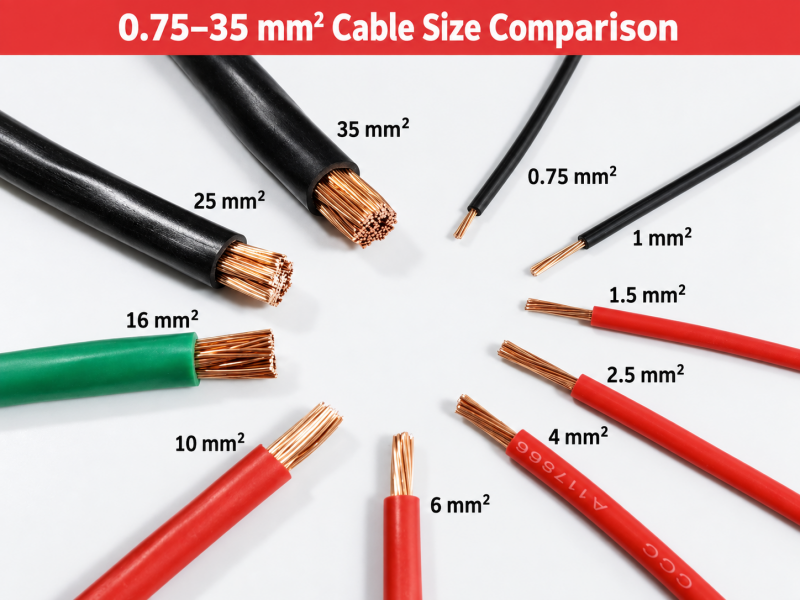
Stranded construction can simplify routing and termination in suitable indoor installations. A fire alarm cable intended for continuous movement, outdoor exposure, direct burial, wet locations, plenums, or circuit-survival applications may require a different construction and separate approvals.
Key Technical Parameters for B2B Procurement
| Item | Supplied specification |
|---|---|
| Construction | 60227 IEC 53 (RVV), 2×0.75 mm² |
| Referenced standard | GB/T 5023.5-2008 / IEC 60227-5:2003 |
| Conductor | 24/0.20 mm bare copper per core |
| Conductor bundle O.D. | 1.13 mm |
| Core insulation | PVC |
| Average insulation thickness | 0.60 mm |
| Minimum insulation thickness | 0.44 mm |
| Insulated core O.D. | 2.4 ± 0.1 mm |
| Core colors | Blue and brown |
| Outer jacket | Black glossy PVC, VW-1 |
| Average jacket thickness | 0.80 mm |
| Minimum jacket thickness | 0.62 mm |
| Finished O.D. | 6.6 ± 0.2 mm |
| Rated voltage | 300/500V |
| Temperature range | -10°C to 70°C |
| Dielectric strength | AC 2000V for at least 1 second |
| Spark test | AC 6000V in air |
| Conductor resistance | 26.0 Ω/km maximum at 70°C, as stated |
| Insulation resistance | Greater than 0.011 MΩ·km |
| Unaged elongation | At least 150% |
| Unaged tensile strength | At least 10.0 N/mm² |
| Flame test | VW-1 |
Match these figures to the signed sample, current reports, and destination-market documents before ordering.
How Does Cable Construction Affect Performance?
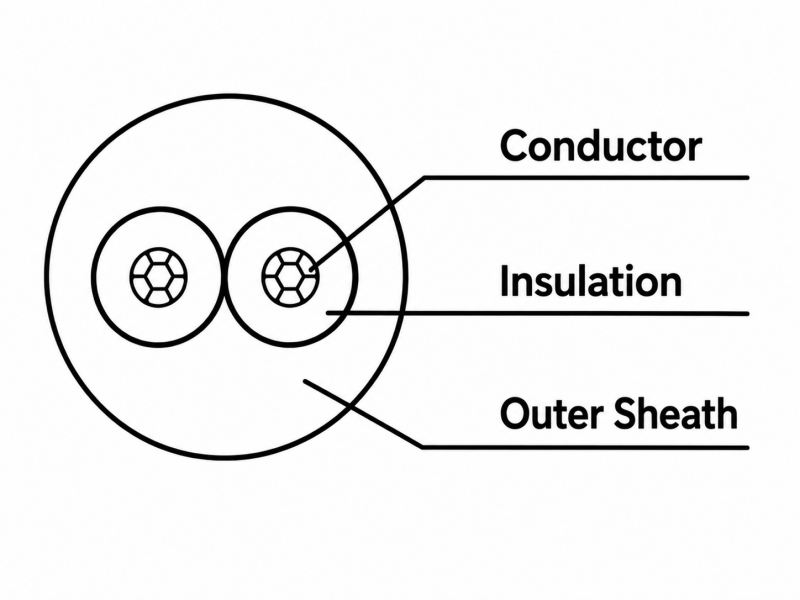
The supplied structure image shows three functional layers: conductor, insulation, and outer jacket. Each layer of a fire alarm cable performs a different function and should be included in incoming inspection.
Stranded Bare-Copper Conductors
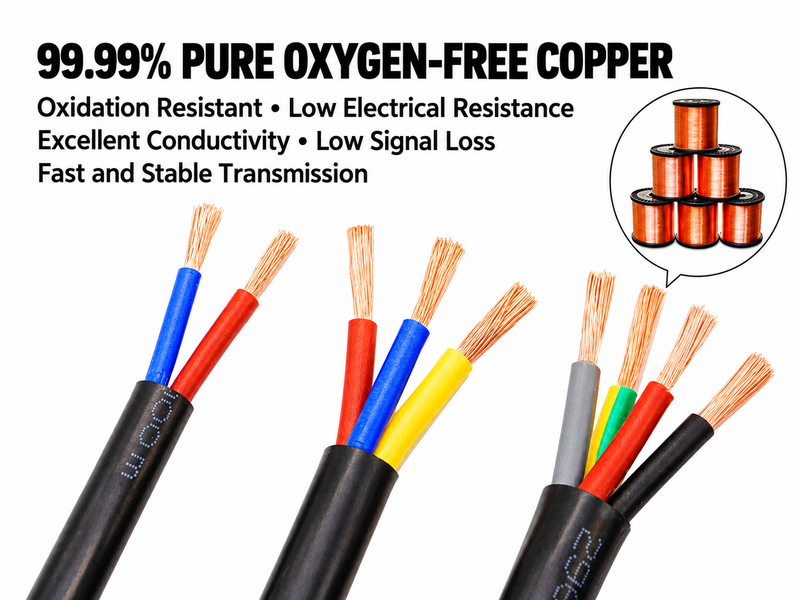
The approval sheet states “bare copper wire” with 24/0.20 mm construction. A promotional image describes 99.99% oxygen-free copper, but this claim is absent from the approval sheet. Use “stranded bare-copper conductor” unless an approved material certificate confirms the oxygen-free grade.
PVC Core Insulation
Each core has PVC insulation averaging 0.60 mm, with a 0.44 mm minimum. Inspect core color, diameter, insulation consistency, stripping performance, and conductor condition.
PVC VW-1 Outer Jacket
The black glossy jacket holds and protects the insulated cores. Its finished outside diameter is specified as 6.6 ± 0.2 mm. VW-1 describes a flame-test property, but it does not establish that the fire alarm cable will maintain electrical circuit integrity during a fire. Fire-resistant, fire-survival, low-smoke, halogen-free, plenum, riser, or direct-burial claims require their own applicable test evidence.
Is This Specification Suitable for Fire Alarm Systems?
Suitability depends on the circuit, installation route, connected load, and local approval requirements. A 300/500V rating alone does not qualify one wiring specification for every detector zone, notification circuit, auxiliary output, or mains connection.
For a broader understanding of how detectors, panels, and notification appliances exchange signals, buyers can first review how a commercial fire alarm system works.
Detection Zone Wiring
A 2-Wire Photoelectric Smoke Detector receives power and communicates its alarm condition through the same zone pair. The panel’s loop voltage, standby-current allowance, alarm-current range, end-of-line supervision, route length, and detector quantity must therefore be checked before approving the conductor specification.
Control Panel Circuit Requirements
The control panel determines the electrical requirements of detector zones, auxiliary outputs, relay interfaces, and notification circuits. Buyers should review the fire alarm control panel selection guide before confirming conductor size, polarity, terminal capacity, circuit supervision, and allowable voltage drop.
Wired Notification Circuits
Sounders and strobes can create higher circuit loads than detector zones. For example, the SR-A83 wired sound and light fire alarm requires installers to evaluate operating voltage, device quantity, alarm current, route length, and the voltage remaining at the final appliance.
The selected wiring should always be approved as part of the complete circuit rather than evaluated only by conductor size.
What Should Buyers Verify Before Bulk Ordering?
1. Define the Circuit
List the connected devices, circuit function, nominal voltage, maximum current, installation distance, supervision method, and allowable end-of-line voltage. These details help the supplier and system engineer evaluate whether the fire alarm cable size is appropriate.
2. Calculate Voltage Drop
Long routes and high loads can reduce voltage at the final device. Calculate with actual route length, conductor resistance, load current, and minimum device voltage rather than nominal area alone.
3. Confirm Standards and Documents
The sheet references GB/T 5023.5-2008 / IEC 60227-5:2003 and displays CCC A096520 and CE markings. Request current documents and verify their scope, model, manufacturer, and validity.
A logo or standard printed on a specification sheet should not replace a review of the complete supporting documentation.
4. Approve a Sample
Before production, inspect the fire alarm cable diameter, strand quantity, strand diameter, insulation thickness, core colors, jacket appearance, printing, meter marks, and packing length. Match electrical and flame-test reports to the exact model and construction being ordered.
5. Specify OEM Requirements
Define jacket and core colors, printed legend, meter sequence, coil or reel length, labels, carton quantity, barcode, packaging, MOQ, and inspection method. Approve material or dimensional changes before production.
FAQ
1. What Does 2×0.75 mm² Mean?
It means the product has two insulated cores, each with a nominal conductor area of 0.75 mm².
2. Is the Conductor Solid or Stranded?
It is stranded. The approval sheet specifies 24 strands of 0.20 mm bare copper in each core.
3. What Is the Finished Outside Diameter?
The specified finished O.D. is 6.6 ± 0.2 mm.
4. What Are the Rated Voltage and Temperature Range?
The supplied document states 300/500V and an operating temperature range of -10°C to 70°C.
5. Does VW-1 Mean the Wiring Is Fire-Resistant?
No. VW-1 refers to a flame test. It does not by itself prove circuit integrity during a fire or compliance with every fire alarm wiring requirement.
6. Is 99.99% Oxygen-Free Copper Confirmed?
The promotional image makes this claim, while the approval sheet states bare copper wire. Request a material certificate or revised signed document before including the oxygen-free copper claim in a sales contract.
7. Can Sumring Support Customized Printing and Packaging?
OEM options may include jacket printing, meter marks, labels, coil or reel length, branding, and packaging, subject to technical evaluation, MOQ, and applicable marking rules.
8. What Information Is Needed for a Quotation?
Send the application, device models, circuit type, voltage and current, route length, conductor size, number of cores, target standard, destination market, colors, printing, packaging, order quantity, and required documents.
Conclusion
A reliable fire alarm cable decision begins with the circuit and ends with documented approval. The supplied 2×0.75 mm² RVV specification provides stranded bare-copper conductors, PVC insulation, a PVC VW-1 jacket, a 300/500V rating, and defined electrical and physical parameters. Final suitability still depends on voltage drop, installation environment, local code, system design, and verified documentation.
Need help matching conductor size, circuit length, connected devices, and destination-market requirements? Contact Sumring for sample evaluation, OEM/ODM support, and a project-based quotation.
For more fire alarm products, explore Fire Alarms, Smoke Detector Types, Fire Alarm Panels, and Gas Alarms.