How Should B2B Buyers Choose a 2-Wire Photoelectric Smoke Detector?
A 2-Wire Photoelectric Smoke Detector is a conventional fire detection device that receives power and communicates an alarm condition through the same pair of zone wires connected to a compatible fire alarm control panel. For B2B buyers, selection should focus on electrical compatibility, sensing performance, installation conditions, and commissioning—not appearance alone.
This matters for distributors, system integrators, contractors, and OEM buyers. Two detectors can share a similar voltage range but still behave differently on a real conventional zone. A good procurement specification therefore starts with the panel and project requirements.
In practice, a 2-Wire Photoelectric Smoke Detector should be approved as part of the complete zone circuit rather than treated as an isolated device.
Why Does Panel Compatibility Come First?
A 2-Wire Photoelectric Smoke Detector shares power and alarm signaling through one zone circuit. The detector and panel must therefore operate as a matched electrical system.
Check the panel’s normal loop voltage, standby-current allowance, alarm-current range, reset method, end-of-line supervision, maximum detector quantity per zone, and remote-indicator requirements. A wide detector voltage range does not automatically mean universal compatibility.
For bulk orders, buyers should confirm the detector against the intended panel model before production. Sample testing on the actual panel is more reliable than comparing catalog voltage figures only.
Which Electrical Parameters Should Buyers Compare?
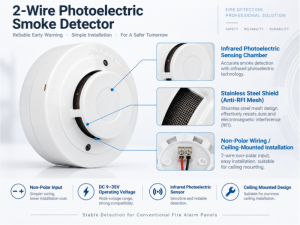
The supplied SR-816 data lists DC 9–35 V operation with non-polar input. Static current is 55 μA. Alarm current is listed as 35 mA at DC12 V and 60 mA at DC24 V.
These parameters help engineers estimate zone loading and confirm whether the panel can recognize the alarm condition correctly. For a 2-Wire Photoelectric Smoke Detector, voltage, standby current, and alarm current should always be reviewed together.
The panel manufacturer’s zone specification should remain the final compatibility reference. Buyers should also confirm end-of-line components, wiring method, and detector quantity per circuit before approving a commercial order.
How Does the Photoelectric Sensing Design Affect Selection?
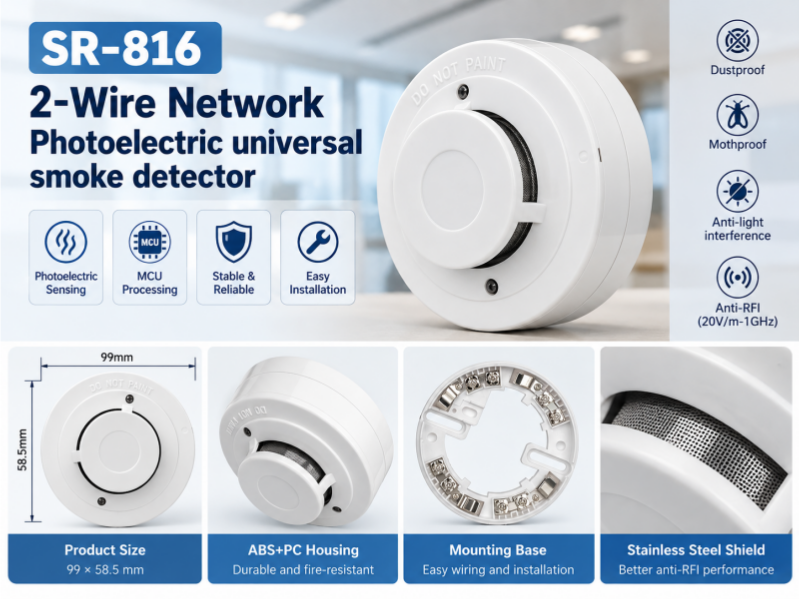
The SR-816 uses an infrared photoelectric sensor with MCU processing. Its optical chamber detects changes caused by smoke particles entering the sensing path, while the microcontroller processes the signal before the unit changes to an alarm state.
The supplied information also describes dustproof, mothproof, anti-light-interference design and a stainless-steel shield for radio-frequency interference resistance. These features are relevant when a 2-Wire Photoelectric Smoke Detector is used in commercial environments where electrical noise or airborne contamination may influence field stability.
Sensitivity is specified as 0.5 dB/m with a tolerance of ±0.01 dB/m. When sensitivity is part of a project tender or engineering requirement, B2B buyers should request the applicable test method and supporting technical documentation.
What Environmental Limits Should Be Checked?
The SR-816 specification lists a working temperature of -10°C to +50°C and relative humidity up to 95% RH without condensation.
Compare these limits with the real installation site. Warehouses, plant rooms, corridors, utility areas, and unconditioned spaces may have different temperature, humidity, dust, steam, or insect exposure.
A 2-Wire Photoelectric Smoke Detector should not be selected only from laboratory specifications. Maintenance access, contamination risk, ceiling conditions, and routine inspection requirements should also be considered during project planning.
What Mechanical Details Matter to Installers?
The SR-816 is ceiling mounted, approximately 99 × 58.5 mm, with ABS+PC housing according to the supplied data.
Installers should confirm base dimensions, terminal arrangement, cable entry, mounting-hole spacing, detector removal method, and access for inspection. When replacing an existing detector, base compatibility should not be assumed simply because the new detector has a similar diameter.
The specification also lists a remote LED indicator function. If detectors are installed in concealed or difficult-to-view positions, the exact remote-indicator wiring and panel compatibility should be confirmed before installation.
What Should Be Tested Before a Bulk Order?
A sample approval should reproduce the intended field configuration. Connect the detector to the actual or technically equivalent fire alarm panel, verify normal standby status, perform an approved functional smoke test, confirm panel alarm recognition, and check reset behavior.
For a 2-Wire Photoelectric Smoke Detector, the test record should also include detector quantity per zone, panel settings, end-of-line arrangement, cable assumptions, and any remote LED connection.
This process is especially useful for distributors supplying products for multiple conventional panel brands because “2-wire” describes the circuit concept, not guaranteed cross-brand compatibility.
SR-816 Reference Specification
| Parameter | Supplied SR-816 Data |
|---|---|
| Model | SR-816 |
| Detector type | 2-wire conventional photoelectric smoke detector |
| Operating voltage | DC 9–35 V |
| Power input | Non-polar |
| Static current | 55 μA |
| Alarm current | 35 mA @ DC12 V; 60 mA @ DC24 V |
| Sensitivity | 0.5 dB/m ±0.01 dB/m |
| Sensor | Infrared photoelectric |
| Signal processing | MCU |
| Alarm indication/output | Remote LED indicator |
| Installation | Ceiling mounted |
| Temperature | -10°C to +50°C |
| Humidity | ≤95% RH, non-condensing |
| Dimensions | 99 × 58.5 mm |
| Material | ABS+PC |
| Warranty shown | 2 years |
These parameters are suitable for initial engineering review. Final project approval should use the latest datasheet, required compliance documents, and a compatibility test with the intended fire alarm panel.
How Should B2B Buyers Write the RFQ?
A stronger RFQ should identify the fire alarm panel model, zone voltage, detector quantity per zone, alarm-current expectations, end-of-line method, site environment, mounting requirements, remote-indicator need, target market, documentation requirements, sample quantity, and customization scope.
When sourcing a 2-Wire Photoelectric Smoke Detector, this RFQ structure helps separate genuine system compatibility from simple price comparison.
For OEM or private-label projects, the technical specification should be frozen before logo, packaging, manual, and label work begins. That keeps commercial customization separate from electrical approval.
A 2-Wire Photoelectric Smoke Detector is best treated as one part of a complete conventional system. Product data, panel behavior, site conditions, compliance needs, and commissioning results should all be linked in one approval process.
FAQ
Is a 2-wire detector the same as a stand-alone smoke alarm?
No. A conventional 2-wire detector normally depends on a compatible fire alarm control panel for power, supervision, and alarm processing. A stand-alone alarm works independently.
Can any DC 9–35 V panel use the SR-816?
Not automatically. Voltage is only one factor. Standby current, alarm current, reset behavior, end-of-line supervision, and zone design must also be checked.
What does non-polar input mean?
It means the detector input is designed to tolerate either wire orientation at its power terminals. The overall circuit must still follow the panel wiring instructions.
Why does standby current matter?
It contributes to the total electrical load of all detectors connected to a zone and must remain within the control panel’s specified limits.
Why should alarm current be verified?
The panel recognizes an alarm through a defined electrical change. Detector alarm current must therefore match the range accepted by the control panel.
Can SR-816 use a remote LED?
The supplied specification lists a remote LED indicator function. Confirm the exact connection method with the detector and panel documentation.
Is SR-816 suitable for ceiling mounting?
Yes. The supplied data specifies ceiling mounting. Base compatibility, spacing, project requirements, and site conditions should still be verified.
What should OEM buyers approve before production?
Electrical compatibility, technical specifications, required compliance documents, sample performance, product labeling, manuals, packaging, and finally branding details should be confirmed.
Conclusion
Choosing a 2-Wire Photoelectric Smoke Detector for a commercial project requires more than comparing price and operating voltage. Panel compatibility, standby and alarm current, sensing performance, environmental limits, mounting details, remote indication, and sample commissioning should all be verified before bulk production.
Sumring can support distributors, fire alarm contractors, system integrators, and OEM/ODM buyers with SR-816 technical review, sample evaluation, project matching, private labeling, packaging customization, and documentation preparation.
If you are sourcing detectors for an existing conventional panel or developing a new fire alarm project, send Sumring your panel model, zone parameters, target quantity, and target-market requirements. Our team can evaluate the application before quotation and help reduce compatibility issues during project installation.