
How Should B2B Buyers Choose a Beam Smoke Detector?
A Beam Smoke Detector is a line-type fire detection device that sends an optical or infrared beam across a large open space and monitors how smoke reduces or changes the received light signal. Instead of sampling smoke at only one ceiling point, it supervises a long optical path, making it suitable for warehouses, factories, shopping malls, exhibition halls, hotel atriums, museums, and other high-ceiling buildings.
For B2B buyers, the correct detector is not simply the model with the longest range. Selection should match the ceiling geometry, optical path, fire alarm control panel, mounting conditions, certification requirements, commissioning method, and maintenance plan. The SR-BS10 conventional reflective beam detector in the supplied material is a useful example of the points buyers should verify before project approval.
Beam detection is only one part of a complete fire protection architecture. B2B buyers planning an integrated project can first review the main components of a building fire alarm system to understand how detection devices, control panels, manual call points, and notification appliances work together.
Why Is Beam Detection Suitable for High-Ceiling Spaces?
A conventional point smoke detector monitors smoke near one sensing chamber. A Beam Smoke Detector uses a long optical path, so a correctly designed detection line can supervise a much wider open area.
This can be useful where ceilings are high, access is difficult, or installing many ceiling detectors would increase installation and maintenance work. Typical applications include logistics warehouses, production workshops, exhibition halls, museums, shopping centers, and large hotel lobbies.
However, room size alone is not enough. Engineers should also consider structural beams, storage racks, cranes, signs, skylights, HVAC airflow, vibration, and future layout changes. The optical path must remain clear and stable.
How Does a Reflective Beam Detector Work?
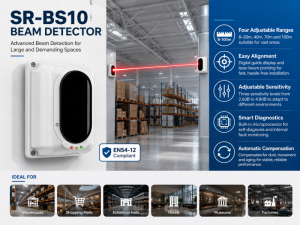
The supplied SR-BS10 image shows a transmitter, receiver, laser beam pointer, digital display guide, horizontal and vertical adjustment points, terminals, status LEDs, and a reed switch. In a reflective arrangement, the transmitter and receiver are in the detector unit while a reflector is mounted at the opposite end of the protected space.
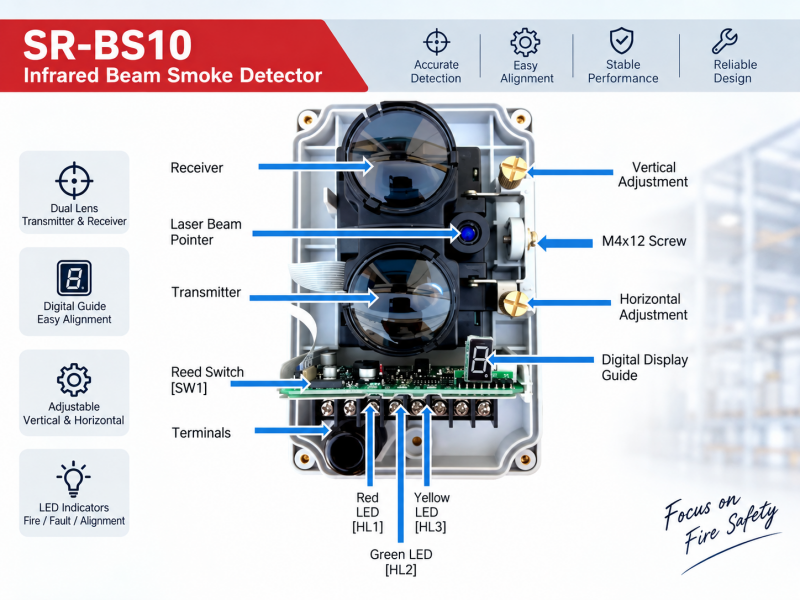
During normal operation, the optical signal travels to the reflector and returns to the receiver. When smoke enters the path, the returned signal is attenuated. The detector’s microprocessor evaluates that change and determines whether it represents an alarm, fault, or condition that can be compensated.
This is why a Beam Smoke Detector needs a clear line of sight. Obstructions, severe misalignment, structural movement, or optical interference may affect performance and must be considered during design.
What Detection Range Should Buyers Specify?
The SR-BS10 label shows an optical path length of 8–100 m, and the supplied overview describes four selectable range settings across this span.
Longer range is not automatically better. The correct setting should be based on the actual distance between detector and reflector, the manufacturer’s approved configuration, site geometry, and the applicable project standard.
A B2B RFQ should therefore state the expected optical path distance rather than only asking for “100 m coverage.” The supplier can then confirm the correct setting, reflector arrangement, and commissioning method.
A well-specified Beam Smoke Detector should be selected by usable project range, not maximum advertised distance alone.
Why Do Alignment and Sensitivity Matter?
Beam detectors depend on accurate optical alignment. The product image shows a built-in laser pointer, digital guide, and separate horizontal and vertical adjustments. These features help installers aim the detector at the reflector and confirm signal quality.
The supplied label also lists a maximum optical direction deviation of 0.4°, highlighting the need for rigid mounting. A detector fixed to a vibrating or moving structure may require additional engineering review.
The product information describes three adjustable sensitivity levels from 2.6 dB to 4.8 dB. Sensitivity should be selected according to the approved instructions, project standard, and site environment. A clean exhibition hall may require a different approach from a dusty warehouse.
The Beam Smoke Detector also includes automatic optical compensation according to the supplied information. This is intended to offset gradual changes caused by dust accumulation, device aging, or small position shifts. It supports stability but does not replace inspection, cleaning, testing, or alignment checks.
How Does It Integrate with a Conventional Fire Alarm System?
The SR-BS10 label specifies 24 VDC non-polar power with a 20–28 VDC operating range. It lists standby current up to 23 mA and alarm current up to 33 mA. These values should be checked against the fire alarm control panel’s power capacity and the project wiring design.
To understand how beam detectors, smoke detectors, manual call points, control panels, sounders, and other devices coordinate across a commercial project, read our guide on how fire alarm systems work in commercial buildings.
A Beam Smoke Detector should be treated as one part of the complete fire detection system rather than as an isolated device. Buyers should confirm how alarm and fault signals are transmitted, whether relay outputs or monitored inputs are used, what reset method is required, and how the panel distinguishes fire from fault conditions. Buyers who need a deeper understanding of panel functions can also review what is a fire alarm control panel before checking detector-to-panel compatibility.
For larger projects, power budget and cable voltage drop should be reviewed together with sounders, strobes, manual call points, remote indicators, and other devices.
Where Should Beam Detection Be Used?
Beam detection is most suitable where a long, unobstructed optical path can be maintained. Common examples include warehouses, atriums, large retail spaces, factories, exhibition centers, transport halls, and museums.
A Beam Smoke Detector may need extra design review where tall racks frequently change, cranes cross the beam, suspended banners are moved, roof structures vibrate, strong sunlight enters the optical path, or condensation and heavy dust are present.
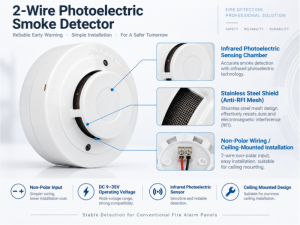
Where a clear and stable optical path cannot be maintained, project designers may need to evaluate point-type detection instead. For conventional panel projects, this guide explains how to specify a 2-wire photoelectric smoke detector for conventional fire alarm systems, including panel compatibility, standby current, alarm current, installation conditions, and commissioning requirements.
The objective is not to use beam detection in every high-ceiling building. It is to select the detection method that matches the fire risk, building geometry, maintenance access, and required standard.
Some projects may combine beam detectors with point smoke detectors, heat detectors, or other fire detection technologies in different zones. Where smoke, dust, steam, or environmental conditions make smoke detection less suitable, buyers can also review where should a heat fire alarm be installed to compare heat detection applications with optical smoke detection.
What Should B2B Buyers Verify Before a Bulk Order?
A professional RFQ should include building type, ceiling height, optical path distance, quantity, fire alarm panel model, supply voltage, alarm/fault interface, destination market, environmental conditions, installation drawing, documentation requirements, and sample-test plan.
For the SR-BS10, the supplied label references EN 54-12:2015 and displays LPCB, CE, and UKCA markings. Before tender submission or project approval, B2B buyers should request the current certificate, exact approved model, certificate number, applicable test documentation, and market-specific conformity documents rather than relying only on a logo printed on the product.
For OEM or ODM procurement, freeze the technical specification before approving logo printing, packaging, manuals, or private-label artwork. Electrical configuration, detection range, sensitivity, certification scope, and fire alarm panel interface should come first.
This is particularly important for distributors selling into multiple markets because certification requirements and system configurations can differ between countries and projects.
How Should Installation and Maintenance Be Planned?
Installers should mount the detector and reflector on stable surfaces, maintain a clear optical path, follow the approved installation height and spacing requirements, complete alignment using the laser and display guide, and record the final signal condition during commissioning.
Routine maintenance should include visual inspection, reflector cleaning where needed, obstruction checks, alignment verification, alarm testing, fault testing, and confirmation that building modifications have not blocked the beam.
A Beam Smoke Detector may reduce the number of devices required in a large open space, but a new storage rack, suspended sign, partition, duct, equipment installation, or structural modification can affect the optical path and should trigger a system review.
For contractors managing multiple warehouses or commercial buildings, keeping commissioning records can also simplify later maintenance because technicians can compare current signal conditions with the original installation data.
FAQ
1. What is the main advantage of a beam detector in a warehouse?
It can supervise a long optical path, making it practical for wide, high-ceiling spaces where many individual ceiling detectors may otherwise be required.
2. Is a 100 m detector always the best choice?
No. The selected detection range should match the actual optical path, approved configuration, installation environment, and project requirements.
3. Why does a reflective detector need a reflector?
The detector sends an optical signal toward the reflector and measures the returned signal. Smoke entering the path changes the amount of light received by the detector.
4. Can it work with a conventional fire alarm panel?
Yes, provided that the detector’s supply voltage, alarm and fault interfaces, reset method, wiring configuration, and electrical characteristics are compatible with the intended control panel.
5. What can cause faults or unwanted alarms?
Obstruction, accumulated dust, structural movement, poor alignment, condensation, optical interference, or unsuitable sensitivity settings may affect system performance.
6. Why is a laser pointer useful?
A laser pointer helps installers aim the detector toward the reflector during initial installation. The digital signal guide can then be used for more accurate final alignment and commissioning.
7. Does automatic optical compensation eliminate maintenance?
No. Optical compensation can help manage gradual signal changes, but routine inspection, cleaning, functional testing, and alignment verification are still required.
8. What documents should B2B buyers request?
Buyers should request the latest technical datasheet, installation manual, wiring information, certificate details, conformity documents, applicable test reports, and a controlled sample specification before bulk purchasing.
Conclusion
For large open and high-ceiling buildings, a Beam Smoke Detector can be an efficient part of a properly engineered fire detection system. The key B2B decision factors are usable detection range, alignment stability, sensitivity, optical compensation, panel compatibility, certification scope, commissioning support, and maintenance access.
Sumring can support distributors, system integrators, contractors, and private-label customers with fire detection products, conventional fire alarm solutions, and OEM/ODM project coordination.
For a beam detection project, buyers should provide the building type, optical path distance, fire alarm control panel model, destination market, certification requirement, expected quantity, and customization requirements before quotation. This allows the technical configuration to be reviewed before price becomes the deciding factor.