How to Choose a Plastic Cover Fire Alarm Heat Smoke Detector Case?
A Plastic Cover Fire Alarm Heat Smoke Detector Case is the outer housing and support structure used to protect and position the electronic, sensing, and mounting components of a smoke or heat detector.
For distributors, fire alarm manufacturers, OEM brands, and engineering suppliers, choosing the right Plastic Cover Fire Alarm Heat Smoke Detector Case requires more than comparing appearance or price. Vent design, internal space, mounting structure, sensor-chamber position, material, and tooling accuracy can all influence assembly and finished-product development.
For distributors, fire alarm manufacturers, OEM brands, and engineering suppliers, housing selection should begin with the detector design rather than appearance alone. Sumring’s international marketplace listings include conventional standalone plastic smoke detector housings, heat/smoke detector cover cases, and smoke sensor chamber housings. The SR-GHZ-A product page also identifies an ABS housing for smoke detector applications.
7 Key Factors When Buying a Plastic Cover Fire Alarm Heat Smoke Detector Case?
Before purchasing a Plastic Cover Fire Alarm Heat Smoke Detector Case, B2B buyers should evaluate seven practical factors: detector type, PCB compatibility, sensing-chamber structure, mounting method, housing material, customization requirements, and finished-product compliance.
A housing must match the PCB dimensions, optical or heat sensing structure, buzzer location, LED position, test mechanism, terminal arrangement, and mounting method. A visually similar cover can still require different internal posts, screw positions, chamber clearances, or base structures.
The second question is detector architecture. Conventional 2-wire or 4-wire detectors, standalone battery alarms, and smoke-and-heat detectors may use different layouts. Buyers should therefore specify the complete application before selecting a shell.
The third question is production scope. Buyers purchasing only a Plastic Cover Fire Alarm Heat Smoke Detector Case may use an existing mold, while OEM customers may need logo changes, surface-texture changes, new mounting features, vent changes, or a fully customized mold.
These options create very different tooling costs, development times, and validation requirements.
How Do SR-GHZ-A, SR-GRT-B and SR-GJA-A Housings Differ?
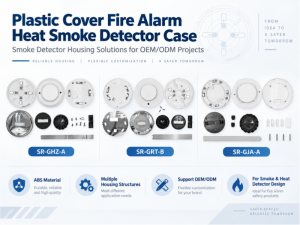
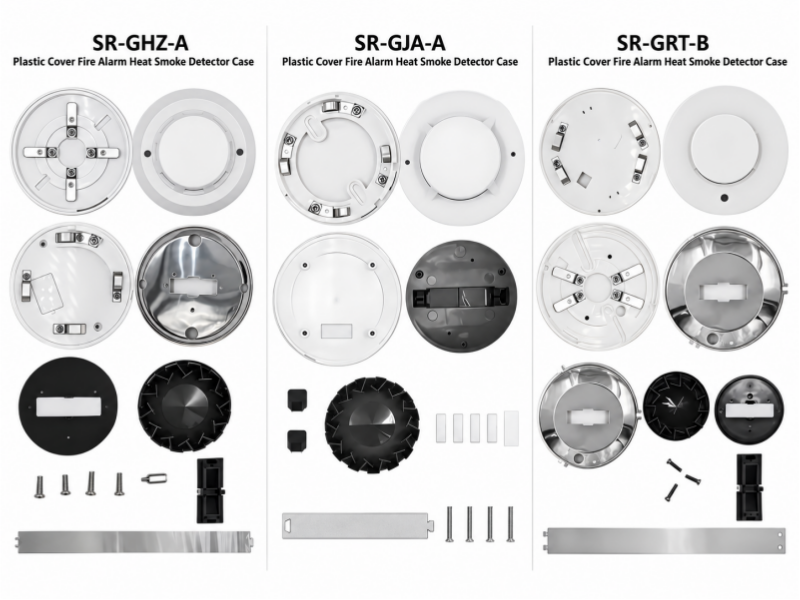
R-GHZ-A, SR-GRT-B and SR-GJA-A demonstrate three different smoke detector housing structures. Their front covers, bases, internal mounting points, metal components, chamber arrangements, and accessory layouts are not identical.
For an OEM project, buyers should therefore avoid choosing a housing only from the external appearance. PCB fixing points, sensor-chamber interface, LED position, screw locations, terminal space, and installation structure should be checked before sample approval.
When selecting a Plastic Cover Fire Alarm Heat Smoke Detector Case, these mechanical details are especially important if an existing PCB or sensing module must fit into a new enclosure.
Why Is ABS Commonly Used for Smoke Detector Cases?
The Sumring SR-GHZ-A smoke detector housing is listed by FireAlarmFactory as an ABS housing.
ABS is commonly used for electronic enclosures because it provides good moldability, dimensional consistency, impact resistance, and a clean surface suitable for volume manufacturing.
However, simply specifying “ABS” is not enough for a professional procurement project.
The buyer should also confirm the required material grade, operating environment, surface finish, color, flame-performance requirement where applicable, and whether recycled material is acceptable.
If your project has a specific material requirement, include it in the purchasing specification rather than assuming that every ABS formulation provides identical performance.
A Plastic Cover Fire Alarm Heat Smoke Detector Case should therefore be evaluated as one part of the complete detector design.
How Can Housing Design Affect Detector Development?
Smoke detector performance depends on the relationship between the outer air-entry structure, sensing chamber, PCB, sensor, and other internal components.
Heat detectors may use a different sensor arrangement and require different exposure to surrounding air.
As a result, changing the enclosure is not purely an industrial-design decision.
Changes to vent geometry, sensing-chamber position, enclosure height, internal spacing, or obstructions may change the conditions around the sensing components. Major mechanical changes should therefore receive engineering review before mass production.
Housing design can also influence manufacturing efficiency.
Correctly positioned screw posts, snap structures, cable channels, terminal openings, LED windows, and test-button mechanisms can simplify assembly and improve production consistency.
Plastic Cover Fire Alarm Heat Smoke Detector Case: Standard Housing or Custom Mold?
For many distributors and private-label customers, an existing housing platform is the fastest route.
It reduces mechanical development work and may allow buyers to focus on PCB matching, branding, packaging, and finished-product testing.
A customized mold becomes more relevant when the project requires a unique appearance, proprietary dimensions, special mounting system, different internal PCB structure, modified airflow geometry, or integration with a dedicated sensor chamber.
A customized project normally requires mechanical drawings, prototype confirmation, mold development, trial samples, assembly evaluation, and finished-product validation.
For many buyers, a practical first step is to evaluate an existing platform such as SR-GHZ-A, SR-GRT-B or SR-GJA-A before investing in completely new tooling.
What Information Should You Send to a Smoke Detector Housing Supplier?
An accurate B2B quotation requires more information than quantity alone.
Buyers should provide the detector type, PCB dimensions, sensing or chamber structure, wiring method, mounting method, desired enclosure dimensions, target quantity, color, logo requirements, material requirements, packaging requirements, and target market.
If you already have a detector that needs a replacement or redesigned enclosure, internal photos and dimensional drawings are particularly useful.
For a Plastic Cover Fire Alarm Heat Smoke Detector Case project, clearly state whether your required supply scope is:
housing components only, housing plus sensor chamber, housing plus mounting accessories, or development of a complete OEM/ODM detector.
This avoids comparing quotations that actually cover different products.
How Should B2B Buyers Evaluate a Manufacturer?
Smoke detector housing procurement becomes easier when the supplier understands both plastic enclosure manufacturing and the finished fire detection product.
Sumring’s official website identifies the company as a fire alarm solution manufacturer covering manual call point covers,gas detectors,smoke alarms, control panels, sounders and related safety devices. The company also states that it supports OEM/ODM and project-based cooperation.
This background can be useful when an enclosure needs to be matched with electronics or developed into a complete detector.
However, B2B buyers should still request model-specific samples, drawings, material information, assembly details, and applicable documentation before confirming mass production.
Certification: Housing Is Not the Same as a Certified Detector?
Certification and performance claims should correspond to the complete tested detector, not only the plastic enclosure. For example, UL Solutions explains that UL 217 applies to smoke alarms, while UL 268 addresses smoke detectors used in fire alarm systems. Buyers developing products for regulated markets should therefore evaluate certification requirements at finished-product level.
FAQ
1.Can Sumring supply only the smoke detector plastic housing?
Related Sumring marketplace listings show smoke detector housings and plastic cases as separate sourcing products. Buyers should confirm whether they need the front cover, base, chamber, mounting components, screws, or a complete housing set.
2.Which housing should I choose: SR-GHZ-A, SR-GRT-B or SR-GJA-A?
Selection should depend on PCB dimensions, chamber structure, mounting arrangement and internal compatibility rather than appearance alone. Send the mechanical requirements before confirming the housing.
3.Can the smoke detector case be customized with our logo?
For OEM/ODM projects, branding, appearance, color, packaging and mechanical changes can be discussed. Sumring states that it provides OEM/ODM support for fire alarm products.
4.Can the same housing be used for smoke and heat detectors?
Some Sumring marketplace descriptions specifically refer to heat smoke detector cover cases, but actual compatibility depends on the sensing structure and internal design of the finished detector.
5.What should be checked before mass production?
Mechanical fit, PCB positioning, chamber installation, mounting, indicator visibility, button operation, airflow or sensor exposure, assembly consistency, material specifications, and finished-detector performance should all be verified.
6.What information is needed to quote a Plastic Cover Fire Alarm Heat Smoke Detector Case?
To prepare an accurate quotation for a Plastic Cover Fire Alarm Heat Smoke Detector Case, buyers should provide the target model, PCB dimensions, detector type, chamber structure, expected quantity, color, logo requirements, mounting method, packaging needs, and target market. Photos or mechanical drawings are especially useful when matching an existing detector design.
Conclusion
Choosing a Plastic Cover Fire Alarm Heat Smoke Detector Case should start with the detector design, not simply the lowest housing price.
For wholesalers, fire alarm brands, OEM manufacturers, and project suppliers, the right enclosure should match the PCB, sensing chamber, mounting structure, material requirements, assembly process, and target-market needs.
Sumring currently provides different housing structures such as SR-GHZ-A, SR-GRT-B and SR-GJA-A, allowing buyers to evaluate an existing platform before considering completely new tooling.
Developing a new smoke detector or heat detector project? Send your PCB dimensions, reference housing, sensing structure, expected quantity, branding requirements, and target market. Our team can help evaluate whether an existing housing or a customized OEM/ODM solution is the more practical option.