Why Did Fire False Alarms in England Rise in 2026?
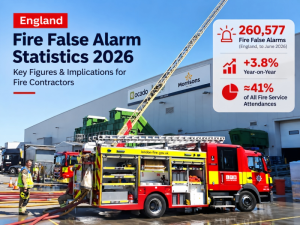
Fire false alarms in England are incidents in which fire and rescue services attend a suspected fire but find that no fire exists or existed. New government figures show that crews attended 260,577 such incidents in the 12 months ending June 2026, up 3.8% from the previous year. For contractors and facility managers, the question is which risks maintenance, design and protective accessories can address.
The statistics were released on 28 October 2026 by the UK Ministry of Housing, Communities and Local Government. They cover England only and count fire service attendances, not every alarm activation.
What Do the Latest Government Figures Show?
The official report records 638,454 incidents attended by fire and rescue services in the year ending June 2026. Of these, 158,659 were fires, while fire false alarms represented about 41% of all attendances.
The breakdown for fire false alarms in England is:
- 260,577 total fire false alarms, compared with 251,039 a year earlier (+3.8%).
- 178,003 due to apparatus, compared with 172,433 (+3.2%).
- 77,028 due to good intent, compared with 72,803 (+5.8%).
- 5,546 malicious reports, compared with 5,803 (−4.4%).
These national figures do not identify individual device types or building sectors.
What Does “Due to Apparatus” Actually Mean?
The government defines apparatus-related false alarms as calls resulting from fire alarm or firefighting equipment operating in error, including accidental initiation by people. This category can involve different equipment and circumstances; it does not identify manual call points as the principal cause.
That distinction matters when interpreting fire false alarms in England. A smoke detector activated by an unsuitable environment, a fault within a system, and an accidentally operated manual call point may require very different corrective actions. The published total cannot establish how many incidents could have been prevented by protective covers.
Good-intent calls reflect a genuine belief in a fire; malicious calls deliberately report a nonexistent emergency. Neither automatically indicates an equipment defect.
Why Should Fire Alarm Contractors Review Their Projects?
For contractors, fire false alarms in England create a reason to examine site-level evidence rather than replace products indiscriminately. Repeated unwanted alarms may disrupt occupants, interrupt operations and increase inspection work. The appropriate response depends on the recorded trigger, the building’s fire strategy and the conditions surrounding each event.
A useful project review starts with the fire alarm control panel log, incident reports, device locations and maintenance history. Compare repeated activations by zone, time and device. Ask whether the issue involves detector selection, contamination, environmental exposure, testing procedures or physical contact with a manual call point.
Site records, rather than national averages, must guide procurement decisions across schools, hospitals, hotels and warehouses.
Where Can Manual Call Point Protection Be Relevant?
Manual call points need to remain visible, accessible and usable in a genuine emergency. However, devices located near moving trolleys, stored goods or busy pedestrian routes may be exposed to accidental impact or casual contact.
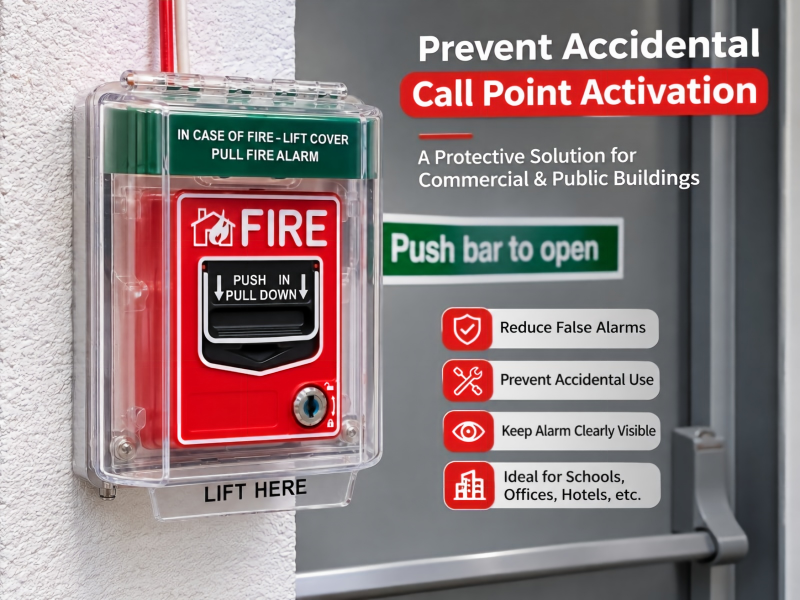
For these specific situations, contractors assessing fire false alarms in England can consider whether a suitable transparent cover would reduce unintended physical operation. A cover may provide a barrier against direct contact; certain configurations offer a local audible warning when opened. This cannot address every cause of false alarms.
SUMRING supplies the SR-A08-PS IP67 manual call point cover, with polycarbonate construction and sound or non-sound configurations. Buyers can review the SR-A08-PS manual call point cover for outdoor projects. The cover’s IP rating does not automatically apply to the entire installation.
What Should Buyers Verify Before Specifying Covers?
A project specification should begin with the installed call point, not the accessory catalogue. Measure its width, height and projection, including the mounting box. Check lid movement, nearby obstructions, visibility, signage and the user’s ability to operate the device promptly.
For outdoor projects, examine the full installation’s exposure to water and dust. For audible-cover versions, verify power arrangements and whether the local warning function is appropriate. Request applicable test documents and any approval required by local rules.
The rise in fire false alarms in England is not proof that every building requires protective covers. A cover should only be selected when the identified risk and relevant installation requirements justify it. It must never obstruct emergency activation.
How Can Operators Build a More Reliable Prevention Plan?
Effective prevention combines investigation, maintenance and clear operating procedures. Review detectors against their installation environment, correct documented faults, maintain accurate records and train staff in alarm response. Where a device repeatedly activates without a fire, identify the cause before changing its location or configuration.
A simple improvement plan includes incident review, corrective action, functional checks and a follow-up review of alarm records. Track whether the same unwanted trigger returns instead of claiming success after a single maintenance visit.
For multi-site procurement, request dimensioned drawings, installation guidance and product documentation.
What Are the Data Limitations?
The figures reflect incidents attended by fire and rescue services, not every alarm that sounded. The government also notes a transition to a new fire incident data platform in November 2025 and incomplete submissions for some areas, meaning certain figures may be revised.
Consequently, fire false alarms in England should be used as a national context indicator, not as evidence of a specific product’s effectiveness or an estimate of savings. The authoritative source is the government’s fire and rescue incident statistics, year ending June 2026.
Conclusion
The latest fire false alarms in England data shows a significant operational issue, but it does not identify one universal cause. Fire alarm contractors should distinguish apparatus-related incidents from good-intent and malicious reports, analyse site records and choose corrective measures suited to each risk.
For manual call points exposed to accidental contact, a correctly specified protective cover may be one useful measure alongside maintenance, training and system design. SUMRING can discuss dimensions, configuration and OEM/ODM requirements with distributors and project buyers, subject to project-specific verification.