What Should Buyers Know About Queensland Smoke Alarm Laws 2027?
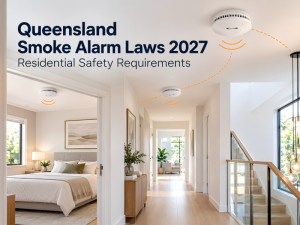
Queensland Smoke Alarm Laws 2027 refers to the final stage of Queensland’s phased residential smoke alarm reforms, requiring the remaining domestic dwellings to have interconnected photoelectric smoke alarms by 1 January 2027. It describes an existing deadline, not a new 2027 law.
For distributors, installers and OEM brands, the deadline affects documentation and procurement. Useful alarm features alone cannot prove market suitability.
Why Is 1 January 2027 Important?
Queensland implemented its smoke alarm reforms in stages. Since 1 January 2017, the updated requirements have applied to new dwellings and substantial renovations. From 1 January 2022, they have also applied to homes being sold or leased. From 1 January 2027, the requirements extend to the remaining domestic dwellings.
Consequently, Queensland Smoke Alarm Laws 2027 should not be presented as an entirely new obligation for rental properties. The current deadline matters especially for existing owner-occupied houses, townhouses and units that have not yet been upgraded. Registered caravans and motorhomes have related but distinct requirements.
Read the official Queensland Fire Department smoke alarm reforms before preparing product claims or quotations.
Which Smoke Alarm Requirements Must Be Verified?
Under Queensland Smoke Alarm Laws 2027, prescribed domestic alarms must be photoelectric, comply with AS 3786-2014, contain no ionisation sensor, be less than ten years past their manufacture date and work when tested. All required smoke alarms in the dwelling must be interconnected, so they activate together when one detects smoke.
Power supply matters as well. Depending on the dwelling and existing installation, alarms must be hardwired or powered by a non-removable ten-year battery. An existing hardwired alarm requiring replacement must be replaced with a compliant hardwired model. New construction and substantial renovation projects have separate hardwired requirements.
Importers should verify the marking on the exact alarm body, technical report, product version and permitted installation configuration. Compliance in another country, or a manufacturer’s ISO quality system, is not proof of compliance with AS 3786-2014.
Where Do Interconnected Smoke Alarms Need to Be Installed?
Queensland Smoke Alarm Laws 2027 require smoke alarms in each bedroom, hallways connecting bedrooms to the rest of the dwelling and on each storey. If a storey has no bedroom, at least one alarm is required along the likely exit route. Placement should follow Queensland’s rules and the approved product instructions, rather than a generic floor-plan illustration.
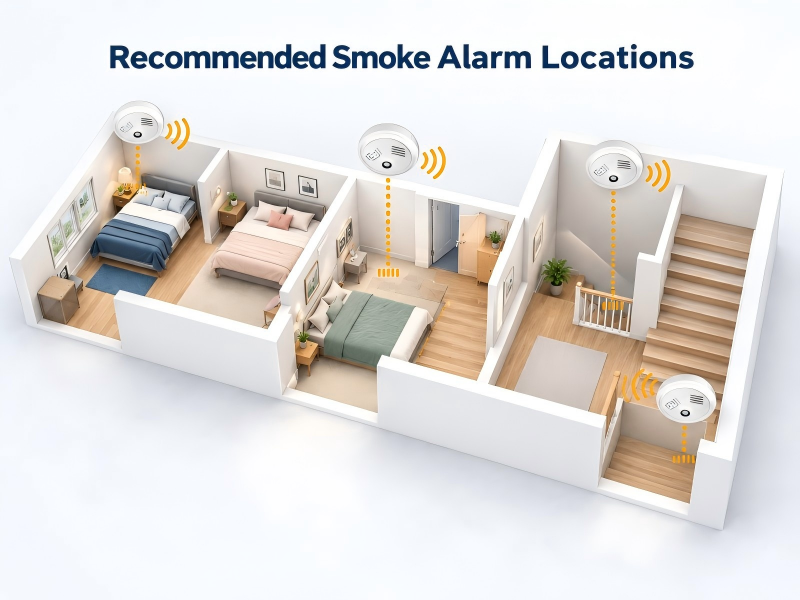
Where practicable, alarms should be mounted on ceilings, away from corners, light fittings, ventilation outlets and ceiling fans at the specified clearances. Installers should calculate quantities from each property layout before quoting retrofit projects.
The Queensland Fire Department FAQ explains device placement, power supply and the acceptable forms of interconnection.
Does a Ten-Year Photoelectric Alarm Automatically Qualify?
No. Queensland Smoke Alarm Laws 2027 involve several requirements that cannot be established from a battery-life statement alone. Consider a standalone photoelectric smoke alarm described in a technical manual reviewed for this article: it has a sealed long-life lithium battery, an approximately 85 dB local piezo alarm, a test button, a hush function and a low-battery audible warning. Its manual describes up to ten years of operation under standby conditions.
These features may be useful, but neither a sound specification nor a battery-life claim establishes AS 3786-2014 compliance. Crucially, a standalone local alarm is not the same as an interconnected system in which all required alarms sound together. A warranty term also differs from the maximum age measured from manufacture.
Before accepting a product for Queensland, request exact-model compliance evidence and demonstrated whole-home interconnection. Resolve any mismatch between manual and sales-model identification first.
Is a 433MHz Wireless Smoke Detector Interconnected?
Not necessarily. Queensland Smoke Alarm Laws 2027 allow wireless interconnection, but the communication method must achieve the required simultaneous response across the dwelling. A 433MHz transmitter might send an event to a compatible panel rather than activate other alarms directly. Matching radio frequency alone does not establish interoperability.
Ask for pairing instructions, peer-to-peer or system interconnection details, compatible devices, radio test results and compliance documentation for the actual configuration. SUMRING explains RF and system compatibility in its 433MHz wireless smoke and heat detector buyer guide. That guide does not certify a product for Queensland.
What Does This Mean for SUMRING’s SR-825PHS?
SUMRING’s earlier 10-year tamper-proof smoke detector article discusses the SR-825PHS as a photoelectric smoke alarm with a sealed 3V lithium power cell. However, the available website information reviewed for this news update does not demonstrate that the exact SR-825PHS model meets AS 3786-2014 or provides the mandated interconnection functionality.
Accordingly, Queensland Smoke Alarm Laws 2027 should not be used to promote the SR-825PHS as a compliant Australian residential alarm without model-specific verification. Distributors should first obtain the current datasheet, model identification, approved technical evidence, supply configuration and confirmed availability. A historical webpage is not compliance evidence.
How Should B2B Buyers Prepare Purchase Specifications?
Procurement teams considering Queensland Smoke Alarm Laws 2027 should provide suppliers with a written, destination-specific requirements sheet instead of asking simply for a “10-year wireless smoke alarm.” Request the following:
- Exact model number and AS 3786-2014 compliance evidence covering the offered configuration.
- Photoelectric detection details and confirmation that the device has no ionisation sensor.
- Demonstrated interconnection method, test procedure and supported device count.
- Non-removable ten-year battery or appropriate hardwired supply, matched to the building.
- Product markings, manufacturing date, user instructions and traceable batch identification.
- Samples, warranty terms, replacement policy, production lead time and shipping plan.
OEM customers must also verify whether branding changes, electronic revisions or alternative enclosures affect certification coverage. SUMRING’s fire alarm products buying guide provides general supplier-evaluation questions for project-based purchasing.
Can SUMRING Support OEM/ODM Discussions for Australia?
SUMRING supports international fire safety equipment sourcing and OEM/ODM cooperation, as described on its manufacturer information page. This experience can support early conversations about photoelectric smoke alarm design, long-life batteries, sample documentation and development requirements.
Development support is not Australian approval. Under Queensland Smoke Alarm Laws 2027, any proposed residential smoke alarm must be evaluated against the exact target standard and installation rules before being advertised for compliant use.
FAQs
1.Does CE or EN14604 Approval Replace AS 3786-2014?
No. Certification or test results for another market may help engineers review a design, but they do not automatically establish conformity to Australia’s required standard.
2.Can a Standalone 10-Year Alarm Be Installed Instead of an Interconnected System?
A standalone alarm cannot by itself meet the whole-home interconnection requirement. Whether a particular product can be part of a compliant arrangement depends on verified technical design and all applicable installation conditions.
3.Do These Rules Apply Throughout Australia?
No. These requirements concern Queensland. Other Australian states and territories have separate fire safety requirements, so importers should identify the destination jurisdiction before finalising a product specification.
What Should Buyers Do Before the Deadline?
The procurement lesson from Queensland Smoke Alarm Laws 2027 is to verify the actual product rather than rely on individual features or broad certifications. Check the intended dwelling, approved interconnection, supply method, standard evidence and installation plan before committing to an order.
For a technical sourcing or development discussion, contact SUMRING with the destination market, relevant standards, preferred power supply, target interconnection method and estimated quantity. SUMRING can discuss OEM/ODM feasibility without representing an unverified existing model as approved for Queensland residential installations.