How to Select an IP67 Protective Cover For Manual Call Points Manufacturer for B2B Projects?
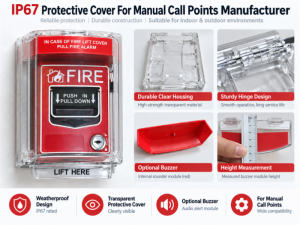
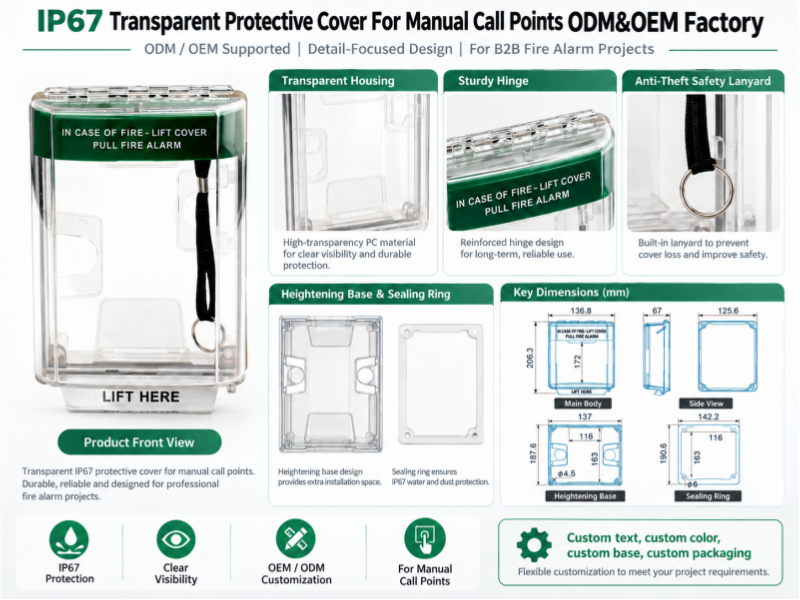
An IP67 Protective Cover For Manual Call Points is a protective enclosure placed around a manual fire alarm call point to reduce exposure to dust, water, accidental contact, and physical damage while keeping the device visible and accessible.
For a B2B buyer, however, choosing the cover itself is only half the job.
The harder question is this: Can the manufacturer supply a cover that actually fits your manual call point, installation method, project environment, and order plan?
That matters when you are buying 500, 5,000, or even more units.
A few millimeters of missing depth may look harmless on a drawing. On site, it can turn into hundreds of covers that cannot close.
So, when choosing an IP67 Protective Cover For Manual Call Points manufacturer, buyers should look beyond unit price. Size, depth, material, IP documentation, buzzer options, mounting base, sample testing, MOQ, and OEM/ODM ability should all be checked before bulk production.
Here is a practical way to do it.
1. Start With Manual Call Point Size—Not the Cover Catalogue
A supplier may say its IP67 Protective Cover For Manual Call Points fits “most standard manual call points.”
That sounds reassuring. It is not enough.
Manual call points from different systems can vary in:
- width;
- height;
- body depth;
- surface back-box depth;
- cable gland position;
- conduit position;
- reset-key access;
- front operating clearance.
Ask the manufacturer for both external dimensions and usable internal dimensions.
Then compare those figures with the installed manual call point, not just the product body.
For procurement teams, a good RFQ should include the MCP model, front photo, side photo, width, height, and total installed projection.
Simple information. Big difference.
2. Depth Is the Measurement Buyers Most Often Miss
Width and height are easy to see.
Depth is where many projects get caught.
A manual call point may have a shallow front body but use a deep surface box behind it. Add a spacer, conduit adapter, waterproof gland, or raised mounting plate, and the total projection changes again.
That is why the manufacturer should ask for wall-to-front projection depth.
Suppose the call point body is 45 mm deep. Add a 35 mm surface box and several millimeters for mounting. A cover selected from the front dimensions alone may no longer fit.
For larger devices, a deeper base may solve the problem.
Sumring’s current product range, for example, separates standard and larger manual call point cover applications rather than assuming one enclosure fits every device.
For B2B projects, that is the safer purchasing mindset: measure first, choose second.
3. Verify the IP67 Rating Instead of Reading the Label
The IP Code is covered by IEC 60529, which classifies degrees of protection provided by electrical enclosures.
So when a supplier advertises an IP67 Protective Cover For Manual Call Points, ask what supports that claim.
Request:
- the test report or relevant documentation;
- the exact tested product model;
- the tested enclosure configuration;
- information about seals and gaskets;
- cable-entry requirements;
- installation instructions that affect sealing.
There is an important distinction here.
An IP67-rated protective cover does not automatically make the complete fire alarm installation IP67. The final result also depends on the enclosed device, mounting surface, cable entry, sealing method, and installation quality.
A reliable manufacturer should explain that clearly rather than simply printing “IP67” in large letters.
4. Ask What Material the Manufacturer Actually Uses
Clear covers are commonly made from engineering plastics, but buyers should not accept vague descriptions such as “strong plastic.”
Ask for the exact material.
For many projects, polycarbonate, or PC, is considered because it can provide good transparency and impact resistance.
But material selection should go further.
Ask about:
- transparency;
- impact resistance;
- outdoor ageing;
- yellowing resistance;
- operating temperature;
- gasket material;
- long-term exposure to the proposed environment.
For outdoor installations, sunlight and temperature cycles matter.
For industrial sites, cleaning agents or chemicals may matter.
For coastal projects, the whole mounting structure and hardware deserve attention too.
A good IP67 Protective Cover For Manual Call Points manufacturer should be able to discuss the application, not merely repeat a material name from a brochure.
5. Decide Whether You Need a Buzzer Version
Some projects only need a physical protective cover.
Others benefit from a local warning when someone lifts the cover.
This is where an optional buzzer becomes useful.
A buzzer version may suit schools, hotels, public buildings, warehouses, transport areas, or other locations where accidental or unauthorized opening is a concern.
Before ordering, confirm:
- whether the buzzer is mechanical or powered;
- operating voltage if power is required;
- current consumption;
- sound level;
- activation method;
- reset method;
- whether the buzzer can be replaced or serviced.
Do not simply ask, “Does it have sound?”
Ask how the sound function works.
That question tells you far more about the manufacturer’s engineering support.
6. Check the Base and Spacer Before Approving Compatibility
The transparent lid gets most of the attention.
The base often decides whether installation succeeds.
An IP67 Protective Cover For Manual Call Points may require a spacer or deeper mounting base when the protected device projects farther from the wall.
The base also affects:
- cable routing;
- screw positions;
- gasket compression;
- total installation depth;
- conduit clearance;
- mounting stability.
If the project uses surface conduit, tell the manufacturer before sample production.
If the project uses several MCP models, do not assume the same base will work for all of them.
For a major project, a customized spacer can sometimes be more sensible than forcing installers to modify hundreds of units on site.
7. Compatibility Should Be Proven, Not Assumed
“Universal” is a useful marketing word.
Engineering teams need stronger evidence.
Before confirming a bulk order, send the manufacturer:
- manual call point brand and model;
- width and height;
- installed depth;
- front and side photos;
- back-box information;
- cable-entry direction;
- installation drawing when available.
Then ask the supplier to confirm the recommended cover model in writing.
For retrofit projects, site photos are especially helpful because nearby doors, pipes, switches, signs, or wall corners can affect lid opening.
A technically capable IP67 Protective Cover For Manual Call Points manufacturer should review these details before production rather than saying, “It should fit.”
“Should” can be an expensive word in a 3,000-piece order.
8. Treat the Sample as an Engineering Approval
For B2B purchasing, a sample is not just something to put on a desk.
Install it.
Open it.
Close it.
Check the manual call point.
Inspect the cable route.
If possible, test it on the actual wall arrangement or a representative installation panel.
During sample approval, verify:
- internal clearance;
- cover opening;
- access to the call point;
- access to reset tools;
- base depth;
- cable routing;
- gasket condition;
- printed wording;
- logo position;
- buzzer operation;
- packaging.
If several manual call point models will be used, test each combination.
Sample verification is one of the cheapest ways to reduce bulk-order risk.
9. Ask About MOQ in Two Different Ways
“What’s your MOQ?”
That question is too broad.
Instead, ask for at least two figures:
Standard-product MOQ:
The minimum quantity for an existing size, standard color, and standard packaging.
Customized MOQ:
The quantity required when changing printing, logo, packaging, color, base structure, dimensions, or tooling.
These numbers may be very different.
A distributor testing a new market may prefer a lower standard MOQ.
An engineering contractor working on a confirmed project may care more about structural customization and delivery schedule.
So the cheapest MOQ is not always the best deal.
The right MOQ is the one that matches your purchasing risk.
10. Separate OEM From Real ODM Capability
OEM and ODM are often placed together on supplier websites, but they are not the same thing.
For an IP67 Protective Cover For Manual Call Points, OEM may include:
- customer logo;
- warning text;
- local language;
- label design;
- color;
- carton marking;
- private packaging.
ODM goes deeper.
It may involve:
- changing enclosure dimensions;
- developing a deeper base;
- moving mounting points;
- changing cable-entry structures;
- adapting the cover to a specific manual call point;
- developing new molds.
If your project requires ODM, ask who handles mechanical drawings, mold review, sample changes, and technical approval.
A factory that can print a logo is not automatically a factory that can redesign an enclosure.
That distinction matters.
A Simple B2B Manufacturer Evaluation Checklist
Before selecting an IP67 Protective Cover For Manual Call Points manufacturer, procurement teams can use this checklist:
| Item | What to Confirm |
|---|---|
| MCP compatibility | Brand, model and installed dimensions |
| Width & height | Internal usable space |
| Depth | MCP + back box + spacer + fittings |
| IP rating | Report, tested model and sealing conditions |
| Material | Exact resin and project suitability |
| Buzzer | Voltage, sound level and activation method |
| Base | Depth, spacer and cable clearance |
| Sample | Real installation verification |
| MOQ | Standard MOQ and customized MOQ |
| OEM | Logo, text, language, color and packaging |
| ODM | Structure, dimensions, mold and engineering support |
| Production | Lead time after final sample approval |
| QC | Incoming, production and final inspection process |
Price still matters, of course.
But for project purchasing, cost per usable installed unit matters more than cost per carton.
A slightly cheaper cover that requires drilling, cutting, spacers, or site modification can quickly become the expensive choice.
FAQ
1. How do I choose an IP67 Protective Cover For Manual Call Points manufacturer?
Check technical compatibility, usable internal dimensions, depth, IP documentation, material, sample support, MOQ, production capability, and OEM/ODM services before comparing price.
2. What dimensions should I send to a manual call point cover manufacturer?
Send the width, height, installed projection depth, back-box depth, front and side photos, cable-entry position, and manual call point model.
3. Is IP67 enough to prove a manual call point cover is suitable for outdoor projects?
No. IP67 is important, but buyers should also check material, UV exposure, mounting, cable sealing, temperature conditions, and the protected device itself.
4. Should B2B buyers test a sample before ordering IP67 manual call point covers in bulk?
Yes. Sample installation helps verify size, depth, lid movement, base fit, sealing, cable routing, printing, and optional buzzer operation before mass production.
5. What is the difference between OEM and ODM manual call point covers?
OEM usually covers branding, text, color, and packaging. ODM may involve new dimensions, bases, mounting structures, cable entries, or mold development.
6. Can one IP67 Protective Cover For Manual Call Points fit every fire alarm brand?
Not necessarily. Manual call points vary in width, height, depth, back boxes, reset access, and conduit arrangements. Each target model should be checked.
7. What MOQ should wholesalers ask an IP67 call point cover factory for?
Ask separately for the standard-product MOQ and customized MOQ. Printing, packaging, structural changes, or new tooling may require different quantities.
8. Why is depth important when selecting a waterproof manual call point cover?
Because the installed depth includes the manual call point, surface box, spacer, cable accessories, and mounting parts. A cover can have enough width and height yet still be too shallow.
Conclusion
Choosing an IP67 Protective Cover For Manual Call Points manufacturer is not simply a search for the lowest unit price.
For wholesalers, contractors, system integrators, and project buyers, the safer process is:
identify the MCP → measure width, height, and installed depth → check the installation environment → review the IP documentation → confirm material and base structure → select buzzer requirements → approve a sample → confirm MOQ → finalize OEM or ODM details → release bulk production.
That sequence sounds a little cautious.
Good.
A B2B fire alarm project is exactly where a little caution can save a lot of rework.
If you are preparing a project RFQ, start with the manual call point model, front and side photos, dimensions, required quantity, destination market, and customization requirements. These six pieces of information give the manufacturer a much better starting point for a technical recommendation and accurate quotation.