What Is an IP67 Weatherproof Manual Call Point Cover and Why Is It Important?
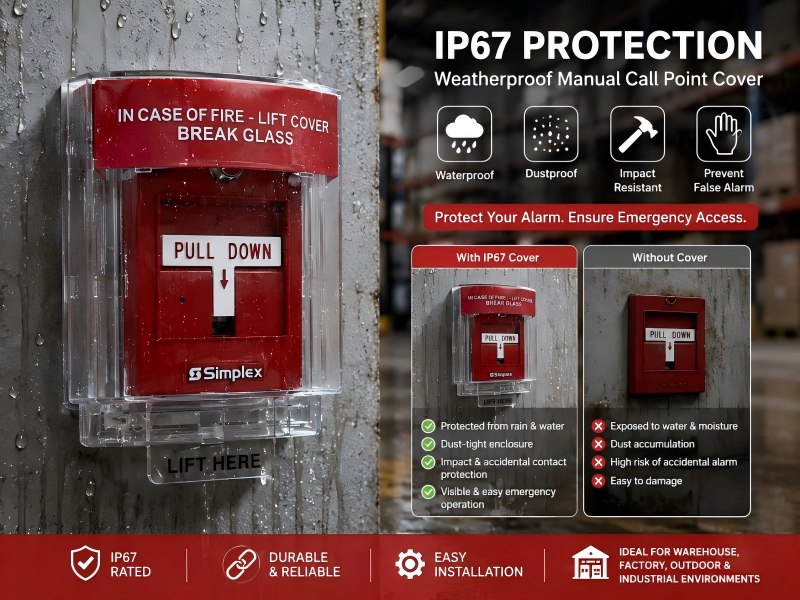
An IP67 Weatherproof Manual Call Point Cover is a protective enclosure installed over a fire alarm manual call point to help shield it from dust, water, accidental contact, physical damage, and unwanted operation while keeping the alarm point visible and accessible.
It sounds like a small fire alarm accessory. In a real project, though, it can solve several very annoying problems.
A manual call point may sit quietly on a wall for years. Yet it must work immediately when someone discovers a fire. Rain, dust, cleaning water, passing equipment, careless contact, and public misuse can all put that simple requirement at risk.
That is why an IP67 Weatherproof Manual Call Point Cover is increasingly considered when engineers plan outdoor, semi-outdoor, industrial, and high-traffic fire alarm installations.
For wholesalers and project contractors, the question is not simply, “Does the cover fit?”
The better question is: Will it keep the manual call point protected without making emergency operation difficult?
What Is an IP67 Weatherproof Manual Call Point Cover?
A manual call point cover is normally a transparent protective housing fitted around a wall-mounted fire alarm activation point.
The transparent structure keeps the alarm device easy to identify. A hinged front lid creates an extra physical barrier against accidental contact. When there is an emergency, the user opens the cover and operates the manual call point.
The cover does not replace the manual call point.
It protects it.
Manual call points play a direct role in raising a fire alarm when someone discovers a fire. UK fire-safety guidance, for example, describes manual call points as devices that allow a person discovering a fire to immediately raise the alarm and warn other occupants.
BS EN 54-11 also specifies requirements and test methods for manual call points used in fire detection and fire alarm systems in and around buildings, including indoor and outdoor conditions.
This outdoor aspect matters.
A normal indoor corridor and an exposed loading dock are two very different places. That little red alarm button may face water, dust, humidity, carts, tools, forklifts, or curious hands every day.
An IP67 Weatherproof Manual Call Point Cover gives the device another layer of environmental and physical protection.
What Does IP67 Actually Mean?
This is where buyers sometimes get mixed up.
The IP Code is defined through IEC 60529, the international standard used to classify degrees of enclosure protection against access, solid objects, dust, and water.
For IP67:
- 6 means the enclosure is dust-tight.
- 7 means it provides protection against temporary immersion in water under defined test conditions.
So an IP67 Weatherproof Manual Call Point Cover is designed for much tougher environmental exposure than a simple indoor plastic guard.
But here’s an important detail.
IP67 does not automatically mean permanent underwater protection. It also does not automatically mean resistance to every high-pressure water jet or cleaning process.
That distinction matters when specifying equipment for factories, washdown zones, tunnels, ports, or other demanding sites.
For project engineers, always confirm the actual enclosure rating, installation method, sealing structure, cable entry, and test documentation instead of relying on the word “waterproof” alone.
Why Is an IP67 Weatherproof Manual Call Point Cover Important?
Manual call points have an unusual job.
They need to be easy for people to reach during an emergency—which also means they are easy to touch, hit, or misuse during normal operation.
That is the contradiction.
An IP67 Weatherproof Manual Call Point Cover helps manage it.
1. It Helps Protect Against Rain and Moisture
Outdoor installations can face rain, wind-driven moisture, condensation, and routine cleaning.
Even in a semi-covered parking area, water can travel farther than expected. Anyone who has inspected equipment after a strong storm knows this.
A weatherproof cover creates an additional barrier around the alarm point and helps reduce direct environmental exposure.
This makes the IP67 Weatherproof Manual Call Point Cover particularly useful for outdoor walls, parking facilities, industrial buildings, loading zones, and partially exposed corridors.
2. It Keeps Dust Away From the Protected Area
Dust looks harmless until it becomes a maintenance problem.
Factories, warehouses, workshops, construction areas, and logistics facilities can generate airborne particles continuously. Over time, dust collects around devices, seams, labels, and moving parts.
Because IP6X indicates dust-tight enclosure protection, an IP67-rated housing is designed for environments where dust control matters.
For engineers managing dozens—or hundreds—of manual alarm points, reducing exposure can make routine maintenance much easier.
3. It Helps Reduce Accidental Activation
Picture a warehouse corridor.
A trolley passes close to the wall. A carton swings sideways. Someone carries a long ladder. A cleaning machine brushes past.
None of these events involve a fire, yet an exposed manual call point can still be accidentally hit.
An IP67 Weatherproof Manual Call Point Cover places a transparent physical barrier in front of the device. The user must lift the cover before operating the alarm point.
That extra movement is simple, but useful.
It helps distinguish intentional emergency operation from casual contact.
4. It Adds Physical Protection
Water is only half the story.
Manual call points in factories, schools, parking areas, public buildings, and logistics sites are also vulnerable to bumps and knocks.
A durable protective enclosure can reduce direct impact on the alarm device itself.
Think of it like a protective phone case. The case does not make the phone more intelligent; it simply handles some of the abuse before the phone has to.
The same principle applies here.
5. It Can Reduce Unnecessary Maintenance
A damaged or repeatedly activated manual call point creates more than a replacement cost.
Someone may need to inspect the alarm system, investigate the event, reset equipment, test the circuit, replace parts, and document the work.
For a single device, that might seem manageable.
Across a large commercial or industrial site? It adds up rather quickly.
A correctly selected IP67 Weatherproof Manual Call Point Cover can help protect the equipment investment and reduce avoidable maintenance caused by environmental exposure or accidental contact.
Where Should an IP67 Weatherproof Manual Call Point Cover Be Used?
Not every manual call point needs IP67 protection.
A clean office corridor with controlled temperature and little public contact may only require a simpler solution.
So where does IP67 make more sense?
Common applications include:
- Outdoor fire alarm stations
- Factories and manufacturing plants
- Warehouses and logistics centers
- Underground and multi-storey parking areas
- Loading bays
- Commercial building entrances
- Public transportation facilities
- Schools and public-access buildings
- Coastal or humid environments
- Industrial corridors
- Outdoor plant rooms
- Utility and service areas
The environment should drive the choice.
For example, a manual call point near a warehouse exit may be protected from direct rain but still face dust and vehicle movement. A parking garage may have humidity, vehicle exhaust, cleaning water, and frequent public access.
That is exactly where an IP67 Weatherproof Manual Call Point Cover starts earning its keep.
For more application guidance, see Where to Install an IP67 Manual Call Point Cover.
How Do You Choose the Right Cover?
Here is where B2B buyers should be careful.
“IP67” alone is not enough.
A cover can have the right environmental concept and still be wrong for the project because the dimensions, opening direction, mounting base, conduit position, or manual call point depth do not match.
Before purchasing an IP67 Weatherproof Manual Call Point Cover, check several points.
Measure Width, Height, and Depth
Do not measure only the front face of the manual call point.
Measure:
- Device width
- Device height
- Projection from the wall
- Back box depth
- Cable or conduit position
- Space required for the cover to open
Depth is especially easy to miss.
A call point may look small from the front but project much farther from the wall once its back box and wiring accessories are installed.
You can also refer to IP67 Protective Manual Call Point Cover Sizing Guide before confirming a project size.
Check Visibility
Emergency equipment should not become visually confusing.
A transparent cover allows occupants to identify the manual call point behind it. Labels and markings should also remain clear.
Simple? Yes.
Important? Absolutely.
Check Emergency Access
Protection should never turn an emergency alarm point into a locked puzzle.
The lid should open in a clear and predictable way, with enough surrounding space for the user to reach the manual call point.
Check the Installation Environment
Ask what the site really looks like.
Is it outdoors?
Is it dusty?
Will the wall be washed?
Is the project close to the coast?
Could forklifts or carts pass nearby?
Will the cover be exposed to direct sunlight?
These questions are more useful than simply asking for “a waterproof cover.”
IP67 Weatherproof Cover vs. Standard Indoor Cover
A standard protective cover may be perfectly suitable for many dry indoor locations.
The IP67 Weatherproof Manual Call Point Cover serves a different need.
Its main advantage is stronger enclosure protection for harsh environments.
| Feature | Standard Indoor Cover | IP67 Weatherproof Cover |
|---|---|---|
| Accidental contact protection | Yes | Yes |
| Device visibility | Usually | Usually |
| Dust protection | Limited by design | Stronger IP-rated protection |
| Water protection | Limited | IP67-rated protection |
| Outdoor suitability | Depends on model | Better suited to harsh exposure |
| Industrial application | Limited in some sites | More suitable for demanding sites |
The point is not that IP67 is always better.
It is better when the environment requires it.
Specifying IP67 everywhere can add unnecessary cost. Using a light indoor cover in a harsh outdoor site can create the opposite problem.
Good project selection sits somewhere between those two extremes.
What Should Wholesalers and Engineering Contractors Confirm?
For B2B purchasing, technical compatibility often matters more than appearance.
Before placing a bulk order for an IP67 Weatherproof Manual Call Point Cover, confirm:
- Internal usable dimensions
- Overall external dimensions
- Protected device dimensions
- Wall projection depth
- Material and transparency
- IP rating documentation
- Mounting method
- Cable entry requirements
- Opening direction
- Optional warning sounder requirements
- Packaging for project delivery
- Logo or text requirements
- OEM/ODM requirements
- Sample approval before mass production
This is especially important when one project uses several different manual call point models.
One cover size may not fit everything.
For custom fire alarm projects, supplying the manual call point drawing or an actual sample can remove a lot of guesswork before tooling or bulk production begins.
So, Is an IP67 Weatherproof Manual Call Point Cover Worth It?
For the right environment, yes.
It is a relatively simple component, but it solves several practical problems at once: environmental exposure, accidental contact, physical damage, and unnecessary maintenance.
More importantly, it protects the manual call point while keeping the device visible and available for emergency use.
That balance is the whole point.
For wholesalers, fire alarm contractors, and system integrators, the IP67 Weatherproof Manual Call Point Cover should therefore be treated as part of project protection planning—not merely as a plastic accessory added at the last minute.
A small cover can save a surprisingly large headache.
FAQ
1. What is an IP67 Weatherproof Manual Call Point Cover?
An IP67 Weatherproof Manual Call Point Cover is a protective enclosure fitted over a fire alarm manual call point to help protect it from dust, water, accidental operation, impact, and harsh environmental exposure.
2. What does IP67 mean on a manual call point cover?
IP67 means the enclosure is dust-tight and protected against temporary water immersion under defined test conditions. It does not mean the cover is designed for permanent underwater installation.
3. Can an IP67 manual call point cover be used outdoors?
Yes. An IP67 Weatherproof Manual Call Point Cover is commonly considered for outdoor and semi-outdoor fire alarm installations where rain, dust, humidity, or other environmental conditions are present.
4. Does a weatherproof cover prevent people from using the fire alarm?
A correctly designed cover should protect the manual call point without blocking emergency access. Users can open the transparent cover and operate the alarm point when required.
5. Can an IP67 manual call point cover help reduce false alarms?
It can help reduce accidental activation by creating an extra physical barrier between passing people or equipment and the manual call point.
6. How do I choose the correct IP67 manual call point cover size?
Measure the manual call point’s width, height, total wall projection, back box, cable entry, and required opening clearance. Checking only the front dimensions may result in a cover that is too shallow.
7. Is an IP67 weatherproof cover suitable for every manual call point?
Not automatically. Compatibility depends on device dimensions, mounting style, depth, cable routing, opening space, and project requirements. Samples or technical drawings should be checked before bulk purchasing.
8. Can IP67 manual call point covers be customized for OEM or ODM projects?
Yes, depending on the manufacturer. B2B projects may require customized dimensions, markings, colors, mounting structures, packaging, or other features to match specific manual call points and installation requirements.