Where Should You Install an IP67 Manual Call Point Cover?
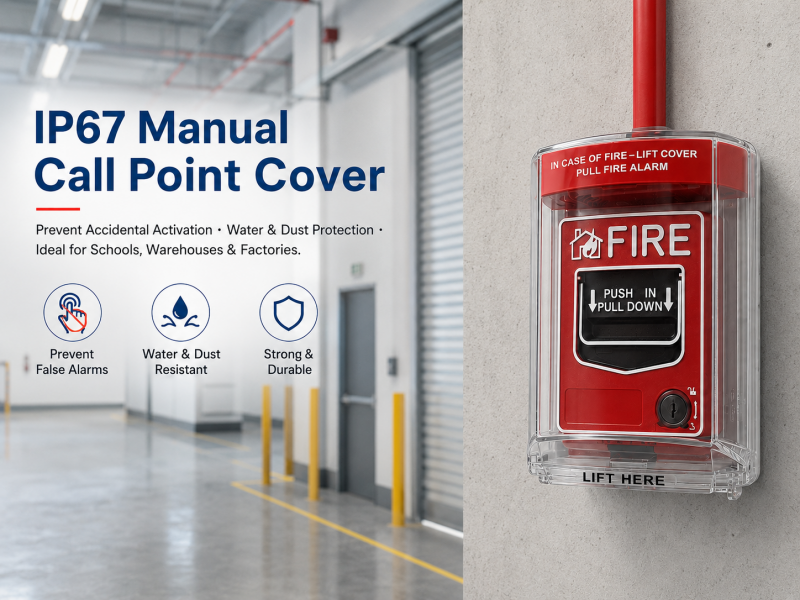
A manual call point cover is a protective enclosure installed over a fire alarm manual call point to help prevent accidental impact, dust, water ingress, and unwanted activation while keeping the alarm button visible and accessible.
So, where should you install an IP67 manual call point cover? The simple answer is this: install it wherever a manual call point needs extra protection but must still be easy to find, reach, and operate during an emergency.
Sounds simple, right? Well, not always.
For B2B wholesalers, fire system contractors, and project buyers, the real question is not only “Can this cover protect the call point?” It is also “Will this cover support a safer, cleaner, more reliable fire alarm layout for the whole site?”
Let’s break it down in a practical way.
First Things First: Don’t Hide the Alarm
The cover protects the manual call point. It must never turn the device into a puzzle.
Manual call points are meant for fast human action. In UK guidance for non-residential premises, manual call points are normally positioned at exit doors, should be conspicuous, and should be no higher than 1.4 m from the floor; occupants should not need to travel more than 45 m to reach one. The same guidance also notes that hinged covers can help deter malicious operation or accidental damage in public access areas.
That gives us the key idea: visibility comes first, protection comes second, and both must work together.
An IP67 manual call point cover is not there to make the call point harder to use. It is there to keep the call point ready for the one moment when someone really needs it.
Near Emergency Exits — The Classic Spot Still Works
The most common installation point is near an emergency exit, final exit, or storey exit.
Why? Because people naturally move toward exits during evacuation. If someone sees smoke, flame, or danger while leaving, the call point is already on the route. No guessing. No backtracking. No “Where’s the alarm button?”
For many commercial and public buildings, this is the safest and most familiar layout. Fire alarm guidance linked to BS 5839 says manual call points should be located on escape routes, especially at storey exits and exits to open air that lead to a place of safety. It also states that no one should normally travel more than 45 m to reach the nearest manual call point.
For contractors, this means the cover should be placed over call points at these high-use locations:
- Final exit doors
- Staircase exits
- Lobby exits
- Corridor-to-exit routes
- Warehouse pedestrian exits
- Plant room exits
- Public entrance and exit zones
The small detail? The cover should not clash with door swing, signage, handrails, access control devices, or evacuation lighting. A neat installation looks simple, but it saves trouble later.
Outdoor Walls and Semi-Outdoor Areas Need IP67 Protection
Here is where an IP67 manual call point cover earns its keep.
Outdoor manual call points face rain, wind, dust, hose-down cleaning, insects, sunlight, and sometimes salty air. A basic indoor cover may look fine on day one, but after a few months outside? Not so charming.
Use an IP67 manual call point cover in outdoor or semi-outdoor areas such as:
- Loading bays
- Factory exterior walls
- Car parks
- Construction sites
- Open-air warehouses
- Chemical storage zones
- Marina and coastal buildings
- Outdoor equipment rooms
- Utility corridors
- Campus walkways
IP67 means the enclosure is designed for strong dust resistance and water protection under defined test conditions. In plain English, it helps the call point stay cleaner and safer in rougher places.
You know what’s funny? Many project problems do not come from the fire alarm button itself. They come from the environment around it: rainwater entering the housing, dust building up, people bumping carts into the wall, or cleaners spraying water near the device. The cover becomes a small shield with a big job.
Public Access Areas: Protect Against Accidental or Malicious Activation
Shopping malls, schools, hospitals, hotels, airports, metro stations, sports venues, and office lobbies all have one thing in common: lots of people, lots of movement, and not always lots of caution.
In these areas, accidental activation happens more often than project owners like to admit. Bags hit the wall. Children press things. Trolleys scrape corners. Someone leans on the call point by mistake. And yes, sometimes people do silly things just because the button is red and tempting.
A Fire Industry Association guidance document notes that fitting a protective cover on a call point was linked to a 16% reduction in false alarms in the Scottish False Alarm Report. It also explains that a hinged cover fitted to a Type A manual call point is not considered to conflict with BS 5839-1:2017 Clause 20 recommendations.
For B2B buyers, that matters. False alarms cost time, staff attention, tenant trust, and sometimes emergency service call-out fees. A cover is not a glamorous product, but it can quietly reduce headaches.
High-Risk Areas:
Some areas deserve extra attention.
Think of boiler rooms, generator rooms, commercial kitchens, battery rooms, workshops, gas storage areas, and machine rooms. These spaces may have higher fire risk, more heat, more vibration, more dust, or more maintenance activity.
Guidance from the Scottish Government notes that where high-hazard equipment or activity exists, placing a call point close by may be desirable so early warning can be given.
An IP67 manual call point cover is useful here because the call point may be exposed to impact, moisture, fumes, or cleaning routines. Still, don’t place it so close to the hazard that a person must move toward danger to activate it. That’s a bad trade.
A better rule is this: install it near the exit from the risk area, not deep inside the danger zone. That way, a worker can activate the alarm while moving away from the hazard.
Industrial Sites:
Factories and warehouses are not quiet little offices. They have forklifts, pallets, ladders, pipes, metal racks, dust, and busy people trying to hit delivery deadlines.
So, for industrial installation, ask a few blunt questions:
Can a forklift hit this call point?
Can stacked cartons block it?
Will workers see it from the main aisle?
Will water spray or dust reach it?
Can someone activate it while wearing gloves?
If the answer feels messy, adjust the position before installation.
For industrial contractors, the sweet spot is usually a visible wall area near an exit route, away from direct vehicle impact, but close enough for fast access. Add signage if needed. Keep the floor area clear. And please, don’t install it behind a rolling shutter rail, a pipe cluster, or a “temporary” stack of goods that somehow becomes permanent.
Schools and Hospitals:
In schools, hospitals, care homes, and public buildings, accessibility matters. Fire alarm devices should be easy to reach for the people expected to use them. NFPA guidance for manual fire alarm pull station height states that the operable part should be mounted between 42 inches and 48 inches above the finished floor.
UK-style guidance often refers to around 1.4 m above floor level, with lower placement considered where wheelchair users may need access.
For project work, this means the cover should not add awkward depth, stiffness, or confusing operation. If a hinged cover is used, it should open smoothly and clearly. In a real emergency, nobody wants to read a mini instruction manual on the wall.
Places You Should Avoid — Yes, Even If the Wall Looks Nice
Some locations look tidy on a drawing but fail in real life.
Avoid placing an IP67 manual call point cover in these spots:
- Behind doors that may stay open
- Behind curtains, shelves, displays, or racks
- Too close to corners where people cannot see it
- Above equipment that blocks access
- Beside doors that do not lead to safe escape routes
- In areas where heavy vehicles can strike it
- On unstable panels or weak wall surfaces
- In places exposed to chemicals beyond the cover’s material limits
One small contradiction here: sometimes a less “pretty” wall is the better installation wall. Fire safety is not interior decoration. A visible, reachable, well-protected call point beats a hidden, elegant one every time.
For B2B Buyers: Match the Cover to the Site, Not Just the Price
For wholesalers and engineering contractors, product matching matters. A low-cost indoor cover may work in a clean office corridor, but it may fail fast in a port warehouse, underground parking area, or outdoor plant room.
When buying an IP67 manual call point cover, check:
- IP rating for dust and water resistance
- PC material strength and impact resistance
- UV resistance for outdoor projects
- Compatibility with common manual call point sizes
- Clear visibility of the alarm button
- Easy opening during emergency use
- Alarm buzzer version if local alert is required
- OEM/ODM support for language, logo, color, and label needs
This is where Sumring can support B2B customers with project-friendly manual call point cover solutions for outdoor, industrial, school, hospital, commercial, and public safety applications. For distributors and contractors, a stable supply chain and clear model matching can save far more than a few cents on unit price.
FAQ:
1. Where is the best place to install an IP67 manual call point cover?
The best place to install an IP67 manual call point cover is near emergency exits, along escape routes, and in outdoor or harsh areas where the manual call point needs dust, water, or impact protection.
2. Can an IP67 manual call point cover be used outdoors?
Yes. An IP67 manual call point cover is suitable for many outdoor and semi-outdoor fire alarm projects, such as loading bays, car parks, factory walls, and open-air corridors.
3. Should a manual call point cover be installed near every exit?
In many fire alarm layouts, manual call points are placed near storey exits and final exits. If those call points face impact, weather, or unwanted activation, adding a protective cover is a smart choice.
4. Will a manual call point cover delay emergency activation?
A properly selected cover should not create serious delay. It should open clearly and allow fast access to the alarm button while reducing accidental or malicious activation.
5. What height should a manual call point cover be installed at?
The cover should match the approved manual call point mounting height for the project region. Common guidance includes around 1.4 m in UK-style layouts or 42–48 inches for the operable part under NFPA guidance.
6. Is an IP67 manual call point cover useful in warehouses?
Yes. Warehouses often have dust, forklifts, pallet movement, and cleaning activity. An IP67 manual call point cover helps protect the call point while keeping it visible on the escape route.
7. Can a manual call point cover reduce false alarms?
Yes, a hinged protective cover can help reduce accidental or unwanted activation in public access areas, schools, hospitals, shopping malls, and transport buildings.
8. What should B2B buyers check before ordering manual call point covers?
B2B buyers should check IP rating, material strength, UV resistance, call point size compatibility, visibility, opening method, buzzer needs, packaging, and OEM/ODM support for project or wholesale supply.
Conclusion
For B2B wholesalers and engineering contractors, the cover is not just a plastic box over a red button. It is part of the fire alarm system’s daily reliability. And when an emergency happens, reliable is exactly what everyone hopes for.