When Do You Need a Manual Call Point Cover with Alarm?
A manual call point cover with alarm is a protective accessory installed over a manual fire alarm call point to reduce accidental or malicious activation while keeping the emergency button visible and accessible.
A manual call point cover with alarm becomes necessary when a fire alarm button is exposed to false triggering, public misuse, impact damage, harsh weather, or high-traffic contact. For schools, hospitals, factories, shopping malls, warehouses, hotels, and outdoor sites, it helps protect the manual call point without removing its emergency function. In B2B fire safety projects, the real value is not only device protection, but also fewer false alarms, easier maintenance, better site management, and a more reliable fire alarm system.
Why Manual Call Points Need Extra Protection?
Manual call points are designed for quick human activation during a fire emergency. That is exactly why they are usually installed in visible and reachable positions. However, this also makes them vulnerable.
In public areas, someone may press the call point by mistake. In schools or transport stations, misuse can happen. In warehouses or factories, trolleys, forklifts, tools, or cleaning equipment may hit the device. In outdoor or semi-outdoor locations, rain, dust, moisture, and UV exposure can shorten the service life of the call point.
A protective cover creates a simple barrier. When the cover includes a local alarm, it adds one more layer of warning before the fire alarm system is activated. The user must lift the cover first, and the cover alarm can discourage casual tampering.
For UK-style fire alarm design, BS 5839-1:2017 is widely referenced for recommending protective covers on manual call points to reduce false alarms. EN 54-11 is also commonly associated with manual call points used in fire detection and fire alarm systems.
When Is a Manual Call Point Cover with Alarm Necessary?
A manual call point cover with alarm is especially useful in places where false alarms are likely to cause disruption, cost, or safety risks. It is not only for “dangerous” environments. It is often needed in ordinary buildings where people move frequently.
1. High-Traffic Public Areas
Shopping malls, airports, schools, hospitals, office buildings, exhibition halls, and railway stations usually have many people passing by. Manual call points installed near corridors, exits, stairwells, and reception areas are easy to touch by accident.
In these areas, a manual call point cover with alarm can reduce unnecessary activations. The transparent cover keeps the call point visible, while the built-in alarm reminds the user that lifting the cover is a serious action.
2. Schools and Universities
Schools are one of the most common places for manual call point misuse. Students may press the alarm out of curiosity, mischief, or misunderstanding. Even one false alarm can interrupt classes, waste emergency resources, and reduce trust in the alarm system.
Installing a manual call point cover with alarm helps prevent casual activation. It does not block emergency use, but it creates a clear warning step before operation.
3. Warehouses and Industrial Sites
In warehouses, logistics centers, factories, and workshops, impact damage is a bigger concern. Manual call points may be installed near loading areas, production lines, storage racks, or machinery routes. Equipment movement can accidentally hit the device.
A strong protective cover can help reduce breakage, dust exposure, and accidental pressing. For industrial buyers, this means lower replacement costs, fewer maintenance calls, and better long-term system stability.
4. Outdoor and Semi-Outdoor Locations
Outdoor manual call points face rain, dust, sunlight, temperature changes, and sometimes corrosive air. For parking areas, construction sites, coastal facilities, utility rooms, outdoor corridors, and factory gates, weather resistance becomes important.
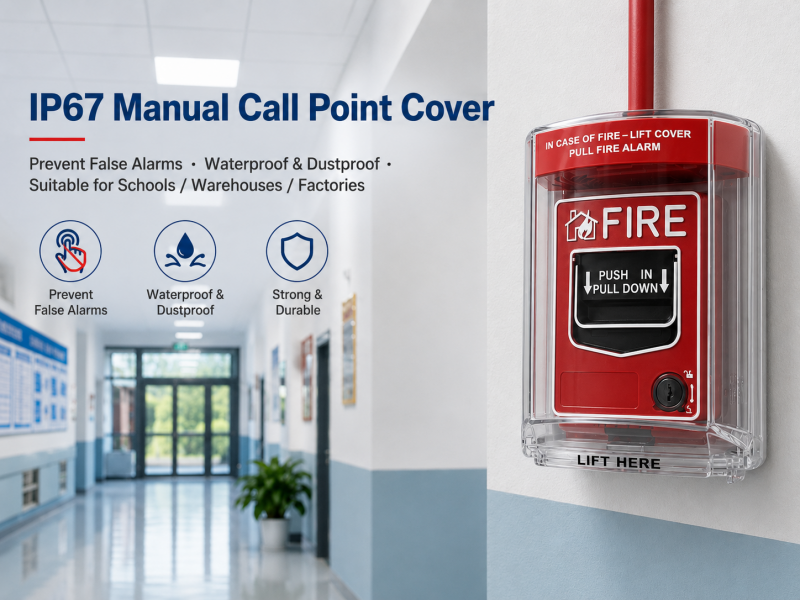
In these environments, buyers should consider an IP-rated protective cover. An IP67 manual call point cover, for example, is designed for stronger dust and water protection, but the exact rating and test documentation should always be confirmed with the supplier before project use.
5. Hotels, Apartments, and Commercial Buildings
Hotels and apartment buildings need a balance between accessibility and control. Manual call points must be easy to identify in an emergency, but false alarms can disturb guests, damage brand trust, and create evacuation fatigue.
A manual call point cover with alarm can be used in corridors, lobbies, parking levels, service areas, and shared facilities. It is a practical solution for property managers who need daily reliability, not just basic compliance.
Alarm Cover vs Standard Cover: Which One Should You Choose?
A standard cover mainly provides physical protection. A cover with alarm adds a local sound warning when the cover is lifted. The second option is more suitable for public areas, schools, commercial buildings, and places with a history of false alarms.
For low-risk technical rooms, a standard transparent cover may be enough. For open-access areas, a manual call point cover with alarm usually provides better deterrence. Some building codes or authorities may require specific approval for local-alarm covers, so project teams should always follow local fire regulations and authority requirements. For example, New York City code allows authorities to require listed protective covers in certain cases and notes approval requirements for local-alarm covers.
Key Buying Factors for B2B Projects:
For distributors, contractors, fire alarm installers, and project buyers, price is only one part of the decision. A reliable manual call point cover with alarm should be evaluated from the full project lifecycle.
First, check material quality. High-strength PC material is commonly used because it offers good impact resistance and visibility. For outdoor use, UV resistance and anti-yellowing performance are also important.
Second, confirm compatibility. The cover should fit the manual call point size, mounting depth, reset method, and wall installation structure. If your project uses different brands of call points, ask whether customization or adapter options are available.
Third, review alarm performance. Sound level, battery type, reset method, standby current, and alarm trigger design all affect long-term use. A loud alarm is helpful, but it should match the environment.
Fourth, consider certification and documentation. Do not assume one certificate covers every project. Buyers should request datasheets, test reports, declaration documents, and applicable certifications such as CE or RoHS where relevant. For fire alarm system projects, compatibility with local standards should be checked by the contractor or fire consultant.
Fifth, evaluate supply stability. For B2B orders, delivery time, sample support, packaging, OEM/ODM customization, after-sales service, and long-term model availability matter. A low-cost product that changes frequently can create problems for repeat projects.
Common Application Scenarios
A manual call point cover with alarm is often used in:
Schools and campuses where misuse is common;
Hospitals where false evacuation creates serious disruption;
Shopping malls and supermarkets with heavy foot traffic;
Factories and warehouses with equipment impact risks;
Hotels, apartments, and office buildings requiring stable daily operation;
Outdoor corridors, parking areas, and utility sites exposed to weather;
Transportation hubs where public access is difficult to control;
In these projects, the cover acts as a small but valuable part of the full fire safety system.
FAQ:
1. What is a manual call point cover with alarm?
A manual call point cover with alarm is a protective cover installed over a manual fire alarm call point. When the cover is lifted, it can emit a local warning sound to discourage misuse.
2. Does the cover stop people from using the call point in an emergency?
No. A properly designed cover should protect the call point while still allowing quick emergency access. Users can lift the cover and operate the call point when needed.
3. Where is a call point cover with alarm most useful?
It is most useful in schools, hospitals, shopping malls, warehouses, factories, hotels, apartments, public buildings, and outdoor areas with high false alarm or damage risk.
4. Is an alarm cover better than a normal transparent cover?
It depends on the site. A normal cover offers physical protection. An alarm cover adds a sound warning, making it better for public or high-risk areas.
5. Should outdoor manual call points use IP-rated covers?
Yes, outdoor or semi-outdoor installations should consider IP-rated covers. The suitable IP rating depends on rain, dust, humidity, and installation exposure.
6. Can a manual call point cover with alarm reduce false alarms?
Yes. It can reduce accidental and casual activation by adding a visible and audible warning step before the call point is pressed.
7. What should B2B buyers check before ordering?
Buyers should check size compatibility, material, alarm volume, battery design, IP rating, reset method, certification documents, packaging, lead time, and OEM/ODM support.
8. Can the cover be customized for projects?
Many suppliers can support customization such as logo printing, color options, language labels, packaging, and size adjustments. Buyers should confirm MOQ and lead time before placing project orders.
Conclusion:
A manual call point cover with alarm is necessary when a manual fire alarm call point needs protection from accidental activation, misuse, impact, dust, moisture, or harsh outdoor conditions. It is most valuable in public, commercial, industrial, educational, and outdoor environments where false alarms can create real cost and operational problems.
For B2B buyers, the best choice should match the project environment, call point size, alarm requirement, IP rating, material quality, certification needs, and long-term supply plan. A good cover does not slow down emergency response. It helps make the fire alarm system more stable, more professional, and easier to manage.