How Does the SR-912W Smart WiFi Gas Detector Work?
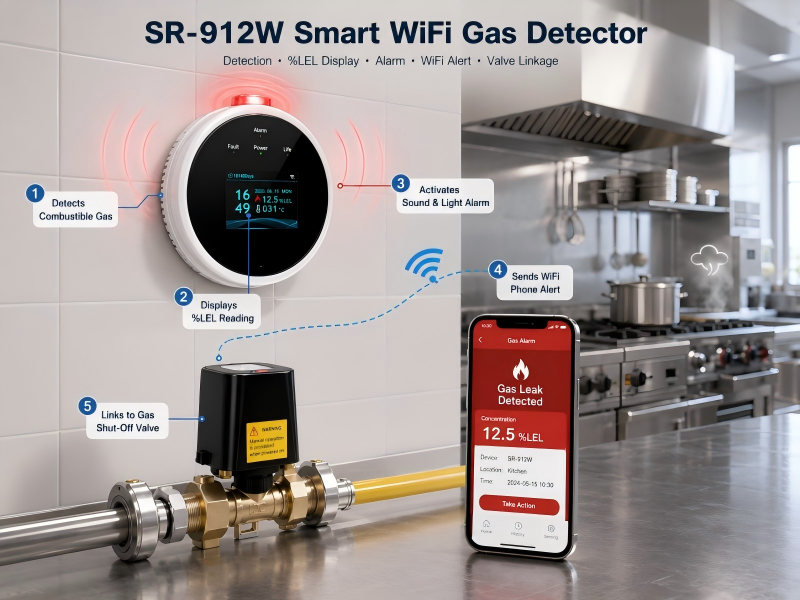
The SR-912W Smart WiFi Gas Detector is a smart combustible gas detection device that continuously monitors gas concentration, displays %LEL readings, provides local sound and light alarms, sends WiFi app notifications, and can support gas shut-off valve linkage for safer gas monitoring in commercial and residential applications.
For distributors, system integrators, property projects, and OEM buyers, the interesting part is not simply that the alarm “beeps.”
The real question is: what happens between the first trace of abnormal gas and the final alarm action?
Here’s how the system works.
First, What Does the SR-912W Smart WiFi Gas Detector Actually Do?
The SR-912W Smart WiFi Gas Detector continuously monitors the surrounding air for the combustible gas type specified for the detector.
Its basic operating chain is fairly simple:
Gas sensing → signal processing → concentration display → alarm decision → local warning → WiFi notification → optional linked action
Think of it like a small safety guard that never needs coffee.
During normal operation, the sensing component continuously checks the air. The internal electronic circuit processes the sensor response and converts it into information that the detector can display and evaluate.
If the detected concentration reaches the configured alarm condition, the detector can move from monitoring mode into warning mode.
That is where several actions can happen almost together.
How Does the SR-912W Detect a Gas Leak?
Inside the SR-912W Smart WiFi Gas Detector is a gas-sensing system designed to react when the target combustible gas appears in the surrounding air.
Rather than guessing whether a room “smells like gas,” the detector monitors changes detected by its sensing element.
The electronic circuit then processes that response and compares it with the alarm logic programmed into the unit.
There are three basic stages:
- Normal monitoring: gas remains below the alarm condition.
- Increasing concentration: the detector recognizes a change and updates its reading.
- Alarm condition: the detector activates its configured warning functions.
One important point for engineering buyers: gas type matters.
Methane, natural gas, LPG, propane, and other combustible gases do not behave exactly the same way. Detector configuration and installation position should therefore match the target gas and the product specification for the project.
That small detail can make a big difference.
What Does 0–100% LEL Mean?
The SR-912W Smart WiFi Gas Detector displays combustible gas concentration using %LEL, with a display range of 0–100% LEL.
LEL means Lower Explosive Limit.
In plain English, it refers to the minimum concentration at which a combustible gas mixed with air can become capable of ignition under the right conditions. Gas detectors commonly use %LEL because it gives users a practical way to understand how a measured concentration relates to a combustible range.
There is an important distinction here:
10% LEL does not mean the room contains 10% gas by volume.
It means the measured concentration represents 10% of that gas’s lower explosive limit.
For example, methane has an LEL of roughly 5% by volume in air.
That is why installers and end users should read %LEL as a safety-related measurement rather than treating it like a normal percentage display.
The TFT screen makes this information easier to check directly at the installation point.
The Alarm Is Local First — and That Matters
WiFi is useful. A mobile app is useful.
But a gas detector should not depend only on someone checking a phone.
When the SR-912W Smart WiFi Gas Detector enters an alarm state, its local warning functions can provide an immediate indication near the hazard area through sound, light, and voice alerts.
This layered warning approach is useful because people respond differently.
Someone may hear the audible alarm first. Another person may notice the visual indicator. A voice message can make the warning easier to understand than a simple tone.
The result is a more direct user experience: something is wrong, and attention is required.
For hotels, apartments, restaurants, kitchens, utility rooms, and similar projects, that immediate local warning is often just as important as remote monitoring.
Then WiFi Adds Remote Awareness
Here is where the “smart” part becomes useful.
The SR-912W Smart WiFi Gas Detector supports Tuya-based WiFi connectivity. Once the unit is properly connected to the supported app and network, gas alarm information can be sent to a mobile device.
Tuya’s smart sensor platform supports real-time gas concentration information, over-limit alarms, and connected-device actions. Its device messaging system can also deliver app notifications through the phone’s operating system.
So imagine a small restaurant after closing.
No staff member is standing beside the detector. A gas-related alarm occurs. The detector sounds locally, but a connected notification can also reach authorized personnel remotely.
That’s the real advantage of adding WiFi: distance no longer automatically means silence.
Of course, mobile notifications depend on factors such as network connection, app settings, cloud service availability, and phone notification permissions. The local alarm should therefore remain the primary immediate warning.
Learn how the SR-912W Smart WiFi Gas Detector detects gas leaks, shows %LEL, sends Tuya alerts, and supports device linkage.
How Does Valve or Mechanical-Arm Linkage Work?
The SR-912W Smart WiFi Gas Detector can also support linked safety equipment, depending on the project configuration.
A typical setup may include:
Gas detector → alarm signal → linked valve or mechanical shut-off device
Why is this useful?
Detection tells people that a problem exists. Linkage can help the wider system respond to that problem.
For example, a compatible actuator may be configured to help shut a gas supply after an alarm signal is generated.
That turns the smart WiFi gas detector from a stand-alone warning device into part of a broader gas safety system.
However, engineers should verify the voltage, interface type, wiring method, actuator compatibility, local regulations, and project design before connecting external equipment.
Never assume two devices work together simply because both mention “valve control.”
What Happens During a Gas Leak? A Simple Example
Picture a commercial kitchen during a quiet period.
A small gas leak begins near the supply equipment.
The SR-912W Smart WiFi Gas Detector is already monitoring the surrounding air.
As the target gas concentration changes, the sensing system responds. The internal electronics process the signal, and the concentration information is shown on the TFT display.
If the programmed alarm condition is reached, the detector can activate its local sound-light and voice warning.
With WiFi connected, an alarm message can also be pushed through the Tuya-based app.
If the project includes a correctly configured compatible shut-off device, the system may also trigger that linked equipment.
So one gas event can produce several layers of response:
Detect. Display. Warn. Notify. Link.
Simple idea, but quite useful in a real building.
Does WiFi Replace a Conventional Gas Alarm?
This is a common misunderstanding.
The WiFi function of the SR-912W Smart WiFi Gas Detector adds remote monitoring and smart-device communication. It does not make the physical detector, correct installation position, or local audible alarm less important.
If the router goes offline, a phone loses internet access, or notifications are disabled, relying only on an app would create an obvious weakness.
A stronger design keeps local detection and warning at the center while treating WiFi as an additional communication layer.
That’s especially relevant for engineering projects.
Smart features are useful. Basic safety functions still have to do the heavy lifting.
Where Should the SR-912W Smart WiFi Gas Detector Be Installed?
Installation position depends on the target combustible gas.
Natural gas and methane tend to rise, while gases such as LPG are heavier than air and tend to collect lower in a room.
That does not mean every detector should automatically be mounted at one generic height.
The installer should confirm:
- target gas type;
- detector specification;
- room layout;
- possible leak sources;
- ventilation and airflow;
- local gas safety requirements;
- manufacturer installation instructions.
Avoid treating installation as an afterthought. A good detector mounted in the wrong location can give a project team a false sense of confidence.
Why Does the SR-912W Matter for B2B Buyers?
For wholesalers and engineering contractors, product selection is rarely about one specification.
You need to think about the whole application.
The SR-912W Smart WiFi Gas Detector combines several functions that can simplify product planning:
- 0–100% LEL concentration display
- 1.77-inch TFT screen
- sound and light warning
- voice alarm indication
- Tuya WiFi app connectivity
- remote alarm notifications
- external linkage capability
- sensor service life designed for approximately five years
The SR-912W remains part of Sumring’s current WiFi gas leakage detector range in 2026.
For B2B orders, buyers should still confirm the target gas, required electrical configuration, app functions, valve interface, labeling, packaging, and certification requirements before placing a production order.
That’s less exciting than talking about WiFi, perhaps—but it prevents expensive surprises later.
So, How Does the SR-912W Smart WiFi Gas Detector Work?
The answer can be summed up in one sentence:
The SR-912W Smart WiFi Gas Detector continuously monitors combustible gas concentration, processes the sensing signal, displays %LEL information, activates local warnings when an alarm condition occurs, and can send Tuya app notifications or support compatible external linkage.
That combination brings traditional gas detection and connected monitoring into the same device.
For a homeowner, that means clearer information.
For an engineering contractor, it means more ways to build a coordinated gas safety solution.
And for distributors? Well, it gives customers something more meaningful to discuss than another plain alarm that simply sits on the wall and waits to beep.
FAQ
1. What gases can the SR-912W Smart WiFi Gas Detector detect?
The supported gas depends on the configured product version. B2B buyers should confirm the target combustible gas, such as natural gas or LPG, before ordering.
2. Does the SR-912W display gas concentration?
Yes. The SR-912W Smart WiFi Gas Detector uses a 1.77-inch TFT screen and supports combustible gas readings from 0–100% LEL.
3. Can the SR-912W send gas leak alerts to a phone?
Yes. When connected to the supported Tuya platform and a working WiFi network, the detector can support remote app alarm notifications.
4. Will the gas detector still alarm if WiFi is disconnected?
Its local detection and alarm functions are separate from remote WiFi notification. App notifications, however, require the relevant network and app services to be available.
5. Can the SR-912W connect to a gas shut-off valve?
The detector supports external linkage applications. The exact valve, actuator, interface, and electrical requirements should be confirmed before system integration.
6. What does %LEL mean on a WiFi gas detector?
%LEL shows gas concentration as a percentage of the gas’s Lower Explosive Limit, rather than simply showing gas percentage by volume.
7. Is the SR-912W suitable for commercial projects?
It can be considered for residential and suitable commercial gas detection applications. Contractors should verify gas type, installation environment, certification, electrical requirements, and local regulations for each project.
8. What should wholesalers confirm before ordering SR-912W gas detectors?
Confirm the target gas, power specification, WiFi and Tuya requirements, alarm functions, external linkage, labeling, packaging, certifications, and OEM/ODM requirements.