What Is a Conventional Control Panel? 7 Key SR-P01 Features
A conventional control panel is a fire alarm control unit that organizes detectors, manual call points, and notification devices into monitored zones, allowing the system to identify the area where an alarm, trouble, or supervisory condition occurs.
For small and medium-sized commercial fire alarm projects, system integrators often need a panel that is straightforward to install, easy to maintain, and flexible enough for different project sizes. The SR-P01 Series is a 4-, 8-, or 16-zone Class B conventional fire alarm control panel designed around these requirements.
With programmable zone functions, notification appliance circuits, relay outputs, DC24V auxiliary power, battery backup capability, and optional RS485 communication, the SR-P01 gives contractors a practical platform for conventional fire alarm applications without introducing unnecessary system complexity.
What Is a Conventional Control Panel?
A conventional control panel receives signals from initiating devices connected to individual fire alarm zones. Devices within the same zone share an initiating device circuit, so the panel normally identifies the affected zone rather than the exact individual detector.
For example, a commercial building may assign separate zones to offices, storage areas, corridors, and utility rooms. When a smoke detector or manual call point operates, the panel indicates which zone has entered the alarm state.
NFPA materials describe the fire alarm control unit as the central component that monitors system inputs and controls outputs. Conventional initiating device circuits can connect devices such as smoke detectors, heat detectors, waterflow devices, and manually operated fire alarm devices.
This straightforward architecture is one reason conventional systems continue to be considered for many small- and medium-scale installations.
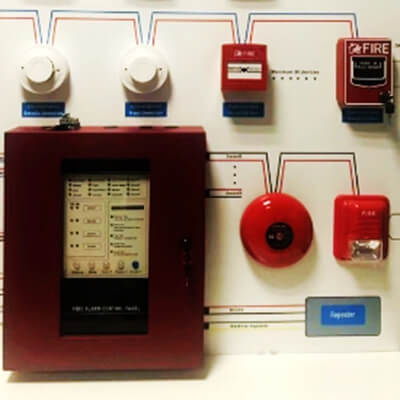
SR-P01 Conventional Control Panel Overview
The SR-P01 Series offers 4, 8, or 16 fire alarm zones, giving contractors several options without changing to a completely different control platform.
According to the supplied product specifications, key parameters include:
- AC input: 220VAC, 50Hz
- Zone capacity: 4 / 8 / 16 zones
- Style B / Class B initiating device circuits
- Two-wire smoke detector and normally-open contact device compatibility
- Two supervisory inputs with DC12V output
- Alarm, trouble, and supervisory Form A relay outputs
- One, two, or four built-in NAC outputs depending on configuration
- 3.0A total DC24V system power
- Maximum current per NAC: 1.25A
- Resettable and non-resettable DC24V outputs
- Optional RS485 communication
- Maximum battery charging capability: 18Ah
For B2B customers, this creates a useful balance between system flexibility and familiar conventional wiring.
7 Proven Benefits of the SR-P01 Conventional Control Panel
1. Flexible 4-, 8-, and 16-Zone Configurations
Project requirements vary significantly. A small retail unit may require relatively few detection zones, while a larger office, warehouse, school, or commercial facility may need more.
The SR-P01 provides 4-, 8-, and 16-zone configurations, allowing installers to select a panel according to the project layout rather than oversizing the system unnecessarily.
2. Supports Common Conventional Initiating Devices
Each zone accepts compatible two-wire smoke detectors and normally-open contact devices.
That makes the conventional control panel suitable for integration with typical conventional system components such as smoke detectors, heat detectors, manual call points, and other compatible initiating devices.
Actual device compatibility, quantity, circuit parameters, and local code requirements should always be verified during system design.
3. Programmable Zone Short-Circuit Response
The SR-P01 allows a zone input short circuit to be configured as either an Alarm or Fault condition.
This gives system designers additional flexibility when adapting the panel to different project requirements and field configurations.
4. Programmable Notification Appliance Circuits
The panel provides built-in Style Y / Class B notification appliance circuits, with configurations supporting one, two, or four sound outputs.
NACs can be programmed as silenceable or non-silenceable, helping contractors configure alarm notification behavior according to the intended fire alarm strategy.
The specified maximum current is 1.25A per NAC, subject to the overall system power budget.
5. Alarm, Trouble, and Supervisory Relay Outputs
Fire alarm installations often need to interact with other building equipment.
The SR-P01 includes Form A relay outputs for:
- General alarm
- Trouble
- Supervisory conditions
These interfaces can support system integration where compatible equipment requires dry-contact status signals.
Any connection to elevators, ventilation equipment, access control, suppression equipment, or other life-safety functions should be engineered according to applicable standards and project approvals.
6. Flexible DC24V Power Outputs
The SR-P01 provides both resettable and non-resettable DC24V power outputs, with total DC24V system power specified at 3.0A.
A resettable output can be useful for compatible four-wire detector circuits that require temporary power interruption during system reset, while non-resettable output can supply compatible auxiliary equipment that requires continuous power.
Correct load calculations remain essential during design.
7. Optional RS485 Communication
For projects requiring additional communication capability, RS485 is available as an optional feature.
This can improve flexibility for suitable system architectures and peripheral integration. However, buyers should confirm the required communication protocol and compatible devices before ordering because an RS485 physical interface alone does not guarantee interoperability between products from different manufacturers.
How Does the SR-P01 Work in a Fire Alarm System?
A typical SR-P01 conventional control panel installation can be understood as a simple signal path:
Detector or manual call point → Zone circuit → SR-P01 panel → Alarm decision → NAC / relay output → Notification devices or connected equipment
When a compatible initiating device changes the electrical condition of its circuit, the panel evaluates the relevant zone. Depending on the signal, it can indicate alarm, trouble, or supervisory status and activate programmed outputs.
This centralized control function is why the fire alarm panel is often described as the “brain” of a fire alarm system.
Where Can a Conventional Control Panel Be Used?
The SR-P01 is primarily relevant to low- and medium-scale conventional fire alarm projects where zone-level identification provides sufficient information.
Potential applications include:
- Small commercial buildings
- Retail stores
- Offices
- Warehouses
- Workshops
- Schools
- Apartment common areas
- Small hotels and hospitality projects
- Equipment rooms
- Industrial support buildings
Project suitability should always be determined by the fire alarm designer, contractor, applicable local codes, and Authority Having Jurisdiction (AHJ).
Conventional Control Panel vs. Addressable Control Panel
The main difference is how alarm locations are identified.
A conventional control panel identifies the zone containing the activated device. An addressable system can identify an individual programmed device or address, providing more detailed event information.
NFPA technical material similarly distinguishes conventional systems from addressable systems and notes that conventional architectures are commonly associated with basic alarm, trouble, and supervisory information for smaller systems.
For projects where simplicity, familiar wiring, and cost control are priorities, conventional architecture may therefore remain appropriate. Larger or more complex sites may benefit from addressable technology.
What Should B2B Buyers Confirm Before Ordering?
For wholesalers, fire alarm contractors, and system integrators, choosing a fire panel should involve more than comparing the number of zones.
Before purchasing the SR-P01, confirm the required zone quantity, mains voltage and frequency, compatible detector parameters, NAC load, total DC24V load, battery capacity, relay requirements, RS485 requirement, enclosure needs, and local installation standards.
Wiring should be evaluated together with the panel configuration. Buyers should check conductor size, circuit length, resistance, voltage drop, terminal capacity, flame performance, and destination-market requirements. The 2×0.75 mm² RVV cable procurement guide provides a practical reference for sample approval and bulk-order verification.
Because the supplied SR-P01 specification states 220VAC, 50Hz, this point deserves particular attention for export projects using different power systems.
Certification requirements should also be confirmed separately for each target market. Product specifications or references to standards should not automatically be interpreted as evidence of a particular third-party certification.
FAQ
1. What zone configurations are available for the SR-P01?
The SR-P01 Series is available in 4-zone, 8-zone, and 16-zone versions, enabling contractors to select the capacity that best matches the building layout.
2. Can the SR-P01 connect to two-wire smoke detectors?
Yes. According to the supplied specifications, the panel’s zone circuits accept compatible two-wire smoke detectors. Detector electrical compatibility should still be verified before system installation.
3. Does the SR-P01 have notification appliance circuits?
Yes. Depending on the configuration, it provides one, two, or four built-in Style Y / Class B NAC outputs, which can be programmed as silenceable or non-silenceable.
4. What is the total DC24V system power?
The specified total DC24V system power is 3.0A, with a stated maximum of 1.25A per NAC. Installers should calculate the complete system load before commissioning.
5. Does this conventional control panel support battery backup?
Yes. The specifications indicate support for sealed lead-acid batteries with a maximum charging capability of 18Ah. Two 10Ah batteries can be housed in the cabinet; larger batteries require a separate battery box.
6. Does the SR-P01 provide relay outputs?
Yes. It provides Form A relay outputs for general alarm, trouble, and supervisory conditions, supporting integration with appropriate external equipment.
7. Is RS485 available?
Yes, RS485 communication is optional. Buyers should confirm the exact communication requirements and compatible devices before placing an order.
8. Is the SR-P01 suitable for every fire alarm project?
No single panel is suitable for every installation. System size, device compatibility, power requirements, applicable fire codes, certification requirements, and AHJ approval should all be evaluated before specifying the panel.
Conclusion
The SR-P01 conventional control panel offers a practical 4-, 8-, or 16-zone platform for small- to medium-scale conventional fire alarm systems. Programmable zone functions, NAC outputs, alarm/trouble/supervisory relays, DC24V auxiliary power, battery support, and optional RS485 give system integrators useful flexibility while retaining the straightforward architecture of a conventional system.
For wholesalers and project contractors, the most important purchasing step is matching the panel configuration to the complete system: detector compatibility, zone count, NAC load, power supply, battery requirements, local standards, and required approvals should all be confirmed before procurement.