IP54 vs IP65 vs IP67: Which Protection Level Is Better for Manual Call Points?
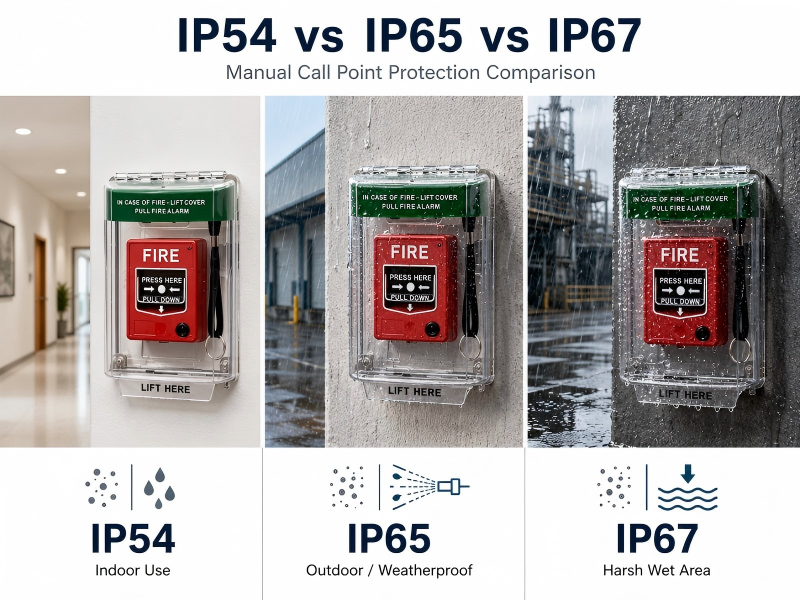
IP54 vs IP65 vs IP67 describes three enclosure protection levels used to indicate how well electrical equipment is protected against solid particles and water under defined test conditions.
If you are buying manual call points or protective covers for a fire alarm project, the obvious question is simple: should you choose IP54, IP65, or IP67?
The answer is slightly less obvious.
IP67 is not automatically the best choice for every manual call point. A clean hotel corridor has very different risks from an outdoor warehouse gate, a dusty factory, or a loading bay washed with water.
For wholesalers and fire alarm contractors, choosing IP54 vs IP65 vs IP67 is really about matching the protection level to the site.
That saves money. More importantly, it helps avoid specifying the wrong product for the environment.
IEC 60529 is the international standard that classifies degrees of protection provided by electrical enclosures using the familiar IP Code.
IP54 vs IP65 vs IP67: What Do the Numbers Mean?
The IP code contains two digits.
The first digit describes protection against solid objects and dust.
The second digit describes protection against water.
That makes the difference between IP54 vs IP65 vs IP67 easier to understand:
| Rating | Dust Protection | Water Protection | Practical Project Fit |
|---|---|---|---|
| IP54 | Dust protected | Splashing water | Indoor or sheltered areas |
| IP65 | Dust-tight | Water jets | Outdoor, dusty, wet locations |
| IP67 | Dust-tight | Temporary immersion | Harsh outdoor or temporary flood-risk areas |
With IP54, limited dust may enter, but not enough to interfere with normal operation. Its water protection is aimed at splashing.
IP65 moves the solid protection to dust-tight and adds protection against water jets.
IP67 is also dust-tight, but its water test addresses temporary immersion rather than simply splashing or jets.
Simple enough—but here comes the detail that often gets missed.
IP54 vs IP65 vs IP67: Is IP67 Always Better Than IP65?
It is tempting to read the numbers like school grades.
54, 65, 67. Bigger number wins, right?
Not always.
When comparing IP54 vs IP65 vs IP67, remember that different water digits describe different test conditions.
IP65 relates to water jets. IP67 relates to temporary immersion.
An enclosure carrying an IP67 rating should therefore not automatically be described as having passed every IP65 water-jet test unless the manufacturer has documentation covering both ratings.
This distinction matters in real engineering work.
Imagine two manual call points.
One sits on an exposed factory wall that is regularly sprayed during cleaning.
The other sits close to ground level in an outdoor area where temporary flooding may occur.
The first project may place greater importance on jet resistance. The second may require temporary immersion protection.
So instead of asking, “Which number is highest?” ask:
What will the manual call point actually face after installation?
That question usually leads to the better specification.
When Is IP54 Suitable for a Manual Call Point?
IP54 can make sense in controlled indoor or sheltered locations.
Think of:
- Office corridors
- Hotel service areas
- Indoor commercial buildings
- Sheltered plant rooms
- Dry warehouses
- Semi-protected indoor industrial spaces
Here, the manual call point may face normal airborne dust and occasional splashes, but not direct heavy rain, hose cleaning, standing water, or severe dust.
For these installations, demanding IP67 everywhere may add specification and purchasing requirements that the site does not need.
There is a catch, though.
“Sheltered” should really mean sheltered.
A loading entrance beneath a small canopy may still receive wind-driven rain. A parking structure may look indoors but experience humidity, cleaning water, dust, and vehicle spray.
That is why IP54 vs IP65 vs IP67 should be judged from real exposure, not just whether the architectural drawing labels an area “indoor.”
When Does IP65 Make More Sense?
IP65 becomes more attractive when dust and direct water exposure increase.
Common locations include:
- Exposed outdoor walls
- Factories
- Logistics areas
- Parking structures
- Loading docks
- Utility areas
- Dusty production zones
- Areas subject to water-jet cleaning
Its dust-tight enclosure protection is useful where fine particles are more than an occasional nuisance.
The water-jet rating also makes IP65 relevant when equipment may experience driven rain or cleaning water.
For many outdoor projects, IP65 can therefore provide a sensible protection level.
But don’t stop at the label.
Cable glands, mounting holes, seals, conduit entries, back boxes, and installation workmanship can all affect the finished assembly.
An IP65 enclosure with a badly sealed cable opening is a bit like wearing a raincoat with the zipper open. The label alone cannot save the installation.
When Should You Consider IP67 for Manual Call Points?
This is where IP54 vs IP65 vs IP67 becomes especially important for demanding projects.
IP67 is designed around dust-tight protection plus temporary water immersion under defined test conditions.
It may be considered for manual call points or protective enclosures used around:
- Outdoor industrial facilities
- Exposed building entrances
- Ports and transportation areas
- Underground parking facilities
- High-humidity locations
- Utility areas
- Sites with temporary flood risk
- Harsh semi-outdoor environments
A protective enclosure can also add another barrier between the manual call point and daily environmental exposure.
For example, Sumring lists its SR-A08-PS manual call point cover with an IP67 rating, industrial-grade PC construction, and versions with or without an audible warning function. Project buyers should still confirm dimensions, installation method, documentation, and local approval requirements before specification.
For product details, see the SR-A08-PS IP67 Manual Call Point Cover.
IP54 vs IP65 vs IP67 by Installation Environment
Here is a simpler way to make a first selection.
| Environment | Suggested Starting Point | Why |
|---|---|---|
| Clean indoor corridor | IP54 | Low dust and limited water exposure |
| Sheltered commercial area | IP54–IP65 | Depends on rain and cleaning |
| Dusty warehouse | IP65 | Dust-tight protection becomes useful |
| Outdoor entrance | IP65 or IP67 | Depends on rain, drainage, and project specification |
| Factory cleaning area | Check IP65 jet requirement | Water jets may be the main risk |
| Temporary flood-risk location | IP67 | Temporary immersion protection may be required |
| Coastal project | Project-specific | IP rating alone does not address UV or corrosion |
| Public high-traffic zone | IP rating + protective cover | Physical contact and unwanted activation also matter |
Notice something?
There is no single winner.
That is the real answer to IP54 vs IP65 vs IP67.
Wait—IP Rating Does Not Tell You Everything
This is one of the most important points for B2B buyers.
IEC 60529 classifies enclosure protection against ingress. Its scope does not mean an IP number alone tells you everything about impact resistance, UV ageing, accidental activation, vandalism, material strength, or fire alarm system approval.
So a manual call point installation should not be selected using the IP number alone.
Also check:
- Enclosure material
- UV resistance for outdoor use
- Impact resistance
- Operating temperature
- Gasket and sealing structure
- Cable entry method
- Manual call point dimensions
- Surface box depth
- Accessibility during an emergency
- Required certificates and test reports
- Project and local regulatory requirements
For protective covers, size deserves special attention.
A manual call point may look compact from the front but become much deeper after a surface box, conduit adapter, cable gland, or mounting spacer is fitted.
Sumring’s sizing guide recommends checking the full installed width, height, and projection depth rather than measuring only the visible face of the call point.
See the IP67 Protective Manual Call Point Cover Sizing Guide before confirming bulk dimensions.
What Should Wholesalers Stock: IP54, IP65, or IP67?
For distributors, the decision is slightly different.
You are not selecting for one wall. You may be stocking products for dozens of project types.
An IP54 product may cover many basic indoor applications.
IP65 can serve a broad range of dusty and outdoor environments.
An IP67 manual call point cover can be useful for customers asking for stronger environmental protection, especially industrial, outdoor, and project-based buyers.
Still, carrying the highest IP number without checking demand can create extra cost and unnecessary stock complexity.
A better approach is to segment customers by application.
Ask them:
Where will the unit be installed? What type of water exposure exists? How dusty is the area? What manual call point and back box are being used?
Five minutes spent asking those questions can prevent a much longer conversation after delivery.
How Should Engineering Contractors Choose?
For engineering contractors, use this simple order:
Environment → project requirement → IP rating → device dimensions → installation details → documentation.
Not the other way around.
If the manual call point is indoors and protected, IP54 may be enough.
If it faces dust, rain, or water jets, examine IP65.
If temporary immersion or a harsher environmental specification is involved, examine IP67.
If the location has both water-jet and immersion risks, check whether the specific product has been tested and documented for the required conditions instead of assuming one IP mark covers everything.
That’s the practical difference between IP54 vs IP65 vs IP67.
IP54 vs IP65 vs IP67: Which Protection Level Is Best?
For most buyers, there is no universal “best.”
IP54 is practical for relatively controlled indoor and sheltered environments.
IP65 offers dust-tight protection and suits many exposed, dusty, wet, or outdoor applications.
IP67 adds protection against temporary immersion and is valuable for more demanding installations where the project calls for it.
For outdoor manual call point protection, an IP67 manual call point cover can provide an extra environmental barrier while keeping the activation device visible and accessible. Sumring currently lists IP67 protective-cover solutions for outdoor fire alarm applications.
The smartest specification is not the highest number on the datasheet.
It is the protection level that matches the real site.
FAQ
1. What is the main difference between IP54, IP65, and IP67?
IP54 provides dust protection and splash resistance. IP65 is dust-tight and protects against water jets. IP67 is dust-tight and protects against temporary immersion under defined test conditions.
2. Is IP67 better than IP65 for outdoor manual call points?
Not automatically. IP65 vs IP67 for outdoor manual call points depends on the exposure. IP65 addresses water jets, while IP67 addresses temporary immersion.
3. Can IP54 manual call points be installed outdoors?
They may suit sheltered areas when the product manufacturer and project specification permit it, but exposed outdoor sites often require stronger water and dust protection.
4. Is an IP67 manual call point waterproof?
IP67 indicates protection against temporary immersion under specified test conditions. It should not be interpreted as unlimited underwater use or protection against every type of water exposure.
5. Do outdoor fire alarm buttons need an IP67 protective cover?
Not every outdoor installation requires one, but an IP67 protective manual call point cover can be valuable where dust, rain, moisture, accidental contact, or harsh site conditions create additional risk.
6. Does an IP67 cover make the complete fire alarm installation IP67?
Not necessarily. Cable entries, mounting holes, gaskets, back boxes, and the enclosed device can affect the completed installation. Check the manufacturer’s documentation and project requirements.
7. Which IP rating is suitable for a dusty warehouse manual call point?
IP65 or another dust-tight solution may be considered when heavy dust exposure is expected. Water exposure and the project specification should also be checked before selection.
8. What should B2B buyers check before ordering an IP67 manual call point cover?
Confirm the manual call point width, height, installed depth, back box, cable entry, opening clearance, required IP rating, quantity, certification needs, and installation environment before placing a bulk order.