SR-915 Smart WiFi Gas Detector vs Traditional Gas Alarm: What Is the Difference?
The SR-915 Smart WiFi Gas Detector is an indoor combustible gas detector designed for CH4 monitoring, local gas warnings, 2.4GHz WiFi communication, Tuya App notifications, and remote device monitoring.
For wholesalers, distributors, smart-home suppliers, and engineering contractors, however, the real question is not simply, “Which one has more features?”
It is this:
Which gas detector gives the project the functions customers will actually use without adding unnecessary cost?
Let’s make that decision easier.
SR-915 Smart WiFi Gas Detector vs Traditional Gas Alarm:
The main difference is connectivity.
A traditional gas alarm normally detects gas and activates an audible or visual warning at the installation site. A smart WiFi gas detector adds a communication layer. It can send information through a WiFi network to an app, so authorized users can receive warnings or check device status away from the detector.
The SR-915 Smart WiFi Gas Detector supports 2.4GHz WiFi and Tuya App communication. The current SR-915 specification also lists AC100–240V power, CH4 combustible gas detection, a 6%LEL alarm concentration, approximately three minutes of warm-up time, and alarm sound pressure of at least 70dB at one meter.
So, smart does not mean the traditional alarm suddenly becomes useless.
It means buyers have another layer of monitoring.
And sometimes, that layer matters a lot.
SR-915 vs Traditional Gas Alarm Comparison
| Feature | SR-915 Smart WiFi Gas Detector | Traditional Gas Alarm |
|---|---|---|
| Gas Leak Detection | Yes | Yes |
| Local Audible Warning | Yes | Usually yes |
| WiFi Connection | 2.4GHz | Usually no |
| Smartphone Notification | Tuya App | Usually no |
| Remote Device Monitoring | Yes | Usually no |
| CH4 Monitoring | Yes | Depends on model |
| Installation | Plug-and-play design | Often simple |
| Network Setup | Required for smart features | Not required |
| Suitable for Remote Management | Better suited | Limited |
| Purchase Cost | Usually higher | Usually lower |
| Main Value | Local + remote warning | Local warning |
Here is the key point: both products may detect the same danger, but they handle information differently.
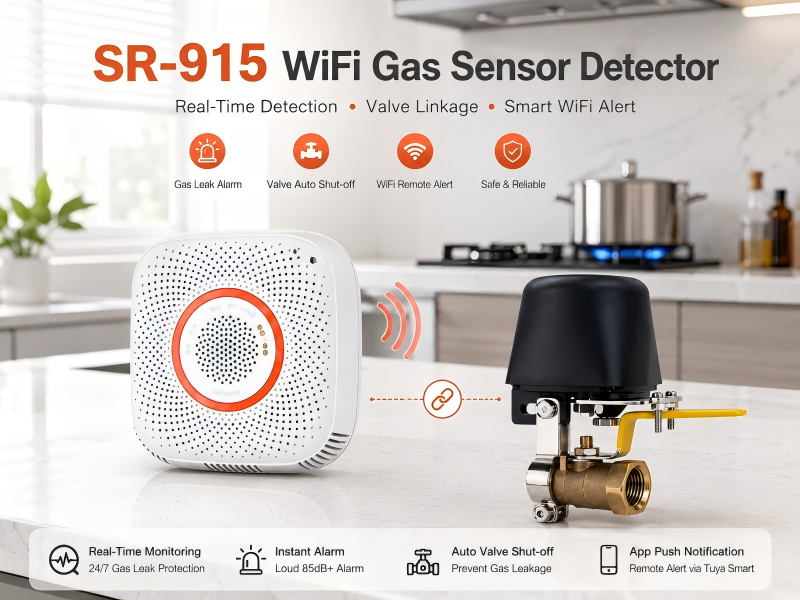
SR-915 Smart WiFi Gas Detector vs traditional gas alarm comparison for commercial gas safety projects
For procurement teams, that difference affects far more than the product price.
1. The Biggest Difference Is Where the Warning Goes
Imagine a gas detector installed in a rental apartment.
With a traditional gas alarm, someone nearby hears the warning. That works well when the property is occupied.
Now imagine the same apartment is empty.
A local alarm can still sound, but who hears it?
The SR-915 Smart WiFi Gas Detector can communicate through the Tuya App and provide remote alarm notifications when connected to a suitable 2.4GHz WiFi network. Users can also check device status through a smartphone.
That makes remote communication valuable for applications such as:
- Rental apartments
- Managed residential properties
- Small commercial kitchens
- Smart homes
- Offices
- Shops
- Multi-property management
For a buyer supplying hundreds of rental properties, this feature can change the product proposition completely.
For a single room where someone is present all day?
Maybe not.
2. Smart Monitoring Does Not Replace Local Detection
There is a common misunderstanding around connected products.
Some buyers assume a smart WiFi gas detector depends entirely on the internet.
That is the wrong way to evaluate it.
The gas sensor and the network communication perform different jobs. Gas detection happens at the device. WiFi handles connected functions such as remote information and app alerts.
The SR-915 uses a semiconductor sensor for combustible gas monitoring and provides an audible alarm locally. Its specification lists an alarm point of 6%LEL with ±3%LEL error.
So WiFi should be treated as an extra communication channel—not as a substitute for the detector itself.
For project engineers, this distinction is important.
Always review how the detector behaves locally and how its connected features behave if the network becomes unavailable.
3. Traditional Gas Alarms Win When Simplicity Matters Most
Here comes the slightly unpopular part.
Smart is not automatically better.
If a project needs only straightforward local gas detection, a traditional alarm may make more commercial sense.
Think about a low-cost housing project with hundreds or thousands of identical units. If the specification asks only for local combustible gas warning, paying for WiFi functions that nobody will configure may add cost without adding practical value.
A traditional gas alarm may also suit buyers who want:
- Simple operation
- No app registration
- No WiFi configuration
- Lower purchasing cost
- Faster user training
- Fewer network-related support questions
There is nothing old-fashioned about choosing fewer functions when fewer functions fit the job.
That is good engineering.
4. The SR-915 Makes More Sense for Connected Properties
Now turn the situation around.
Suppose your customer manages fifty apartments across several buildings.
Walking into every room just to check device status is hardly convenient.
This is where the SR-915 Smart WiFi Gas Detector becomes more interesting.
Its Tuya connection gives the detector a place within a connected property environment. Sumring lists real-time gas leak alerts and remote monitoring among the main SR-915 functions.
That can make the model attractive to:
- Smart-home distributors
- Property technology suppliers
- Residential project contractors
- Rental property operators
- Online smart-device sellers
- Security and safety product wholesalers
The product is not merely “an alarm with WiFi.”
From a sales angle, it belongs to a different buying category: connected gas safety.
5. Installation and Network Requirements Change the Buying Decision
Traditional alarms are often easier to explain.
Power the unit. Install it correctly. Test it. Done.
A smart detector adds another step: network configuration.
The SR-915 Smart WiFi Gas Detector uses a 2.4GHz WiFi connection and works with the Tuya App. Its plug-and-play structure is designed to keep setup relatively simple.
Still, B2B buyers should check the installation environment before placing a bulk order.
Ask:
- Is 2.4GHz WiFi available at the installation site?
- Will the customer actually use the Tuya App?
- Who will configure each detector?
- Who receives app alerts?
- Is the WiFi signal stable near the gas appliance?
- Does the project require only local alarms?
- Are there local certification requirements?
That last question matters.
A detector can have excellent features and still be the wrong product if it does not match the regulations or project specification in the destination market.
6. Compare Total Project Cost, Not Just Unit Price
This is where purchasing gets interesting.
Traditional gas alarms may have a lower unit cost.
But unit cost is only one line on the spreadsheet.
For a commercial project, buyers should also consider:
- Installation labor
- Network setup
- User training
- Property management needs
- After-sales support
- App configuration
- Maintenance procedures
- Packaging requirements
- Plug and voltage requirements
- Certification
- OEM branding requirements
The SR-915 Smart WiFi Gas Detector supports AC100–240V, which helps when supplying projects across different power markets. Sumring also lists the SR-915 for wholesalers, distributors, smart-home suppliers, contractors, and OEM/ODM orders.
For a distributor, that flexibility can be commercially useful.
But again, don’t pay for a feature simply because it sounds impressive.
Buy the function your customer needs.
Which Projects Are Better for the SR-915 Smart WiFi Gas Detector?
The SR-915 Smart WiFi Gas Detector is worth serious consideration when remote information is part of the customer’s buying requirement.
It may be suitable for:
Smart residential projects: Users want local gas detection plus smartphone alerts.
Rental properties: Property owners may value connected monitoring when they are away.
Commercial kitchens: Remote warnings can add another information channel when a site is unattended.
Smart-home distribution: WiFi and Tuya compatibility create a clearer retail story than a basic standalone alarm.
Property management projects: Connected devices may be easier to integrate into a broader smart-building purchasing strategy.
Online sales: App connectivity gives sellers additional features to demonstrate and explain.
When Is a Traditional Gas Alarm the Better Choice?
Choose a traditional gas alarm when simplicity, price, and local warning are the main priorities.
For example, a traditional unit may be more practical when:
- Remote notifications are unnecessary.
- Internet access is unreliable.
- Users do not want app configuration.
- The project specification calls only for local alarms.
- Purchasing cost is extremely sensitive.
- Maintenance teams prefer simple standalone equipment.
Sounds almost too simple, right?
Yet good procurement is often about removing unnecessary features rather than collecting them.
What Should B2B Buyers Confirm Before Ordering SR-915?
Before purchasing the SR-915 Smart WiFi Gas Detector in quantity, confirm the actual project requirement first.
A useful purchasing checklist includes:
- Target gas — SR-915 is designed mainly for combustible gas such as CH4.
- Alarm requirement — Check the required alarm concentration and applicable local standard.
- Power supply — SR-915 supports AC100–240V.
- WiFi environment — Smart functions use 2.4GHz WiFi.
- App requirement — Confirm whether Tuya is suitable for your customers.
- Installation location — SR-915 is intended for indoor applications.
- Certification — Confirm certification requirements for the destination country or project.
- OEM/ODM needs — Discuss branding, packaging, manuals, plugs, and project-specific requirements before mass production.
One more thing: if a project requires gas valve control, exhaust fan linkage, relay output, or other external equipment, confirm the exact hardware configuration before ordering rather than assuming every smart gas detector provides the same interfaces.
That small conversation before production can prevent a much bigger conversation after installation.
FAQ
1. What is the main difference between the SR-915 Smart WiFi Gas Detector and a traditional gas alarm?
The main difference is connectivity. The SR-915 provides local gas detection plus 2.4GHz WiFi, Tuya App notifications, and remote monitoring, while a traditional gas alarm normally focuses on local warnings.
2. Does the SR-915 Smart WiFi Gas Detector detect natural gas?
Yes. The SR-915 is designed to detect combustible gas, especially CH4 methane, which is a major component of natural gas.
3. Does the SR-915 gas detector work with 5GHz WiFi?
The published SR-915 specification lists 2.4GHz WiFi. Buyers should make sure the installation network supports 2.4GHz connectivity.
4. Is a smart WiFi gas detector safer than a traditional gas alarm?
Not automatically. Safety depends on correct gas selection, installation, testing, maintenance, certification, and project design. Smart connectivity mainly adds remote communication functions.
5. Is the SR-915 suitable for commercial projects?
Yes. It can suit apartments, rental properties, smart homes, kitchens, and selected commercial gas-safety projects where CH4 monitoring and remote notifications are required.
6. What is the SR-915 gas alarm concentration?
The published specification lists an alarm concentration of 6%LEL, with an error of ±3%LEL. Project buyers should still check local codes and tender requirements before selection.
7. Can wholesalers order the SR-915 with OEM or ODM requirements?
Yes. Sumring states that the SR-915 is available for distributor, wholesale, project, and OEM/ODM requirements, subject to the specific order configuration.
8. Should I buy a smart WiFi gas detector or a traditional gas alarm for bulk projects?
Choose a smart WiFi model when remote alerts and connected management create real value. Choose a traditional gas alarm when the project needs simple local detection and purchasing cost is the stronger concern.
Conclusion
The SR-915 Smart WiFi Gas Detector vs traditional gas alarm decision is not really about “new technology versus old technology.”
It is about how the alarm information needs to move.
A traditional gas alarm can be a sensible, economical choice when users only need a warning at the installation site. The SR-915 Smart WiFi Gas Detector goes further by combining CH4 monitoring with 2.4GHz WiFi, Tuya App alerts, and remote status monitoring.
For wholesalers and project contractors, the smartest purchase is therefore not always the product with the longest feature list.
Ask three questions first:
What gas needs to be detected? Who needs to receive the warning? Does that person need to receive it remotely?
If remote monitoring matters, SR-915 deserves a place on the shortlist.
If it does not, a simpler traditional gas alarm may be exactly what the project needs.