Outdoor Wireless Horn Siren: How to Choose the Best One? 7 Key Factors
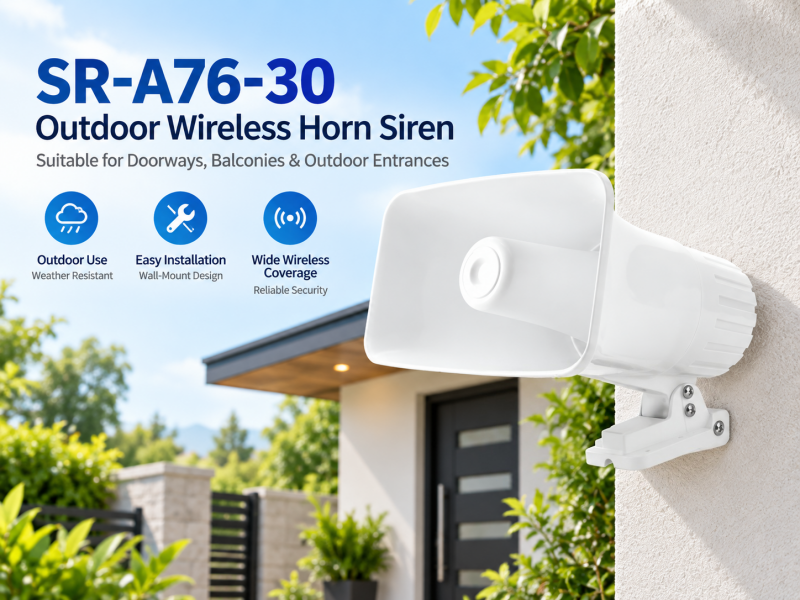
An outdoor wireless horn siren is an external audible alarm device designed to receive wireless alarm signals and produce a high-output warning sound across outdoor or large-area security applications.
For installers, security distributors and system integrators, choosing a siren is not simply about finding the highest dB number. Wireless range, sound projection, backup power, environmental resistance, installation method and system compatibility all affect whether the device will work reliably in a real project.
The SR-A76-30 is designed around these practical requirements. According to its listed specifications, it combines 433 MHz wireless communication, an open-area wireless distance of 100–200 meters, AC power with backup battery support, and a horn-type acoustic structure intended for long-distance warning.
What Is an Outdoor Wireless Horn Siren Used For?
An outdoor wireless horn siren extends the audible alarm coverage of a security or warning system.
Instead of relying only on an indoor control panel buzzer, a horn siren can be positioned where sound needs to reach a larger area. Typical applications may include:
- Warehouses
- Factory compounds
- Commercial buildings
- Construction facilities
- Equipment yards
- Farms
- Perimeter security systems
- Remote buildings
- Industrial sites
For B2B projects, the main objective is usually clear: when an alarm event occurs, people across the required area should receive an audible warning quickly.
For smaller gates, orchards, sheds or remote outdoor areas where local motion detection and solar charging are more important than long-distance horn coverage, a solar-powered motion alarm for remote outdoor areas may provide a more flexible solution.
This makes acoustic coverage and system compatibility more important than appearance alone.
High Sound Output Is Important—but dB Is Not Everything
The SR-A76-30 is described with a sound output of up to 135 dB.
A high-output horn can be useful in large or noisy environments where a small indoor siren may not provide sufficient warning coverage.
However, professional buyers should avoid evaluating products only by their maximum decibel specification.
Actual sound performance can be influenced by:
- Measurement distance
- Installation height
- Wall and building obstruction
- Ambient noise
- Horn direction
- Input voltage
- Acoustic structure
For this reason, buyers comparing an outdoor wireless horn siren should ask the supplier about the test conditions behind the published sound specification.
For project samples, field testing is also recommended.
433 MHz Wireless Communication and 100–200 m Open-Area Range
The listed RF frequency of the SR-A76-30 is 433 MHz, with a specified wireless distance of approximately 100–200 meters in an open area.
This can reduce cabling requirements in projects where running additional signal wiring is inconvenient.
Wireless solutions may be particularly useful for:
- Detached buildings
- Outdoor entrances
- Warehouses
- Temporary sites
- Large compounds
- Retrofit alarm projects
It is important to understand that “100–200 m” refers to open-area conditions.
Concrete walls, metal structures, electrical interference and equipment placement can reduce practical RF distance. A professional installer should therefore evaluate the real site rather than designing the entire system around the maximum quoted range.
This distinction makes the content more useful for engineering buyers and prevents unrealistic project expectations.
AC Power Plus Backup Battery Support
Another practical feature is its dual power arrangement.
According to the available specification:
| Specification | SR-A76-30 |
|---|---|
| Power Adapter | AC 220V, 50/60Hz |
| Backup Battery | DC 7.4V / 850mA |
| Battery Support Time | ≥10 hours |
| Standby Consumption | <0.6W |
The backup battery provides continued operating support when the primary power supply is interrupted.
For commercial alarm projects, backup operation should always be evaluated according to the complete system design. Battery condition, alarm frequency, ambient temperature and operating load can all affect real backup duration.
Buyers should therefore confirm actual project requirements before finalizing quantities or system architecture.
Outdoor Operating Conditions
An outdoor wireless horn siren may be exposed to heat, cold, humidity and changing weather conditions.
The listed SR-A76-30 environmental specifications include:
- Operating temperature: -45°C to +60°C
- Humidity: ≤95%
- Plastic housing
- Outdoor-oriented design
These figures provide useful procurement references, especially for projects in regions with demanding climates.
However, “outdoor design” should not automatically be interpreted as a specific IP rating unless that rating has been formally specified and verified for the product.
For exposed installations, B2B purchasers should confirm water-ingress requirements, mounting orientation and installation protection with the supplier before deployment.
Why the Internal Horn Structure Matters?
One notable point in the product information is the internal magnetic design.
The SR-A76-30 is described as a 12V 30W siren using a 12-type magnet structure.
Different products can have similar external housings while using different internal acoustic components. These differences may influence:
- Sound frequency
- Power consumption
- Acoustic projection
- Perceived loudness
- Long-distance warning performance
This is particularly relevant for distributors comparing visually similar products from multiple factories.
Rather than judging the siren only by its housing, professional purchasers can request samples and compare internal design, sound characteristics and actual field performance.
This approach is especially useful for OEM and long-term distribution projects.
Installation Size and Mounting Considerations
The approximate dimensions shown for the SR-A76-30 are:
- Width: 19.5 cm
- Overall height: 22.5 cm
- Horn depth/height reference: 11.9 cm
The product also uses a mounting bracket intended to simplify installation.
Before ordering an outdoor wireless horn siren, installers should check:
- Available mounting space
- Horn direction
- Wall strength
- Cable and power access
- Wireless signal path
- Exposure to rain
- Maintenance accessibility
Correct positioning can make a significant difference to both RF reliability and sound coverage.
B2B Procurement Checklist for an Outdoor Wireless Horn Siren
For wholesalers, contractors and system integrators, specification matching should come before price comparison.
Ask your supplier to confirm the following before placing a project order:
Wireless compatibility:
Confirm that the 433 MHz communication protocol is compatible with your control equipment. Frequency alone does not guarantee interoperability.
Sound performance:
Request information about rated sound level and measurement conditions.
Power requirement:
Verify whether AC 220V is suitable for your target market and project.
Backup operation:
Confirm battery configuration and expected backup time.
Environmental suitability:
Check temperature, humidity and required ingress protection.
Installation:
Review product dimensions and bracket requirements.
Sample testing:
For large projects, test communication distance and sound coverage at the actual site whenever possible.
These checks reduce installation problems and make supplier comparisons much more meaningful.
FAQ
1. What is an outdoor wireless horn siren?
It is an audible warning device designed for outdoor or large-area alarm applications that receives wireless signals and generates a high-output horn sound.
2. What wireless frequency does the SR-A76-30 use?
The listed RF frequency is 433 MHz.
3. How far can the SR-A76-30 communicate wirelessly?
Its specified open-area wireless distance is approximately 100–200 meters. Actual range may decrease when walls, metal structures or interference are present.
4. How loud is the SR-A76-30?
The available product information lists sound output up to 135 dB. Buyers should confirm the related measurement conditions when comparing different sirens.
5. Does the siren have backup power?
Yes. The specifications show a DC 7.4V / 850mA backup battery with listed support time of at least 10 hours.
6. Can it be installed outdoors?
It is designed for outdoor-oriented applications and lists an operating temperature from -45°C to +60°C. For exposed installations, confirm the required waterproof or IP protection level before ordering.
7. Can any 433 MHz control panel work with this siren?
Not necessarily. Devices using the same frequency can still use different communication protocols. Compatibility should be confirmed before purchasing.
8. Who should consider this type of wireless horn siren?
It is particularly relevant for security distributors, installers, system integrators, contractors and OEM buyers requiring audible warning coverage across outdoor or large commercial areas.
Conclusion
Choosing an outdoor wireless horn siren requires more than comparing the highest sound level on a specification sheet.
For project buyers, wireless compatibility, actual communication distance, acoustic projection, backup power, operating environment and installation conditions determine whether the siren will perform reliably after installation.
The SR-A76-30 combines a 433 MHz wireless interface, 100–200 m listed open-area wireless range, high-output horn structure, AC supply and backup battery support, making it worth evaluating for suitable outdoor and commercial alarm projects.
For distributors, OEM buyers and system integrators, the most practical next step is to provide your control panel type, required quantity, installation environment and target market so compatibility and configuration can be checked before bulk purchasing.