How to Choose a Smoke and CO Combo Alarm for Residential Projects?
A smoke and CO combo alarm is a dual-function safety device designed to detect smoke from a fire and carbon monoxide in one unit. For residential project buyers, choosing the right model is not only about combining two functions. It also requires evaluating sensor technology, target-market compliance, power supply, alarm indication, installation, maintenance, documentation, and supplier support before bulk purchasing.
For developers, distributors, contractors, property managers, and private-label brands, a project-based selection process helps reduce specification mistakes across apartments, rental housing, dormitories, senior-living projects, and other residential applications.
1. Start With the Residential Project Requirements
Before comparing models, define where the alarms will be used. A 20-unit renovation may have different requirements from a new 500-unit housing development or a private-label retail program.
Confirm the target country, building type, installation location, expected quantity, preferred power source, packaging language, required service life, and local approval needs. These details determine which configuration should move to the sample and quotation stage.
A smoke and CO combo alarm should therefore be selected around the project specification rather than only around the lowest unit price.
2. Compare Smoke and CO Sensor Technologies
A combined alarm contains two different detection functions. The smoke side commonly uses photoelectric sensing, while the CO side commonly uses an electrochemical sensor.
For procurement teams, the key question is not just which sensor names appear on the data sheet. Ask how the sensors are integrated, how different alarm conditions are indicated, how the unit is tested during production, and what quality documents are available.
For larger projects, request technical data and sample units before approval. This allows engineers and buyers to evaluate operation, housing quality, indicators, buttons, mounting design, and consistency.
3. Check Certification and Market Compliance
Compliance requirements vary by market and project. A model suitable for one country should not automatically be assumed suitable for another.
Before ordering a smoke and CO combo alarm, ask which standards the exact model has been evaluated against, which certificates or test reports are available, and whether market-specific labeling or documentation is required.
Do not use certification for another model as proof of compliance. For regulated projects, confirm the final specification against local codes, tender documents, or requirements from the relevant authority.
This step is particularly important for importers serving several countries because certification, labeling, installation, and documentation expectations may differ between markets.
4. Select the Right Power and Maintenance Strategy
Power configuration affects installation cost and long-term maintenance. Residential projects may use replaceable batteries, sealed batteries, mains power with backup, or other project-specific designs.
For rental housing and multi-unit projects, calculate more than the initial purchase price. Review battery replacement frequency, low-battery indication, test and hush functions, access for maintenance, and expected replacement intervals.
A smoke and CO combo alarm with a practical maintenance strategy may create better project value than a lower-priced model that requires frequent servicing.
Property managers should therefore consider lifecycle cost instead of comparing purchase prices alone.
5. Review Alarm Indication and User Interface
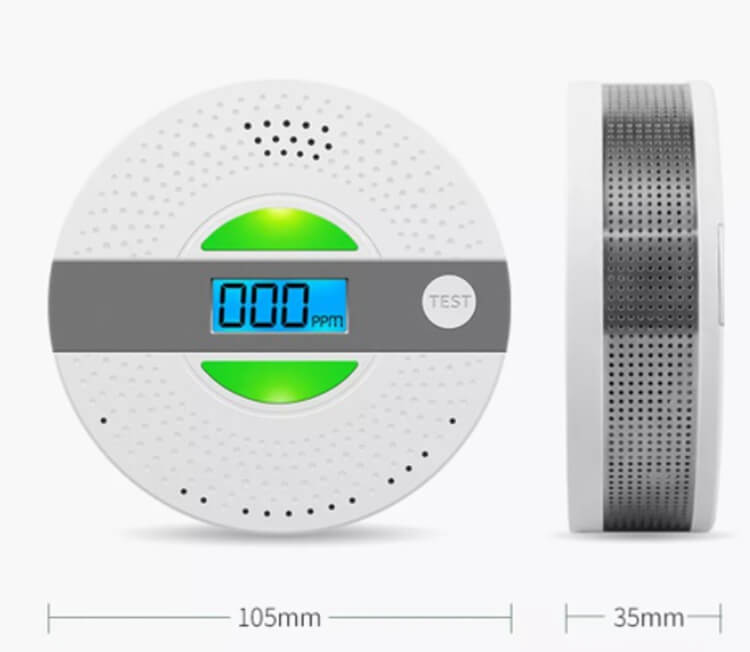
Buyers should review the audible alarm, visual indicators, display or voice functions if included, test button, hush function, fault warning, and low-power warning.
The interface should also match the intended users. Export programs may require custom labels, multilingual packaging, instructions, or market-specific manuals.
For B2B buyers, clear operation can reduce installation questions and after-sales support across hundreds or thousands of residential units.
The alarm status should also be easy for residents, maintenance teams, and installers to understand during normal operation, testing, fault conditions, or battery replacement.
6. Confirm Installation Compatibility
Ask for dimensions, mounting-base drawings, installation instructions, recommended locations, and environmental limitations.
Contractors should also confirm whether the detector is intended for ceiling or wall mounting and whether the mounting design fits the planned workflow.
A sample installation is useful before mass deployment. It can reveal practical issues involving mounting, visibility, access, labeling, and maintenance that may not be obvious from a catalog.
For renovation projects, buyers should also consider whether the new alarm can be installed efficiently without creating unnecessary changes to the existing property.
7. Evaluate the Supplier, Not Just the Alarm
For volume procurement, supplier capability can be as important as the device itself.
Review quality-control procedures, production capacity, traceability, sample support, lead time, warranty, documentation, and communication.
If private labeling is required, ask whether the manufacturer supports logo printing, packaging design, manuals, barcode labels, and carton marks.
For deeper customization, confirm whether ODM services are available for housing, power options, firmware, or project-specific features.
A dependable smoke and CO combo alarm supplier should clearly explain which changes are standard customization and which require engineering validation, tooling, testing, a higher MOQ, or extra lead time.
This is particularly important for distributors developing their own brand because customization decisions can affect cost, production schedule, testing, and future repeat orders.
8. Compare Quotations on Total Project Value
The cheapest quotation is not always the lowest-cost project solution. Compare offers using the same specification and order quantity.
When comparing a smoke and CO combo alarm quotation, confirm the exact model, sensor configuration, power supply, included accessories, certification status, packaging, MOQ, unit price, customization charges, sample terms, lead time, warranty, and shipping terms.
This prevents buyers from choosing an apparently low-cost product that later requires additional packaging, documents, accessories, or rework.
Distributors should also ask whether pricing changes at different order quantities. This makes it easier to plan trial orders, regular replenishment, and larger annual purchasing programs.
9. Use a Pre-Order Approval Process
Before mass production, confirm the specification, review compliance documents, test samples, approve artwork and labels, confirm the final quotation, and retain an approved reference sample.
For a customized smoke and CO combo alarm, this process is especially important because branding, manuals, packaging, labels, and product configuration may all need to match the purchase order.
A documented approval process also makes communication easier among purchasing, engineering, quality, sales, and the supplier.
For repeat orders, an approved sample and confirmed specification can also help maintain product consistency.
B2B Procurement Checklist
Before sending an RFQ, prepare the target market, project type, quantity, required certification, power preference, installation method, required alarm features, packaging language, OEM/ODM needs, sample requirement, delivery schedule, and destination.
Providing this information at the beginning usually produces a more accurate quotation and reduces repeated clarification.
A professional RFQ should answer four basic questions: Where will the alarm be sold? Where will it be installed? What specifications are required? How many units are needed?
This gives manufacturers enough information to recommend a suitable configuration rather than simply quoting a generic model.
How Sumring Can Support Residential Projects?
For overseas distributors, importers, contractors, and private-label buyers, Sumring can support project discussions around alarm selection, samples, technical documentation, packaging, and OEM/ODM requirements.
Instead of sending only a generic product inquiry, provide the target market, estimated quantity, preferred specifications, and compliance requirements.
This helps the supplier identify a more suitable configuration and clarify customization or documentation before production.
For customers building their own product range, OEM and ODM discussions can also cover branding, packaging, manuals, labels, and project-specific requirements.
FAQ
1.What should B2B buyers check first?
Start with the target market and project specification. Confirm required standards, application, quantity, power supply, installation method, expected service life, and documentation before comparing prices.
2.Is a combo alarm always better than separate smoke and CO alarms?
Not always. The correct solution depends on local requirements, project design, installation strategy, and maintenance planning. A combined unit can simplify procurement, but it must still match the project specification.
3.What documents should importers request?
Typical requests include a data sheet, user manual, available certificates or test reports, labeling information, packaging details, warranty terms, and sample approval records.
4.Can a smoke and CO combo alarm be customized for private-label projects?
OEM options may include logos, labels, manuals, and packaging. More extensive ODM changes may require engineering evaluation, tooling, testing, MOQ, and additional lead time.
5.Should buyers approve samples before bulk production?
Yes. Sample approval helps verify the configuration, operation, installation, appearance, packaging direction, and documentation before a larger order is released.
Conclusion
Choosing a smoke and CO combo alarm for a residential project should be treated as a procurement and engineering decision rather than a consumer-style product comparison.
Define the application first, then evaluate sensing technology, compliance, power strategy, installation, maintenance, supplier capability, documentation, and customization.
For distributors, contractors, developers, and private-label brands, the final smoke and CO combo alarm selection should balance compliance, lifecycle cost, supply reliability, and project fit. This process makes quotations easier to compare and reduces specification changes after ordering.
Contact Sumring with your target market, project quantity, required features, and OEM/ODM needs to discuss a suitable residential alarm solution.