
Smoke Alarm vs CO Alarm: What Does Each Detect?
A smoke alarm vs CO alarm comparison explains the difference between two safety devices that look similar but monitor different hazards. A smoke alarm warns when smoke particles enter its sensing chamber. A carbon monoxide (CO) alarm monitors an invisible, odorless gas produced by incomplete combustion. Neither standard single-function device can perform the other’s job.
For project buyers, this distinction helps prevent missing detection coverage.
What Is the Main Difference Between the Two Alarms?
The simplest smoke alarm vs CO alarm answer is about what enters the sensor: particles versus gas molecules. Smoke may accompany a developing fire. CO can accumulate when a fuel-burning appliance malfunctions or exhaust enters an occupied space, even without visible smoke.
These are separate hazards; owning one alarm does not establish coverage for the other.
How Does a Smoke Alarm Detect a Fire?
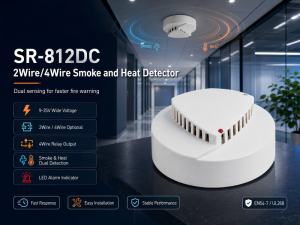
Most residential smoke alarms use photoelectric or ionization sensing. A photoelectric chamber directs light away from a receiver. When smoke particles enter, scattered light reaches the receiver and can trigger a warning. Ionization technology detects changes in a small electrical current as combustion particles enter its chamber.
Their response characteristics differ by fire conditions. NIST explains these principles in its smoke detector technology overview.
Within a smoke alarm vs CO alarm assessment, a key limitation is that ordinary photoelectric smoke sensing does not measure carbon monoxide concentration. A fire may produce both, but each function needs a suitable sensor.
How Does a Carbon Monoxide Alarm Detect Gas?
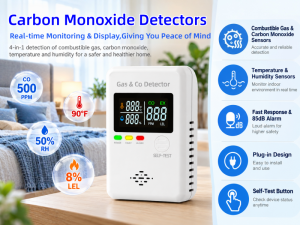
A CO alarm measures carbon monoxide in the surrounding air. Many residential units use electrochemical sensing: CO reacts at an electrode, creating a measurable electrical signal. The alarm’s electronics evaluate gas concentration and exposure over time against its programmed response criteria.
The smoke alarm vs CO alarm distinction also concerns timing. Smoke detection responds when sufficient particles reach a chamber. CO alarm response generally depends on both the concentration detected and the period of exposure, as defined by the device’s applicable standard.
CO may originate from faulty heaters, boilers, or vehicle exhaust without visible smoke.

Smoke Alarm vs CO Alarm: Detection Comparison
| Feature | Smoke Alarm | CO Alarm |
|---|---|---|
| Target | Airborne smoke particles | Carbon monoxide gas |
| Common sensor | Photoelectric or ionization | Electrochemical |
| Primary warning | Smoke associated with a fire | Harmful CO exposure |
| Does not normally detect | CO, methane, LPG | Smoke, methane, LPG |
| Typical application | Bedrooms, corridors, occupied floors | Sleeping areas and floors needing CO protection |
| Assessment basis | Smoke response and alarm coverage | CO concentration, exposure, and alarm coverage |
This smoke alarm vs CO alarm table describes standard single-function devices. Specialized multi-sensor units can monitor more than one hazard, but only when their specifications explicitly list the relevant functions.
What Can Neither Alarm Detect?
A standard smoke alarm should not be advertised as a carbon monoxide monitor. Likewise, a dedicated CO alarm does not replace a smoke alarm. Neither device automatically detects natural gas (methane) or liquefied petroleum gas (LPG).
A combustible gas detector uses technology selected for its stated target gas. Buyers searching for a smoke detector vs combustible gas detector should check the sensor’s gas type, alarm threshold, and environment rather than assume the word “gas” means CO.
For any smoke alarm vs CO alarm product listing, verify the actual detection functions on the datasheet. Displays, Wi-Fi, and buzzers do not add sensing functions.
Smoke Alarm, Smoke Detector, and CO Alarm: Are These Different Terms?
A residential smoke alarm usually contains both the smoke sensor and an audible warning device. In a building fire alarm system, a smoke detector may instead report a signal to a fire alarm control panel, which manages notification equipment.
A CO alarm incorporates its own warning function; a CO detector may be one element in a larger monitored system. Check wiring, sounder, and control-panel specifications.
The smoke alarm vs CO alarm terminology matters especially when importers translate specifications: “smoke detector,” “CO detector,” and “combustible gas detector” should not be treated as interchangeable product categories.
Where Do Smoke and CO Alarms Belong?
Location requirements are not identical. U.S. Fire Administration guidance calls for smoke alarms in bedrooms, outside separate sleeping areas, and on every home level. The U.S. Consumer Product Safety Commission recommends CO alarms on each level and outside sleeping areas.
For smoke alarm vs CO alarm placement decisions, check local codes, approved installation instructions, ventilation patterns, and audibility. Do not select mounting height simply by assuming CO either rises or sinks. Combination products must satisfy the placement requirements applicable to their design and intended location.
Test alarms as instructed, maintain power supplies, and replace equipment at the specified end-of-life. A test button does not by itself verify a gas sensor’s calibration.
What Should B2B Buyers Verify Before Ordering?
A useful smoke alarm vs CO alarm procurement review starts with five questions: What hazard is present? What sensing function is stated? Where will the device operate? What notification method is required? Which destination-market standard applies?
For example, UL Solutions distinguishes U.S. residential smoke alarms evaluated to UL 217 from CO alarms evaluated to UL 2034. Buyers should request model-specific evidence rather than infer compliance from a supplier’s general certificate.
SUMRING buyers who need more technical detail can review how CO detectors work, then explore the smoke and CO combo alarm selection guide or the separate stand-alone vs combination CO alarm comparison. These pages address related purchasing decisions.
FAQ
1. Can a smoke alarm detect carbon monoxide?
No. A standard smoke-only alarm does not contain a CO sensing function. Choose a separately specified CO alarm or a verified multi-function unit.
2. Will a CO alarm detect smoke from a fire?
No. A standard CO-only alarm measures CO, not smoke particles. It cannot substitute for required smoke detection.
3. Is a photoelectric smoke alarm the same as a CO detector?
No. Photoelectric technology detects light scattered by smoke particles; typical electrochemical CO sensing measures a gas-related electrical reaction.
4. Do CO alarms detect natural gas or LPG leaks?
Not unless the specific model includes dedicated sensing for those gases. Check its named target gases and certified functions.
5. Can both alarms activate during the same fire?
Yes, under some conditions, because combustion can produce smoke and CO. Their activation is not guaranteed to occur together.
6. What is the difference between a smoke detector and a smoke alarm?
A smoke alarm typically provides its own audible warning. A system smoke detector may send its signal to a control panel instead.
7. Are smoke and CO alarm installation positions identical?
Not necessarily. Each function has specific coverage and placement rules. Follow local codes and the product manufacturer’s instructions.
8. Which certifications should an importer request?
Request applicable, model-specific test reports and certificates for the destination market. U.S. smoke and CO alarm requirements commonly reference UL 217 and UL 2034 respectively.
Conclusion
The essential smoke alarm vs CO alarm difference is detection scope: smoke alarms sense combustion particles, while CO alarms monitor a poisonous gas that cannot be seen or smelled. Neither standard device replaces the other or automatically monitors methane or LPG.
For a reliable project specification, identify the hazard first, then confirm sensor type, alarm output, placement rules, service life, and documentation. SUMRING can discuss suitable detection configurations and OEM/ODM requirements against your stated market and project needs.