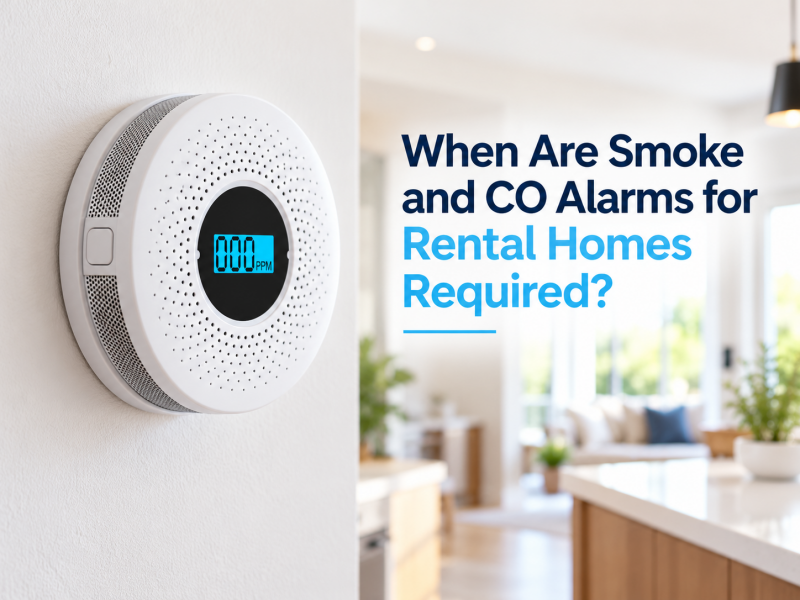
When Are Smoke and CO Alarms for Rental Homes Required?
Smoke and CO alarms for rental homes are residential safety devices that warn occupants of smoke from a potential fire, carbon monoxide (CO), or both. For landlords and B2B suppliers, their use is determined by local housing rules, the building layout, equipment risks, and ongoing maintenance duties—not simply by the number of apartments in a purchasing order.
Rental portfolios include older houses, newly built flats, and renovations. Assess each property before preparing a wholesale quotation.
Which Rental Events Trigger an Alarm Compliance Review?
For rental property smoke alarm compliance, landlords and property managers should review coverage before a new tenancy begins, after a substantial renovation, when fuel-burning equipment changes, and whenever an existing alarm fails or reaches its replacement date.
For distributors supplying smoke and CO alarms for rental homes, these events create distinct purchasing needs: initial installations, replacement stock, retrofit programmes, and ongoing maintenance inventory. A new tenancy calls for checking duties and device condition, not automatically replacing every alarm.
How Do Landlord Duties Differ Between England and the United States?
In England, landlord smoke and carbon monoxide alarm requirements include at least one smoke alarm on every storey containing living accommodation. A CO alarm is required in any room used as living accommodation that contains a fixed combustion appliance, excluding a gas cooker. Required alarms must be checked on the day a new tenancy begins, and faulty devices reported by tenants must be repaired or replaced as soon as reasonably practicable. See the UK Government’s landlord guidance.
In the United States, smoke and CO alarm obligations depend on state and local requirements, building classifications, and adopted codes. The U.S. Fire Administration recommends smoke alarms inside bedrooms, outside separate sleeping areas, and on every level. This recommendation should not be confused with a single nationwide rental-property law.
Before ordering smoke and CO alarms for rental homes, buyers should confirm the precise jurisdiction, dwelling type, and authority having jurisdiction. Rules for licensed shared housing or larger buildings can be different from those for individual rental houses.
Where Should Alarms Be Placed in a Rental Unit?
A floor plan—not a fixed “one alarm per apartment” assumption—should drive the device schedule. Identify bedrooms, hallways, occupied levels, appliances, ventilation patterns, and any requirement for interconnected warning.
Smoke and CO devices can have different positioning instructions. A combination unit is appropriate only when its approved mounting position satisfies both functions and the local rules. The U.S. Consumer Product Safety Commission offers general CO placement guidance.
For smoke and CO alarms for rental homes, installers should document each location, use the approved product instructions, and avoid assuming that placing one combined unit near a boiler protects every sleeping area.
What Product Evidence Should Procurement Teams Request?
Before approving a bulk order, request model-specific datasheets, test reports, relevant certification or listing records, installation instructions, battery information, end-of-life indicators, and replacement procedures.
For US projects, buyers may need to check applicable UL 217 smoke-alarm and UL 2034 CO-alarm listings. UL Solutions explains that combination models can be listed for both functions. Other markets may require different standards and acceptance documents. A manufacturer’s general certification statement never establishes approval for every individual model.
When sourcing smoke and CO alarms for rental homes, specify whether the project calls for replaceable batteries, sealed batteries, hardwired supply, interconnection, or additional accessible alerting features. Do not substitute one configuration without project approval.
For broader technical selection, read SUMRING’s smoke and CO combo alarm buying guide.
What Should Happen at Tenant Handover?
A practical handover includes an alarm test, a recorded device location, an installation or replacement date, and clear occupant instructions. Property managers should explain the normal test procedure, fault reporting channel, and what tenants should do if an alarm sounds.
During occupancy, assign responsibility for inspections and maintain a register of faults, repairs, and replacements. Local law and tenancy terms determine which tasks belong to the landlord or tenant. For smoke and CO alarms for rental homes, a documented workflow helps protect residents and supports consistent management across multiple sites.
A CO alarm does not replace inspection and maintenance of combustion appliances. A faulty alarm should never remain out of service merely because a tenant changeover is approaching.
How Can Distributors Build a Rental-Property Purchasing Plan?
Buyers seeking bulk smoke and CO alarms for property managers should group orders by dwelling type and compliance requirements rather than purchase one universal SKU. A useful request for quotation includes:
-
Destination country and applicable city or state
-
Number of properties, floors, bedrooms, and relevant appliances
-
Required alarm types, power methods, and interconnection
-
Model-specific approvals and documentation
-
Installation dates, spares, warranty, and lead time
-
OEM labels, multilingual manuals, packaging, and order volume
For smoke and CO alarms for rental homes, this approach helps wholesalers estimate quantities, stage deliveries, and prepare replacement stock without making unverified compliance promises.
Buyers managing a broader development can also review smoke and CO alarm project planning. For a product starting point, see the SUMRING SR-821THS smoke and CO detector. Confirm the current revision, documentation, and destination-market approval before specification.
What Does a 60-Unit Rental Retrofit Look Like?
Consider a property company upgrading 60 flats across three buildings. Its installer first inventories rooms, occupied levels, existing alarms, and fuel-burning appliances. The compliance manager verifies local requirements. Procurement groups approved devices and adds maintenance spares.
The resulting specification for smoke and CO alarms for rental homes may contain both separate and combination devices. The goal is not the fewest boxes; it is a verifiable, maintainable solution for each dwelling. The quantity cannot be determined from the number of flats alone.
FAQs
1. Do all rented homes legally need a CO alarm?
Not under one universal global rule. Requirements vary with location, appliances, building type, and local regulation. Check the governing law before purchase.
2. Must landlords test alarms when tenants move in?
In England, relevant landlords must check prescribed alarms on the day a new tenancy starts. Other markets set their own testing duties.
3. Can one combination alarm cover an entire apartment?
Only if the applicable code, floor plan, and approved installation instructions allow it. Multiple locations may be necessary.
4. Are battery alarms permitted in rentals?
For smoke and CO alarms for rental homes, some jurisdictions permit battery devices; others specify battery types or wiring. Verify local requirements.
5. Who replaces an alarm reported as faulty?
Responsibility depends on local law. In England, relevant landlords must arrange repair or replacement once a reported prescribed alarm is found faulty.
6. Can wholesalers request custom branding?
Yes. An OEM and ODM fire alarm manufacturer may discuss labeling, manuals, and packaging, subject to the certified product configuration.
7. What should a bulk RFQ for smoke and CO alarms for rental homes include?
State the destination market, quantity, applicable standards, mounting requirements, power supply, expected delivery, and supporting documents.
8. How often should rental alarms be replaced?
Follow each model’s stated service life, end-of-life indication, and applicable local rules; never assume every smoke and CO alarm has the same lifespan.
Conclusion
Choosing smoke and CO alarms for rental homes begins with the landlord’s legal obligations and ends with an installation record that can be checked. Different properties may need different devices, approvals, and maintenance schedules.
SUMRING supports B2B distributors, installers, and property-project buyers with product discussions, sample evaluation, and OEM/ODM enquiries. Send your destination market, target volume, and required standards to request a model-specific proposal—then confirm approval with the relevant local authority before installation.