How Can B2B Buyers Verify Smoke and CO Alarm Certification?
Smoke and CO alarm certification is evidence that a specified combination smoke and carbon monoxide alarm has been assessed against applicable safety requirements. For importers, contractors, and private-label brands, the key question is whether documents cover the exact alarm, market, and production version ordered.
This guide explains certification lookups, model matching, OEM changes, and approval before bulk purchasing.
1. What Requirements Apply in the Destination Market?
Start with the destination country and intended installation. A standalone domestic alarm, an interconnected residential device, and a detector connected to a commercial fire alarm panel may follow different approval routes. Requirements can also differ by occupancy and locality.
Create a written specification identifying the product category, intended users, battery or mains supply, installation arrangement, and required approvals. Confirm country-specific rules with the responsible authority or consultant.
Effective smoke and CO alarm certification checks begin with this application definition. A recognizable certification mark does not automatically make a product suitable for every project.
For broader residential equipment selection, see the smoke and CO combo alarm buyer’s guide.
2. Are Both Detection Functions Covered by the Standards?
In the United States, UL 217 covers smoke alarms and UL 2034 covers single- and multiple-station carbon monoxide alarms. UL Solutions explains that combination alarms can be Listed when both sets of relevant requirements are satisfied. UL 268, by contrast, addresses smoke detectors used in fire alarm systems; it is not an automatic substitute for domestic smoke-alarm evaluation.
For European or UK sourcing, EN 14604 addresses household smoke-alarm devices, while EN 50291-1 addresses CO detection apparatus for domestic premises. Check applicable editions, marking, and national rules. For smoke alarms under applicable EU construction-product rules, check the Declaration of Performance and notified-body details. CE marking alone is not proof of UL certification or every claimed CO function.
Always confirm smoke and CO alarm certification for both hazards rather than accepting a smoke-only or CO-only document.
3. How Can Buyers Check an Official Certification Record?
Request the issuer’s name, certificate or file number, legal certificate holder, certified models, applicable standards, and current status. Compare those details with the product label and supplier quotation.
For UL Solutions certifications, search UL Product iQ. For ETL claims, use Intertek’s certified product directories. For other certification marks, use the issuing body’s official directory or request written verification directly from the issuer.
This is the most important part of smoke and CO alarm certification verification: a genuine certificate may belong to a different legal entity, product family, or discontinued configuration. If a listing is missing, request clarification from the issuer.
4. Does the Test Report Match the Ordered Model?
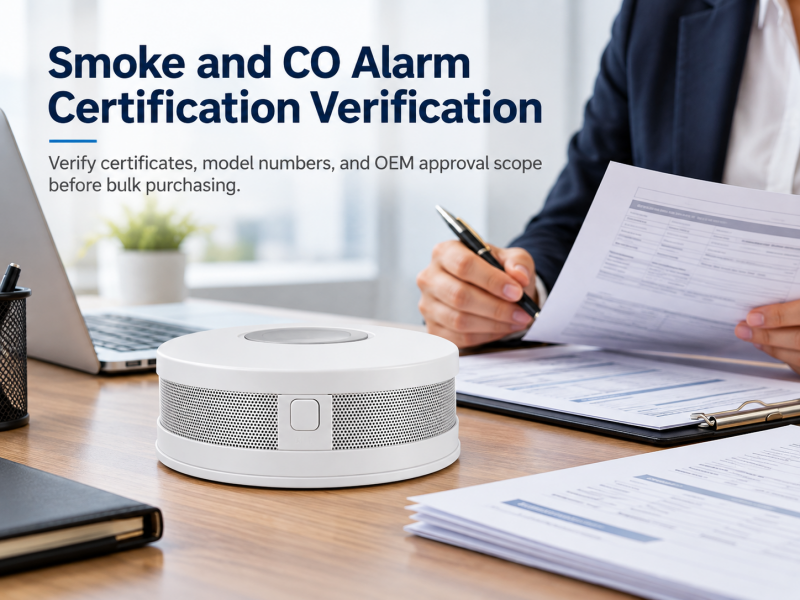
The phrase smoke and CO alarm test report requirements should lead buyers to model-specific evidence, not a generic laboratory PDF. Check the report number, issuing laboratory, test dates, standards and editions, sample description, and tested configuration.
Pay particular attention to sensor type, power supply, printed circuit board revision, enclosure, firmware, labeling, and model suffix. Request the approved model schedule when several variants share a product family name. Distinguish laboratory testing from an active certification scheme.
Reliable smoke and CO alarm certification decisions connect the report, listed model, and physical sample. For a product-information example, examine the SR-821THS smoke and carbon monoxide detector; obtain separate confirmation of its market-specific approvals before making any certification claim.
5. Can an OEM Brand Use the Manufacturer’s Approval?
The question behind private label smoke and CO alarm certification is whether a proposed brand, label, and product version remain within an approved certification scope.
Branding, model renaming, instructions, packaging, and replacement parts can trigger different reviews. A new sensor, battery chemistry, circuit design, firmware, or housing can affect certified performance. Ask the certificate holder and certification body what must be reviewed, added to a listing, or retested before shipment.
For OEM/ODM purchase agreements, identify the legal holder of the approval, approved factory, permitted marks, label-artwork approval process, and responsibility for future changes. Do not assume smoke and CO alarm certification transfers automatically when a distributor adopts a new brand name.
See our battery-operated smoke and carbon monoxide detector guide for product customization and evaluation considerations.
6. Will Mass Production Remain Consistent With the Approved Sample?
Certification paperwork cannot replace manufacturing controls. Ask the factory how it manages incoming sensors, electronic components, calibration, alarm-function checks, batch traceability, and engineering changes. Request an agreed sample-inspection plan and procedures for handling nonconforming units.
An ISO 9001 quality-management certificate can support factory assessment, but it does not certify a particular combination alarm. Require notification before compliance-relevant changes.
Continuous smoke and CO alarm certification assurance depends on matching production units to the approved design, not simply keeping an old PDF on file.
7. What Evidence Should Be Approved Before the Purchase Order?
Create one compliance file for each model and destination market. Record the official directory result, certificate holder, approved variants, standards and editions, reports, product labels, manuals, relevant declarations, and authorized OEM arrangements. Record the verification date and reviewer.
For smoke and CO alarm compliance for importers, also confirm customs documentation, local-language instructions, packaging claims, and any required registration or project acceptance. Resolve conflicting model numbers before authorizing packaging or paying for bulk production.
A smoke and CO alarm certification checklist helps prevent unsupported claims, tender delays, and rework. For building-specific procurement, consult our smoke and CO alarm project planning guide.
FAQs
1. Is a laboratory test report the same as certification?
No. A report records test results; certification indicates status under a specified scheme. Confirm each document’s scope.
2. Does a CE mark prove that an alarm is UL Listed?
No. CE and UL follow different frameworks. Check applicable destination-market rules.
3. Must a combination alarm satisfy both smoke and CO standards?
Buyers claiming compliance for both functions should obtain evidence addressing both hazards under the applicable standards and approval system.
4. Can buyers verify certificates without contacting the manufacturer?
Often. Search the issuer’s directory by file number or model. For smoke and CO alarm certification, clarify uncertain records directly with the certification body.
5. Can a private-label model share an existing certificate?
Possibly, depending on the certification program and approved changes. Written confirmation is necessary before using a mark or stating that the new model is certified.
6. What if a model number does not appear in the listing?
Request an updated model schedule or issuer confirmation. A similar-looking model number is not sufficient evidence of coverage.
7. Is ISO 9001 sufficient for market access?
No. ISO 9001 relates to a manufacturer’s quality-management system and does not replace product testing, certification, or legal market-entry requirements.
8. Which documents should an importer request before payment?
Request model-specific test reports, current listing evidence, datasheets, approved labels, user instructions, applicable declarations, and records covering planned OEM modifications.
Conclusion
Smoke and CO alarm certification is most useful when buyers can trace every compliance claim from the applicable standard to the official record, exact product model, and approved production version.
SUMRING works with overseas distributors, contractors, and OEM/ODM buyers on model selection, technical-document requests, sample evaluation, and project-specific sourcing. Available approvals depend on the actual model and market; certification for one product should never be presented as approval for another.
Send your destination country, target standards, expected quantity, branding needs, and documentation checklist through SUMRING’s contact page to discuss an appropriate sourcing and verification process.