What Are Bus-Type Fire and Alarm Systems? A Guide to Working Principles, Wiring and System Selection
How Do Bus-Type Fire and Alarm Systems Work?
Fire and alarm systems are coordinated safety networks that detect possible fire conditions, communicate events to a control unit, and activate the required warnings or building interfaces. A bus-type automatic fire alarm system is an addressable arrangement in which compatible devices exchange information with a microprocessor-based panel over a shared communication circuit. This distinction matters when distributors and contractors select compatible equipment.
What Does “Bus-Type” Mean in a Fire Alarm Network?
In this context, a bus is a shared communication pathway linking multiple field devices to the controller. Each compatible detector or interface module receives an individual address, allowing the control panel to identify which point is reporting an event. The panel communicates with connected devices according to the manufacturer’s protocol, often through repeated polling and responses.
Unlike simple zone-based indication, address identification can pinpoint a particular detector, call point, or module. However, the terms “bus-type” and “addressable” do not guarantee that products from different manufacturers can communicate with one another. Buyers assessing fire and alarm systems need a confirmed compatibility list.
How Does the Controller Receive and Process Signals?
A microprocessor-based controller supervises the network and processes messages from devices. Under normal conditions, it checks communications and relevant circuit conditions. If a compatible detector reports an alarm, the panel identifies its address, applies programmed logic, and activates outputs specified in the approved design.
For example, a warehouse detector may report an alarm. The panel identifies its programmed location and initiates the designated response. Interface modules may monitor equipment status or command approved safety equipment.
This address-by-address process is why bus-type fire and alarm systems can offer more precise event information than a conventional zone circuit. Functions depend on devices, firmware, and programming.
Are Two-Wire, Three-Wire, and Four-Wire Designs the Same?
No. The original description of bus systems includes two-wire, three-wire, and four-wire arrangements, but wire count alone cannot identify a system’s communication method.
Some addressable signaling line circuits combine power and communication on a pair of conductors. Other products may require separate conductors or additional power connections. Notification appliances and interface modules may also use separate circuits rather than drawing all power from the addressable bus.
For fire and alarm systems, a two-wire addressable fire alarm loop should never be assumed interchangeable with a conventional two-wire detector circuit. Confirm the actual wiring diagram, polarity, voltage range, permitted topology, loop capacity, cable limits, and supervision requirements before ordering equipment. Follow manufacturer instructions.

Which Components Participate in Bus Communication?
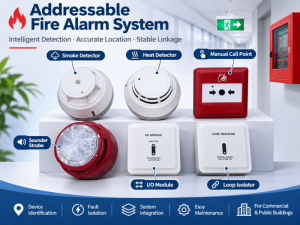
An addressable network can include compatible smoke detectors, heat detectors, manual call points, monitoring modules, control modules, and circuit isolators. Not every alarm bell, sounder, or strobe communicates directly on the bus; some notification products require a dedicated circuit or approved interface.
The role of addressable fire alarm system interface modules is particularly important when a project requires monitoring or control beyond basic detection. The module’s input behavior, output ratings, and approved control functions must match the installation specification.
For a closer look at individual component roles, see SUMRING’s addressable fire alarm system device compatibility guide. It covers device-level procurement checks.
Can a Bus-Type System Detect Faults and Support Linkage?
Many controllers supervise communication and wiring, allowing them to report trouble conditions such as missing devices or circuit interruptions. Some older address-coded arrangements provide only limited fault details, while more advanced products can identify additional device or circuit conditions.
Similarly, certain older detector designs use factory-set alarm thresholds. Adjustable sensitivity and advanced analog reporting are available only where the selected device and panel support them. Neither capability should be assumed from the word “addressable.”
Programmable cause-and-effect logic is another advantage. Properly specified fire and alarm systems may operate compatible output modules to support functions involving fire doors, smoke control, or other approved building interfaces. Such functions require engineering review, verified equipment ratings, and documented commissioning.
Bus-Type vs. Conventional: What Changes for Buyers?
| Procurement issue | Conventional architecture | Bus-type addressable architecture |
|---|---|---|
| Alarm identification | Usually identifies a zone | Can identify a specific addressed point |
| Field communication | Zone-based initiating circuits | Manufacturer-specific address communication |
| Programming | Generally simpler zone logic | Potentially more detailed cause-and-effect logic |
| Expansion | Subject to zone and panel limits | Subject to loop, address, and panel limits |
| Maintenance | Locate an event within the zone | Investigate the reported address or fault |
Neither architecture is automatically the best choice. Smaller projects may prioritize simplicity; larger or more complex facilities may benefit from greater location detail and programmable integration. The correct selection for fire and alarm systems depends on the approved design, lifecycle cost, and local requirements.
What Should B2B Buyers Verify Before Procurement?
For a bus-type fire alarm system supplier evaluation, request a complete equipment schedule rather than purchasing detectors by appearance or voltage alone. Essential documents include a panel-to-device compatibility matrix, loop loading calculations, supported addressing range, cable and topology requirements, and cause-and-effect description.
Also verify the exact model’s approvals, replacement availability, programming tools, technical documentation, and OEM/ODM customization scope. A private-label change, firmware modification, or enclosure redesign can affect approval status; confirm the impact before production.
Compare landed equipment costs alongside commissioning effort and future service access. A lower component price does not necessarily mean a lower project cost when proprietary protocol restrictions or unavailable replacement parts are involved. These checks make fire and alarm systems sourcing more reliable for integrators and international distributors.
What Standards and Installation Rules Matter?
Requirements depend on the market, occupancy, and local authority. In the United States, NFPA 72 is a major reference for fire alarm and signaling design and related practices. NFPA’s Guide to Fire Alarm Basics distinguishes conventional initiating device circuits from addressable signaling line circuits.
Other markets may specify relevant parts of EN 54 or additional national requirements. Compliance must be checked against individual components, the complete design, and the required approvals. Because fire and alarm systems are safety-critical, component certificates do not establish approval for the complete installation.
FAQs
1. Is a bus-type fire alarm system always addressable?
In this article, “bus-type” means an address-coded fire alarm network. Other industries also use the word “bus,” so project specifications should explicitly identify the intended fire alarm protocol and equipment family.
2. Do addressable devices from different brands work together?
Not necessarily. Similar wiring and voltage are insufficient. Verify communication protocol and the controller manufacturer’s supported device list before purchase.
3. Can a two-wire conventional detector connect directly to an addressable loop?
Usually not without an appropriate approved interface. Review the control panel’s technical documentation and device compatibility requirements.
4. Does every addressable detector have adjustable sensitivity?
No. Some devices use factory-set thresholds; others permit adjustments through compatible panel functions. Check the specific detector and controller documentation.
5. Can a bus system identify open circuits or missing devices?
Many can report such troubles, but diagnostic detail and the affected coverage depend on topology, isolators, and panel capabilities.
6. Are sounders and strobes always connected to the same bus?
No. Depending on design, notification equipment may use a separate notification appliance circuit, loop-powered device, or interface module.
7. What is the most important document for OEM or project buyers?
A written compatibility matrix is critical. It should be reviewed together with the approved device schedule, wiring documentation, certifications, and commissioning requirements.
Conclusion
Bus-type fire and alarm systems use addressed communication between field devices and a microprocessor-based controller to identify events and support programmable responses. Their practical value comes from correct protocol matching, circuit engineering, fault supervision, and verified integration—not simply from the number of wires.
For B2B procurement, SUMRING can discuss suitable fire safety product categories and potential OEM/ODM requirements based on your project specifications. Confirm model-specific compatibility, approvals, and system responsibilities before placing an order.