How Do Fire Detection and Warning Devices Work Together?
Which Devices Work Together in a Conventional Fire Alarm System?
A conventional fire alarm system is a zone-based network of fire detection, manual activation, control, and warning equipment. Instead of identifying every initiating device individually, its control panel normally indicates the affected zone. For B2B buyers, the challenge is verifying that these devices can operate together within project requirements.
Why Must Conventional Fire Alarm Devices Be Matched as a System?
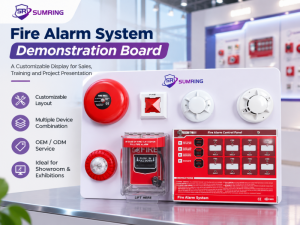
A conventional fire alarm system depends on coordinated inputs and outputs. A smoke detector, heat detector, or manual call point sends a signal through a monitored initiating circuit. The control panel interprets that condition and activates configured notification circuits. Audible and visual appliances then warn occupants; approved interfaces may perform additional building-safety functions.
This arrangement suits recognizable building zones but cannot normally identify an individual detector. Zone labeling and circuit supervision remain essential.

Which Seven Device Groups Work Together?
1. Conventional Fire Alarm Control Panel
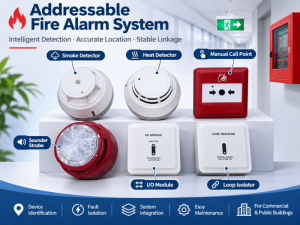
The fire alarm control panel (FACP) receives initiating signals, identifies the alarm zone, supervises supported circuits, and operates assigned outputs. Buyers should confirm zone quantity, permitted devices per circuit, alarm-output capacity, fault indicators, and any relay or auxiliary terminals. Not every accessory is compatible.
For a conventional fire alarm system, the approved panel documentation should be the starting point for the complete device schedule rather than an afterthought.
2. Wired Smoke Detectors
Smoke detectors sense smoke according to their detection technology and send an alarm condition to the compatible panel. Select them for the actual installation environment, mounting requirements, and maintenance conditions. Conventional and addressable models are not interchangeable.
For conventional smoke and heat detector selection, check detector bases, standby current, alarm characteristics, reset behavior, and whether the panel supports the proposed two-wire or separately powered arrangement.
3. Wired Heat Detectors
Heat detectors respond to specified temperature conditions or temperature rise, depending on design. They may suit locations where smoke detection is inappropriate, but cannot automatically replace smoke detectors. Verify operating temperature, wiring, and application requirements.
4. Manual Call Points or Pull Stations
Manual devices allow someone who observes a fire to initiate an alarm without waiting for automatic detection. Terminology varies: manual call point internationally, pull station in North America. Verify contacts, reset method, protection, and accessibility.
In a conventional fire alarm system, a manually operated device must produce the expected panel response and remain identifiable in the correct zone.
5. Fire Alarm Bells, Horns, and Electronic Sounders
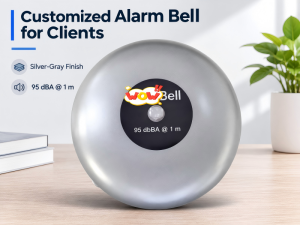
Audible appliances provide the warning people can hear. Conventional projects may use motorized bells, electronic sounders, horns, or sirens, depending on design and market practice. Their sound patterns, output levels, power needs, and mounting requirements differ.
Specify fire alarm sounder and strobe requirements against the applicable project rules. Do not assume a particular European siren tone or North American horn pattern applies to every installation.
6. Strobes and Voice Notification Equipment
Visual warning devices complement audible alarms, particularly where the design requires visible notification. Combined sounder-strobes are another option, provided the control panel or power supply can operate their specified load and synchronization requirements.
Speaker-strobes and recorded evacuation messages require a suitable voice alarm or emergency communication arrangement. A basic conventional control panel does not necessarily include that capability. Message wording and sequencing must match the approved evacuation plan.
7. Power Supplies, Monitored Circuits, and Interfaces
Power continuity and monitored wiring support the entire installation. The system may require a suitable standby battery arrangement, supervised initiating and notification circuits, and correctly specified end-of-line devices. Optional interfaces depend on the panel and approved design.
A conventional fire alarm system should be evaluated as a complete electrical load, including normal operation, alarm demand, and standby requirements—not merely as a set of separately priced products.

How Does the Alarm Sequence Work in Practice?
Consider a small commercial building with separate zones for its reception area, office floor, and storeroom. If a compatible smoke detector activates in the storeroom, the panel indicates that zone and operates programmed warning outputs. The display generally does not identify the exact initiating detector. Manual call point activation follows the same sequence.
The sequence is initiation, panel response, notification, and approved auxiliary actions. This is why conventional fire alarm system components must be verified together during commissioning rather than tested only as individual products.
What Should Overseas B2B Buyers Check Before Ordering?
Use a documented compatibility checklist before requesting a quotation:
| Check | Evidence to Request |
|---|---|
| Panel and detection circuits | Model-specific compatibility list, zone limits, wiring instructions |
| Alarm appliances | Voltage, current, output loading, acoustic and visual specifications |
| Power and supervision | Battery calculation, end-of-line details, fault-monitoring behavior |
| Project compliance | Applicable approval documents for each exact device configuration |
| Acceptance and maintenance | Wiring diagrams, commissioning procedure, replacement-part availability |
For conventional fire alarm wiring compatibility, matching nominal voltage alone is insufficient. Detector operating modes, circuit resistance, sounder loading, supervision arrangements, and the panel’s published limitations must also be reviewed.
Requirements differ by destination country and authority having jurisdiction. For U.S. projects, consult the NFPA 72 fire alarm and signaling standards information. In EN 54 markets, request the relevant model-specific evidence instead of assuming that one certificate covers every component or customized version.
For panel selection, read SUMRING’s conventional control panel selection guide.
An OEM conventional fire alarm system supplier should be able to discuss product labeling, documentation, packaging, and device availability while distinguishing customization options from approved technical configurations. SUMRING supports project discussions with overseas distributors and integrators; final suitability must be confirmed against the proposed equipment and destination-market requirements.
Frequently Asked Questions
1. Can smoke detectors and heat detectors share one conventional zone?
Sometimes, if the panel and both device types are explicitly compatible and the engineered zone design allows it. Check the manufacturer’s instructions and applicable local requirements.
2. Does every conventional detector have a unique address?
No. A conventional fire alarm system normally indicates the activated zone, not an individual device address. Accurate zone labeling helps responders locate the event.
3. Can a conventional panel operate a sounder-strobe?
Potentially, if the notification output, wiring, voltage, current capacity, and any synchronization needs are supported. Confirm the exact product combination.
4. Can a standard panel play voice evacuation instructions?
Not necessarily. Voice messages normally need compatible voice alarm or emergency communication equipment and an approved design.
5. Are fire alarm bells interchangeable with horns?
No. They can serve similar audible-warning purposes, but sound characteristics, electrical requirements, and applicable rules may differ.
6. Can a carbon monoxide detector connect to the panel?
Only where a compatible interface, permitted signal treatment, and project design support it. Carbon monoxide alarms should not be assumed to behave like ordinary fire alarm initiating devices.
7. What documents should OEM and ODM buyers request?
For a conventional fire alarm system, request datasheets, wiring diagrams, compatibility evidence, applicable certificates, packaging details, and acceptance-test procedures.
Conclusion
A reliable conventional fire alarm system coordinates smoke and heat detection, manual activation, panel supervision, audible warnings, visual or voice notification where specified, and dependable power. For international buyers, component compatibility and documented performance are more important than a visually matched product list. Share your project specification with SUMRING to review potential equipment combinations and OEM/ODM requirements before procurement.