

smoke detector manufacturer
24
2026-09
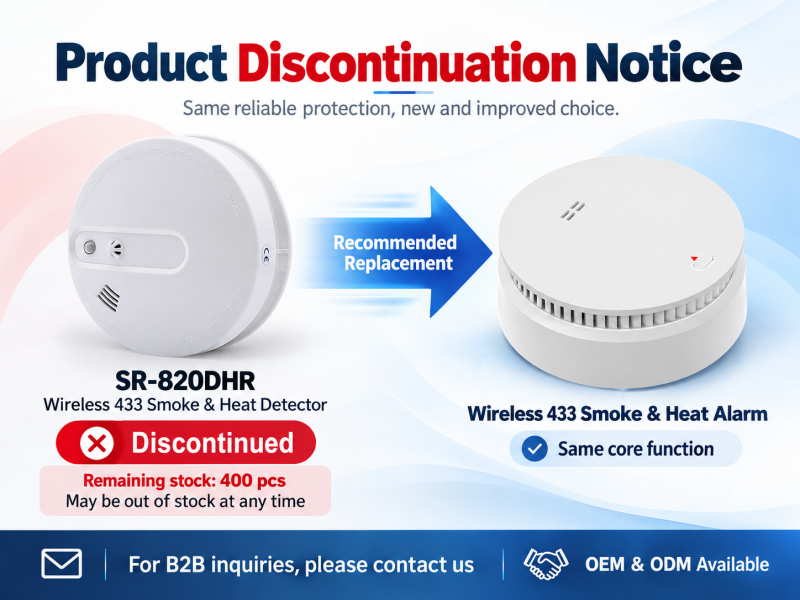
Wireless 433 Smoke & Heat Detector Replacement Notice
SUMRING is issuing a product lifecycle update for B2B distributors, wholesalers, installers, contractors, and trading partners. The SR-820DHR Wireless 433 Smoke & Heat Detector has been discontinued. At present, approximately 400 units remain in stock, and availability may change quickly as existing inventory is allocated. For customers who still require the SR-820DHR for existing orders, replacement projects, or channel inventory, we recommend confirming stock before placing a purchase order. Once the remaining inventory is sold, this model will no longer be available for regular supply. A Replacement Is Available for New Inquiries To support continuity for ongoing customer inquiries, Sumring can now recommend a current wireless 433 smoke & heat detector with the same core application: combined smoke and heat detection with 433 MHz wireless communication. For existing installations, follow our 433MHz smoke and heat detector replacement guide to check the installed host, run a sample pilot, and plan a phased rollout before approving the new model. This replacement provides distributors, installers, project contractors, and trading companies with a practical alternative when the original SR-820DHR is no longer available. For distributors and contractors evaluating replacement options, choosing a new wireless detector requires more than matching the 433MHz frequency. RF protocol......
18
2026-09
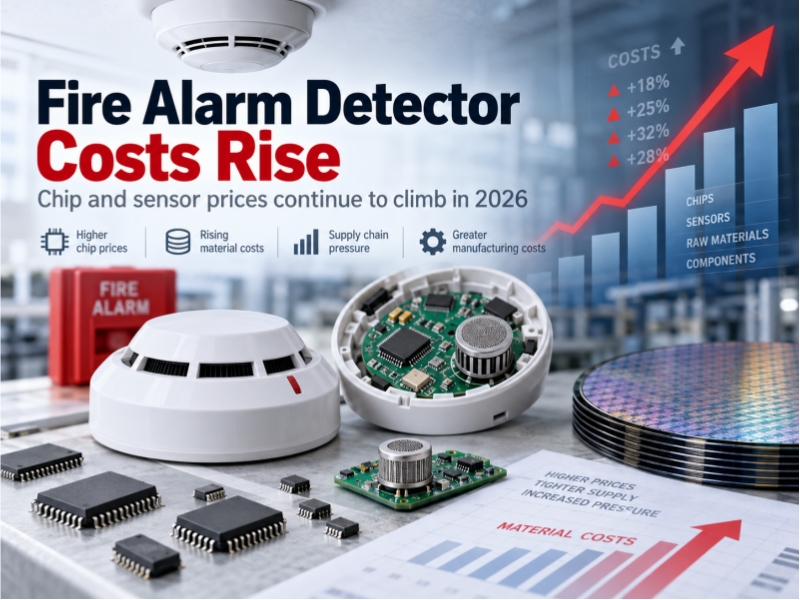
Fire Alarm Detector Costs Rise as Chip Prices Surge 20%
2026 Industry Notice: Rising Raw Material and Chip Prices Are Increasing Fire Alarm Detector Manufacturing Costs In 2026, the fire alarm detector cost structure is facing increasing pressure as prices for semiconductor chips, sensor components, electronic materials, and manufacturing services continue to rise. From CIS image sensors and MCUs to power-management components and structural materials, cost increases across the upstream supply chain are gradually being transmitted to fire alarm detector manufacturers and downstream buyers. For distributors, system integrators, project contractors, and fire alarm equipment importers, closer attention to purchasing schedules, inventory planning, and supplier stability is becoming increasingly important. Direct Materials Represent More Than 80% of Detector Costs Raw materials used in fire alarm detectors can generally be divided into three categories: core electronic components, structural parts, and auxiliary materials. In many detector designs, direct materials represent the majority of total manufacturing cost and may account for more than 80% of the product cost structure. A typical bill of materials may include: Sensor modules, photoelectric components, or CO sensors: approximately 20%–30% MCU, SoC, and communication modules: approximately 15%–25% Power supply and battery-management components: approximately 10%–15% PCB, housing, connectors, buzzers, LEDs, terminals, and other components Photoelectric smoke detectors depend heavily on......
31
2024-08
How Are Smoke and CO Combo Alarms Quality-Tested Before Shipment?
The term smoke and CO alarm testing means verifying a combination alarm’s smoke sensor, carbon monoxide sensor, electronics, warning functions, and batch consistency before shipment. Factory screening, laboratory performance evaluation, and certification testing are different activities. For overseas distributors, contractors, and private-label brands, documented checks help reduce quality disputes and costly returns. A convincing supplier audit follows the product from purchased components through functional inspection to shipment release. Why Must Both Sensing Functions Be Verified Separately? A combination alarm contains two different safety functions. A buzzer test cannot demonstrate sensor performance, and passing a smoke test does not prove CO detection. A credible smoke and CO alarm testing plan therefore separates smoke-channel verification, CO-channel verification, shared electronics, and complete-device checks. Buyers should request the approved test plan, applicable acceptance criteria, and records identifying the model and production lot. Which Incoming Materials Should Be Inspected? Incoming checks may cover sensors, circuit boards, battery contacts, sounders, LEDs, housings, and packaging. Each component needs defined acceptance criteria and an appropriate inspection method. Incoming inspection records should identify supplier lots and document any rejected materials. For international purchasing programs, this creates a clearer basis for resolving recurring component problems. In a dual-sensor smoke and......
18
2022-10
How Should B2B Buyers Evaluate 10 Year Tamper Proof Smoke Detectors?
Let's Discuss Your Project
Contact us for suitable solution, and to meet your needs with maximum efficiency!
1. How can I become a SUMRING distributor?
We welcome global partners for fire alarm system distribution.You can apply for:Regional distributor rights,OEM branding cooperation,Project-based supply agreements,Long-term B2B partnership,Contact us to discuss your target market and business plan.
2. Why choose SUMRING fire alarm systems?
Our Key advantages include:Factory-direct fire alarm manufacturer pricing;Fast delivery for urgent engineering projects;Complete fire detection product portfolio;OEM/ODM customization capability;Stable quality control under ISO9001 system;Suitable for global mid-tier fire protection projects.
3. Do you provide technical support for fire alarm systems?
Yes, we provide full technical support including:Fire alarm system installation guidance,Wiring and configuration support,Troubleshooting assistance,Project-based consultation for distributors and contractors.
4. What shipping methods are available for fire alarm products?
We offer global logistics solutions:Sea freight (main export via Shenzhen / Hong Kong ports),Air freight,Express delivery (DHL, FedEx, UPS, TNT),China-Europe Railway Express (for EU markets).