How Does the SR-915 Smart WiFi Gas Detector Work?
SR-915 Smart WiFi Gas Detector: 7 Powerful Safety Facts
A gas leak rarely starts with noise. It spreads quietly through a kitchen, rental apartment, hotel room, or small shop. No smoke. No sparks. No clear warning at first. That is exactly why the SR-915 Smart WiFi Gas Detector matters.
The SR-915 Smart WiFi Gas Detector monitors CH4 methane gas and warns users through local sound-light alarm and Tuya App remote alerts. For B2B wholesalers, safety product distributors, and engineering contractors, it is more than another wall-mounted alarm. It is a compact early-warning point for modern indoor gas safety projects.
So, how does it work? Let me explain it in a practical way.
Table of Contents
- How gas sensing works
- What happens during an alarm
- Why WiFi and Tuya App alerts matter
- Where to install the detector
- Why it fits B2B gas safety projects
- FAQ
What Does the SR-915 Smart WiFi Gas Detector Do?
The SR-915 Smart WiFi Gas Detector monitors indoor air for combustible gas, especially CH4 methane. Methane is often linked with natural gas use in kitchens, apartments, hotels, dormitories, rental homes, and small commercial spaces.
When gas escapes from a pipe, stove connector, appliance, or valve, the detector checks the nearby air. If the concentration reaches the alarm level, it sends a warning. Simple? Yes. But in gas safety, simple and clear is often the strongest design.
For project buyers, the detector helps build a safer indoor gas monitoring plan. Nearby people get a local alarm, while users away from the room can receive app alerts.
First, the Sensor Notices Gas Before People Do
People may not smell gas fast enough. Someone may be asleep. A tenant may be out. Airflow may move the gas away before anyone notices. The SR-915 Smart WiFi Gas Detector is built to keep watching the space.
Its gas sensing element reacts when CH4 concentration changes in the surrounding air. The sensor sends a signal to the internal control circuit. Then the device judges whether the condition is normal or risky.
That is the first key layer: detection. Without steady detection, an alarm is only a plastic shell on the wall. The SR-915 Smart WiFi Gas Detector turns air changes into a readable safety signal.
Then the Circuit Decides When to Alarm
Detection alone is not enough. The detector also needs to decide when a warning should happen. Inside the SR-915 Smart WiFi Gas Detector, the control circuit reads the sensor signal and compares it with the alarm setting.
If the gas level is normal, the device stays in monitoring mode. If the gas level reaches the alarm range, the warning starts. This helps users act instead of guessing.
You know what matters in a real gas leak? Speed and clarity. Nobody wants a vague signal. Sound and light warnings help nearby people notice the risk quickly.
Local Alarm Comes First
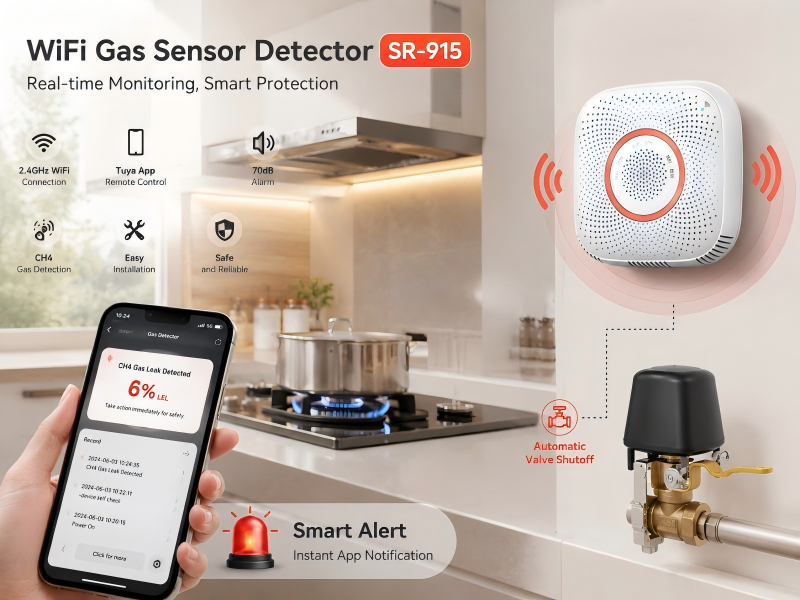
When a gas leak is detected, the SR-915 Smart WiFi Gas Detector can trigger an audible warning and a visual alarm indicator. Its product information highlights a sound-light alarm with ≥70dB alarm sound.
That local alarm matters. A phone may be muted. The network may be weak. A user may not check app messages right away. But people close to the gas source still need a direct signal.
For contractors, this makes the detector useful in apartments, small restaurants, hotel rooms, rental homes, and shared staff areas. It can serve as a daily safety point in spaces where gas appliances are used often.
WiFi Sends the Warning Beyond the Room
The smart part comes next. The SR-915 Smart WiFi Gas Detector supports 2.4GHz WiFi and works with the Tuya App. Through the app, users can check device status and receive remote alerts.
Here is the clean way to understand it: WiFi does not detect gas. The sensor detects gas. The circuit judges the level. The local alarm warns nearby people. WiFi carries the message to the user’s phone.
That is why the detector fits smart home safety, rental property management, and light commercial projects. If nobody is near the kitchen, the app alert still helps the user know something is wrong.
For B2B sales, this point is easy to explain: local alarm plus remote app notification. It is practical, clear, and easy for buyers to understand.
Why 2.4GHz WiFi Makes Sense?
Some buyers ask, “Why 2.4GHz WiFi?” Fair question.
For many smart safety devices, 2.4GHz is widely used because it works with most home routers and supports broad indoor coverage. A gas detector does not need high-speed video data. It needs stable status reporting and alarm communication.
During installation, contractors should check the WiFi signal before final mounting. If the signal is weak, local alarm can still work, but remote app messages may not arrive smoothly. Small detail. Big difference.
Can It Work With Valve Linkage?
In some smart gas safety setups, the SR-915 Smart WiFi Gas Detector can be used with gas valve shutoff linkage, depending on the full system design and compatible accessories.
This matters for engineering projects. Many contractors are not only asking, “Can it alarm?” They also ask, “Can it help reduce risk after detection?” When matched with the right valve actuator, the system can help close the gas source after an alarm signal.
Valve linkage should be planned carefully. Gas pipe type, valve size, actuator match, installation position, and local project rules all matter. Still, for apartments, rental housing, staff dormitories, and smart kitchen projects, this feature can make the detector more attractive.
Where Should the Detector Be Installed?
Placement should match the gas type and room layout. Since methane is lighter than air, a natural gas detector is usually installed higher on the wall and near the possible leak source.
Avoid spots with heavy steam, thick cooking oil smoke, direct wind, or blocked airflow. A detector hidden behind a cabinet may look neat, but it may not sense gas well. Pretty placement is not always safe placement.
Common application areas include residential kitchens, rental apartments, hotels, serviced apartments, small restaurants, staff dormitories, smart home gas safety projects, and gas appliance rooms.
Why B2B Buyers Can Position It Easily?
For wholesalers, the SR-915 Smart WiFi Gas Detector has a clear market story. Gas safety is not a luxury add-on. It is a daily safety need in many homes and commercial spaces.
For project contractors, the value is more practical. They care about app setup, installation flow, after-sales questions, and whether users can understand the product quickly. A device with CH4 gas detection, Tuya App alerts, sound-light alarm, and possible valve linkage is easier to present as a complete indoor gas safety solution.
For distributors, the detector also works well in product pages, dealer catalogs, smart home safety bundles, and project proposals. It gives a simple message: detect early, alarm clearly, and notify remotely.
A Small Device, But a Serious Safety Layer
The SR-915 Smart WiFi Gas Detector works through a clear process. It senses CH4 gas, checks the concentration, triggers a sound-light alarm, sends Tuya App alerts, and supports smart safety linkage when the right system is used.
That is a lot for a compact detector. And honestly, that is the point. A good gas detector should sit quietly, watch the air, and speak up when something is wrong.
For B2B buyers, the SR-915 Smart WiFi Gas Detector brings together smart monitoring and practical installation value. For end users, it adds one more chance to catch a gas leak early. Small device. Serious job.
FAQ:
1. What gas does the SR-915 Smart WiFi Gas Detector detect?
The SR-915 Smart WiFi Gas Detector is designed for CH4 methane gas detection, making it suitable for natural gas leak monitoring in kitchens and indoor gas appliance areas.
2. Does the SR-915 support Tuya App alerts?
Yes. The detector supports Tuya App remote alerts, so users can receive alarm messages and check device status through a smartphone.
3. Does the SR-915 use 2.4GHz WiFi?
Yes. It supports 2.4GHz WiFi, which is commonly used for smart safety devices and indoor monitoring products.
4. What happens when the detector senses gas?
When gas concentration reaches the alarm level, the detector triggers a local sound-light alarm and sends a Tuya App notification.
5. Can it work with an automatic gas shutoff valve?
The detector can be used in smart gas safety setups with valve linkage, depending on the matched accessories and project configuration.
6. Is it suitable for B2B gas safety projects?
Yes. It is suitable for wholesalers, contractors, smart home suppliers, rental housing projects, apartment safety upgrades, and light commercial gas monitoring.
7. Where should a methane gas detector be installed?
For methane gas detection, it is usually installed higher on the wall near the possible leak source, while avoiding steam, oil smoke, and strong airflow.
8. Why choose a smart WiFi gas detector instead of a basic alarm?
A smart WiFi gas detector gives both local warning and remote app notification, helping users notice gas leak risks even when they are away from the site.