How Should B2B Buyers Compare Heat Detector Wiring Types?
How Should B2B Buyers Compare Heat Detector Wiring Types?
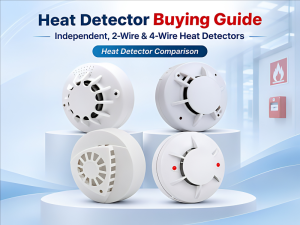
A heat detector is a fire detection device that monitors temperature and responds when a specified thermal condition occurs. Depending on its design, it may sound a local warning or communicate an alarm condition to a compatible fire alarm control panel. It does not sense smoke particles, and it must not replace smoke detection required by applicable codes.
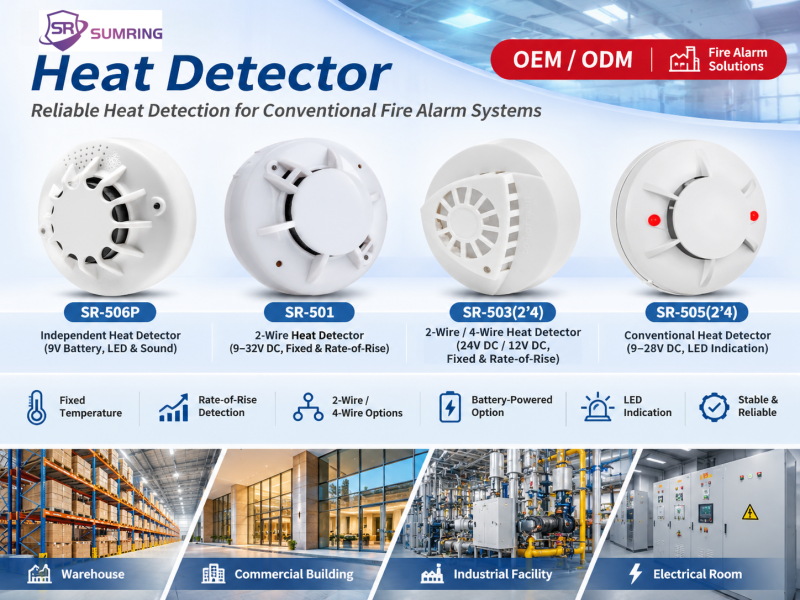
For distributors and system integrators, the challenge goes beyond choosing a temperature rating. Similar housings may conceal different voltages, wiring, outputs, and alarm behavior. This guide compares five SUMRING models and explains what to verify before sampling or placing a bulk order.
Why Do Wiring Options Matter More Than Appearance?
Choosing a heat detector begins with the required system architecture. An independent unit can provide a local audible indication. A conventional wired detector generally depends on the control panel and associated notification equipment to distribute an alarm. They cannot be interchanged without checking the design.
Two-wire circuits can carry supply power and alarm signaling over a shared connection. Four-wire arrangements commonly separate power from signaling, but the exact terminals and output behavior are model-specific. Purchasers should obtain the wiring diagram, approved control-panel interface, and reset requirements rather than assume all products bearing the same wire count are compatible.
What Are the Key Differences Between Five SUMRING Models?
| Model | System and Power | Detection and Environment | Main Procurement Consideration |
|---|---|---|---|
| SR-506P | Independent; 9V battery; LED and sound output | Listed alarm point: 57°C; operating range 0–80°C; humidity ≤90% RH | Local warning option; no panel interface or interconnection documented |
| SR-501 | Two-wire; non-polarized 9–32V DC; 200µA standby and ≤50mA alarm at 24V | Fixed 57°C; rise above 15°F/min; installation temperature −20–66°C; 10–93% RH, non-condensing | Broad supply range; verify panel current and reset behavior |
| SR-503-2 | Two-wire; 24V DC; ≤200µA standby and 60mA alarm at 24V | 57°C or 8–15°C/min rate-of-rise; 0–80°C; humidity ≤90% RH | LED and network output; verify compatible conventional circuit |
| SR-503-4 | Four-wire; 12V DC; ≤200µA standby and 60mA alarm | 57°C or 8–15°C/min rate-of-rise; 0–80°C; humidity ≤90% RH | LED and network output; request terminal and supervision details |
| SR-505(2) | Conventional two-wire; 9–28V DC; 50 ± 5mA alarm at 24V | 0–85°C; humidity ≤90% RH; green LED flashes in detection mode | ABS housing; alarm threshold and standby-current notation need confirmation |
Figures come from the supplied product sheets, not independent testing. Each heat detector must be assessed against its current, model-specific documentation. The source sheets for SR-503-2 and SR-503-4 reference GB 4716-2005, EN 54-5, and UL 521; this does not by itself establish certification or listing under those standards.
How Should You Evaluate Two-Wire Models?
A two-wire heat detector for a conventional fire alarm panel can reduce field wiring complexity when the panel supports its signaling method. However, voltage range alone does not prove compatibility. SR-501 specifies non-polarized 9–32V DC operation, while SR-503-2 specifies 24V DC. SR-505(2) lists 9–28V DC; its alarm current is specified at 24V.
Check the panel’s initiating circuit voltage, standby current allowance, alarm current limits, end-of-line arrangement, and reset method. For retrofits, request the panel model and detector-base details. Test approved equipment with the panel before bulk purchasing.
When Is a Four-Wire Model the Better Choice?
A four-wire heat detector may suit designs that call for separate supply and signaling paths. The SR-503-4 sheet states 12V DC input, 60mA alarm current, LED indication, and a network output. It does not identify a relay contact rating, contact type, or exact pin assignment.
Before specifying 4-wire heat detector wiring requirements, ask for terminal markings, alarm and fault states, power-loss behavior, reset procedures, and supervision provisions. These determine whether the interface fits the control equipment. A four-wire label should never be treated as proof that a device offers a dry-contact relay or works with any conventional panel.
Where Does a Battery-Powered Independent Unit Fit?
A battery-powered heat detector such as SR-506P offers a different procurement path. The supplied sheet identifies a 9V battery, a 57°C alarm point, and LED plus sound outputs. It does not establish wireless connectivity, linked alarms, sound pressure level, battery life, or a secondary output.
This distinction matters when buyers compare a battery-powered independent heat alarm with a centralized system. A local sounder can warn nearby occupants, but it does not demonstrate that a remote panel will receive an alarm. Confirm the intended occupancy, audible performance, testing method, and local approval before selecting this architecture.
Which Temperature and Response Figures Need Attention?
A fixed-temperature heat detector responds after its sensing element reaches a specified thermal condition. Rate-of-rise operation instead considers how rapidly temperature changes. SR-501 lists a response to a rise greater than 15°F per minute, while the SR-503 variants state 8–15°C per minute. These are manufacturer-sheet descriptions, not proof of equal sensitivity or interchangeable test classifications.
Operating range is also different from alarm point. A device rated to operate up to 80°C does not necessarily activate at 80°C. Actual response depends on sensor design, airflow, ceiling conditions, and thermal lag. For hot garages and other demanding spaces, verify that the alarm rating fits normal temperatures.
The U.S. Fire Administration’s heat alarm guidance advises garage-specific heat alarms with substantially higher rated temperatures than the 57°C ratings shown here; do not market these models as automatically suitable for garages.
What Should Overseas Buyers Check Before an OEM/ODM Order?
A heat detector compliance statement should be tied to the exact model, revision, destination market, and claimed application. Request current certificates or test reports where required, together with datasheets, installation instructions, labels, and approved wiring diagrams. A standards reference in a catalog is not a substitute for a verifiable listing.
A heat detector RFQ should specify country, project type, control panel, voltage, thermal response, quantity, and packaging language. Clarify whether OEM branding or ODM modification would require fresh testing or approval. For related equipment categories, see SUMRING’s fire alarm products for B2B projects.
FAQs
1. Is a two-wire detector interchangeable with any fire alarm panel?
No. Match electrical limits, alarm signaling, reset behavior, base, and supervision with the specific panel documentation.
2. Does four-wire always mean a relay output?
No. Obtain the terminal diagram and contact specifications; the supplied SR-503-4 sheet only identifies a network output.
3. Which of these models can sound without a control panel?
SR-506P explicitly lists a sound output. Audible warning is not documented for the other four in the supplied sheets.
4. What is the difference between fixed-temperature and rate-of-rise response?
Fixed-temperature operation responds at a specified thermal condition. Rate-of-rise operation responds to sufficiently rapid heating, subject to the model’s design.
5. Can the listed 57°C models be selected for any garage?
No. Assess normal peak temperature, applicable requirements, occupancy, and suitable alarm ratings before making a selection.
6. Do references to EN 54-5 or UL 521 confirm approval?
No. Ask for valid, model-specific certificates or listing records and check the applicable market requirements.
7. What information makes a B2B quotation more reliable?
Provide your country, panel model, wiring type, supply voltage, required approvals, quantities, and OEM/ODM expectations.
Conclusion
The right heat detector is determined by more than a common housing or nominal alarm temperature. Five SUMRING models illustrate different choices in power supply, wiring, current demand, and warning outputs.
Align each selection with the approved fire alarm design, obtain current technical evidence, and verify compatibility before committing to a purchase. For project quotations, send SUMRING your panel details and intended application so the appropriate options can be reviewed.