
Why Carbon Monoxide Detector Sensitivity Matters to B2B Buyers in 2026?
Carbon monoxide detector sensitivity describes how reliably a device detects carbon monoxide (CO) and how its electronics interpret concentration and exposure time before issuing a warning. It is more than the lowest display reading. With US standards discussions continuing in November, carbon monoxide detector sensitivity is increasingly relevant to importers, distributors and private-label brands.
Trend 1: US Discussions Put Low-Level CO Performance in Focus
In its September 2026 activity update, the US Consumer Product Safety Commission (CPSC) summarized a petition proposing alarms at 30 ppm after one hour or 15 ppm after 30 days. The petition also requested digital readings accurate within ±3 ppm, including below 30 ppm. These proposals are not mandatory thresholds. Importers should follow the final standards process before changing labels, certification plans or customer specifications. A proposed alarm concentration must never be presented as a current compliance requirement.
On November 16, a UL 2075 task group continued discussions concerning low-level CO monitors. The talks do not require existing household alarms to issue low-level warnings. Buyers should assess carbon monoxide detector sensitivity against applicable requirements, not proposed figures alone.
Trend 2: Three Performance Concepts Must Remain Separate
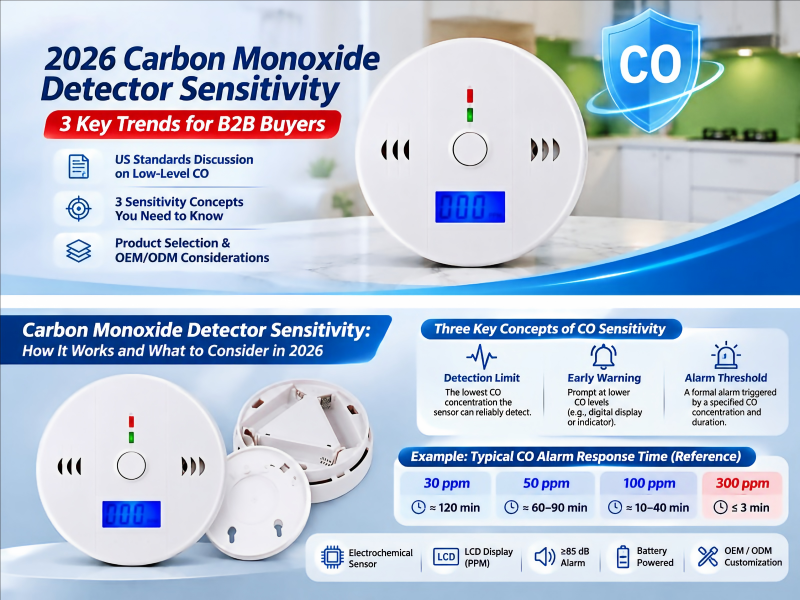
First, the sensor detection limit identifies the lowest concentration reliably measured under defined test conditions. This is a starting point when comparing carbon monoxide detector sensitivity claims. Second, an early-warning feature may present a low-level reading or a separate visual or audible notice. Third, the formal alarm threshold combines gas concentration with a required response-time window.
Confusing them creates misleading claims. A screen showing one-ppm increments does not, by itself, demonstrate one-ppm measurement accuracy. Display resolution, measurement accuracy and alarm decision logic are different engineering specifications. Readings can also be affected by calibration, temperature and humidity. Likewise, an electrochemical sensor does not guarantee a particular certified alarm response without complete-device testing. Responsible carbon monoxide detector sensitivity claims need supporting test conditions, documented accuracy and verification of the finished alarm.
The distinction matters when specifying a low-level carbon monoxide monitor or electrochemical CO alarm.
Trend 3: Current SUMRING Products Offer a Practical Comparison
SUMRING currently lists standalone CO alarms, including the SR-907 and SR-907-2. The SR-907-2 product page specifies an electrochemical sensor, LCD, three AA batteries, an 85 dB alarm at one meter and low-battery indication.
Its published response schedule includes approximately two hours at 30 ppm, 60–90 minutes at 50 ppm, 10–40 minutes at 100 ppm and within three minutes at 300 ppm. These are manufacturer-listed values; buyers should request current test reports rather than treating the specification as proof of UL 2034 or EN 50291 certification. No independently verified sub-30-ppm warning function is claimed here.
For a standalone CO alarm with LCD display, carbon monoxide detector sensitivity must be considered together with sensor service life, battery characteristics, installation conditions and documented response times. Compare model-specific documents before ordering.
What Should Overseas OEM and Wholesale Buyers Request?
A useful purchasing checklist starts with the destination country and intended use. Ask suppliers for a model-specific datasheet, applicable certificates, full alarm-time test results, low-concentration display accuracy and the distinction between early warnings and emergency alarms. Check sensor drift, interference resistance, fault alerts, end-of-life indication and replacement instructions. Request evidence of performance after humidity changes and sensor aging, not only results obtained under ideal laboratory conditions. These checks make carbon monoxide detector sensitivity measurable over the device lifecycle.
For private-label development, carbon monoxide detector sensitivity should be agreed before decisions about packaging, display design or marketing claims. Logo customization never substitutes for market approval.
Distributors comparing an OEM carbon monoxide detector supplier should also ask whether sample testing represents the exact hardware and firmware proposed for mass production. Evaluate documented performance, not an isolated ppm number.
Conclusion
The 2026 debate makes carbon monoxide detector sensitivity worth examining, not exaggerating. Buyers need to distinguish detection capability, optional early warning and certified emergency response.
SUMRING welcomes B2B inquiries concerning standalone CO detectors and OEM/ODM requirements. Review the SR-907-2 Carbon Monoxide Detector with LCD and share your target market, order volume, required approvals and preferred features. Our team can discuss available configurations and the documents needed for evaluation, while carbon monoxide detector sensitivity remains a measurable purchasing criterion rather than an unsupported promise.