How to Choose the Right Fire Alarm Control Panel: Conventional, Two-Wire and Addressable Systems Compared
Which Fire Alarm Control Panel Type Fits Your Building Project?
A fire alarm control panel is the central unit that monitors compatible fire detectors and manual call points, identifies alarm or fault conditions, and activates warning or control outputs. Selection depends on system architecture, zones, device compatibility, and local approval.
For distributors and contractors, the goal is a fire alarm control panel that meets the approved fire strategy and uses compatible devices.
Start With the Fire Strategy, Not the Catalog
Before comparing brands, obtain the building layout and the designer’s required detection and alarm zones. A zone is an identifiable portion of a property used for alarm indication and response. It is not automatically the same as one room or one floor.
Record occupancy, fire compartments, required zones, future expansion, and whether responders need zone-level or individual device identification.
An eight-zone panel is not necessarily suitable for an eight-floor building. Treat fire alarm panel zone capacity as a design decision: review zone boundaries, circuit limits, and evacuation arrangements.
The correct fire alarm control panel follows the system design rather than forcing the design around an available product.
Compare Three Panel Architectures
1. Conventional: Straightforward Zone-Based Identification
Conventional panels connect compatible initiating devices to supervised detection circuits assigned to zones. When an alarm occurs, the panel generally indicates the affected zone, not the particular detector. Notification appliances commonly use separate sounder circuits.
A conventional fire alarm panel for small buildings can be economical where the layout is straightforward and zone-level location information is acceptable. Longer cable routes and troubleshooting can increase total cost.
Before ordering a fire alarm control panel of this type, check the actual zone count, devices permitted per circuit, detector electrical characteristics, sounder output ratings, and fault-monitoring functions. Detector limits are model-specific.
2. Two-Wire: Potentially Less Field Cabling
In a purpose-designed two-wire fire alarm system panel, compatible detectors, manual call points, and certain notification devices may share the same zone circuit. This can reduce separate sounder wiring in applications supported by that system.
The critical word is “compatible.” Two-wire describes different technologies in the market; it does not guarantee that every two-wire detector or sounder can be mixed on any two-wire circuit. Check approved devices, load, alarm behavior, and supervision arrangements.
Such a fire alarm control panel may suit projects where wiring simplicity matters but zone-level indication is sufficient. Compare installed costs, not only panel prices.
3. Addressable: Individual Device Information
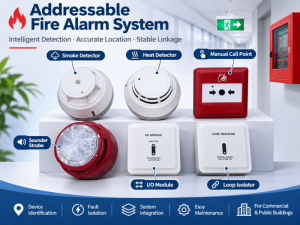
An addressable system uses compatible devices with individual identities. It can report a programmed device address and location description, allowing personnel to distinguish, for example, a corridor detector from a storeroom detector within the same general area.
An addressable fire alarm control panel for commercial buildings may suit complex layouts, large device counts, and phased expansions. Addressable loops can support flexible configurations, but loop loading, topology, isolation, and fault tolerance depend on the approved design and specific equipment.
Do not assume every addressable loop continues operating normally after a cable break. The actual circuit class, isolator arrangement, and installed wiring determine what remains functional during a fault.
Side-by-Side Procurement Comparison
| Decision Factor | Conventional | Compatible Two-Wire System | Addressable |
|---|---|---|---|
| Alarm location shown | Usually zone | Usually zone | Individual device/point |
| Wiring approach | Detection and sounder circuits commonly separate | Some devices may share a zone circuit | Addressable signaling circuits or loops |
| Procurement priority | Zone count and circuit ratings | Approved device ecosystem | Point capacity, protocol and expansion |
| Typical fit | Relatively simple layouts | Projects prioritizing suitable shared wiring | Complex or expanding facilities |
This is a starting framework, not a substitute for engineering approval. A lower purchase price does not necessarily mean a lower installed cost. Labor, cable runs, programming, training, spare parts, and maintenance all belong in the comparison.

Seven Checks Before Issuing a Purchase Order
For an informed fire alarm control panel selection, ask the supplier to document:
-
Required zones or addresses: Match the approved drawings and identify realistic spare capacity.
-
Device compatibility: Confirm detector bases, call points, sounders, strobes, and interfaces by model—not merely by voltage.
-
Output and power budget: Verify notification circuit current, auxiliary supply demand, standby battery sizing, and mains voltage.
-
Supervision: Review how the selected equipment indicates open circuits, short circuits, power faults, and disabled zones.
-
Interface requirements: Clarify monitored links, dry contacts, communication protocols, and any building-system connections.
-
Local compliance: Identify applicable design standards and accepted product approvals before placing an order.
-
After-sales support: Request wiring documents, technical guidance, spare-device availability, and commissioning responsibilities.
These details make supplier quotes easier to compare.
What Should Overseas Buyers Check About Standards?
British projects involving non-domestic premises may refer to BS 5839-1:2025. The British Standards Institution’s official BS 5839-1:2025 overview explains its scope for system design, installation, commissioning, and maintenance.
Other markets may reference NFPA 72, EN 54 product standards, or local regulations. A design code does not automatically certify a product. Request model-specific approvals for the destination market.
The right fire alarm control panel therefore needs both technical suitability and a clear compliance pathway, assessed by a qualified local designer or authority.
Where SUMRING Can Support Procurement?
For conventional projects, SUMRING offers zone-based panel options and related detection and notification products. The SR-P01 series includes 4-, 8-, and 16-zone configurations; its specific specifications and compatibility requirements are described in the SUMRING SR-P01 conventional control panel guide.
For OEM/ODM procurement, share the device schedule, destination market, supply voltage, and approval needs. A fire alarm control panel quotation should identify what is included, what is optional, and which device combinations require further verification.
FAQs
1. Is a conventional panel always cheaper than an addressable system?
Not necessarily. Conventional equipment can cost less initially, but cable quantities, installation labor, testing, and future expansion may change total cost.
2. How many detectors can one zone support?
There is no single universal number. Limits depend on the panel specification, detector characteristics, electrical loading, installation rules, and approved design.
3. Can two-wire panels operate ordinary sounders on detector circuits?
Only when the chosen system explicitly supports those sounders and their electrical behavior. Shared wiring is not a universal two-wire feature.
4. Does an addressable panel eliminate the need for zones?
No. Addressable systems can still use programmed geographical or functional zones for indication, response, and system management.
5. Can devices from different brands be connected together?
Sometimes, but compatibility must be documented. Matching voltage or connector appearance alone is insufficient; communication protocols and circuit behavior matter.
6. Which panel is best for a warehouse or hotel?
It depends on the fire strategy, building complexity, required location detail, operating procedures, and local rules—not just the property category.
7. What should be included in an export RFQ?
Provide drawings, zone and device quantities, power supply details, required outputs, destination country, certification requirements, and expected order volume.
8. Can a conventional system be expanded later?
Often, within the available zone and power capacity. Expansion beyond those limits may require additional approved equipment or a redesigned system.
Conclusion
Selecting a fire alarm control panel starts with the approved strategy and a verified device schedule. Conventional, two-wire, and addressable options each have valid applications; the best choice balances indication detail, compatible wiring, installation cost, and future maintenance. For B2B procurement, obtain model-specific documentation and local approval guidance before finalizing an order.