Where Should Smoke Detectors Be Installed in Buildings?
Where Should Smoke Detectors Be Installed in Buildings?
Smoke detector placement means selecting appropriate rooms and mounting positions so that smoke can reach an alarm promptly and occupants can hear the warning. For residential projects, an effective plan considers sleeping rooms, corridors, each building level, cooking areas, ceiling geometry, and local fire rules.
This guide helps overseas distributors, contractors, and developers plan coverage. Household alarms and panel-connected detectors can have different installation and approval requirements.
Why Does the Installation Location Matter?
Smoke often rises beneath the ceiling, but doors, stairs, and ventilation affect its movement. Poor mounting positions may expose alarms to steam or cooking fumes, or leave sleeping areas inadequately covered.
Good smoke detector placement should provide warnings where needed while limiting nuisance alarms. Repeated unwanted alarms may encourage occupants to disconnect devices. A temporary hush function is not a substitute for correcting a poor location.
Where to Install Smoke Alarms in Bedrooms and Sleeping Areas
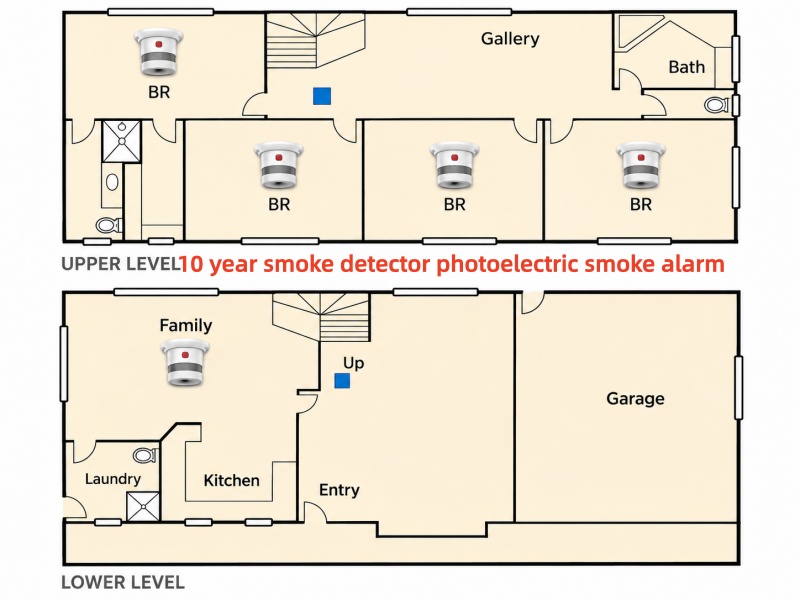
Bedrooms deserve special attention because occupants may be asleep behind closed doors. According to the U.S. Fire Administration’s smoke alarm installation guidance, smoke alarms should be installed inside each bedroom, outside each separate sleeping area, and on every level of a home, including the basement.
For contractors, smoke detector placement begins with a marked floor plan. Identify bedrooms, including converted sleeping rooms, and the corridors serving them. One central hallway alarm does not necessarily cover bedrooms behind closed doors.
For international projects, apply destination-country requirements rather than treating U.S. guidance as universal.
How Should Hallways, Stairs, and Different Floors Be Covered?
A hallway outside bedrooms is an important warning location. Multiple sleeping zones, long corridors, and separated floor plans require closer review. Stairways also matter because smoke may move between building levels through the stair opening.
In multi-story homes, review smoke detector placement floor by floor, including required basement coverage. Near staircases, account for doors and obstructions; immediately beside a doorway is not automatically the right spot.
For apartment developments, distinguish individual dwelling coverage from shared corridors and other building fire alarm systems. Common areas may be governed by separate system design, detector spacing, and approval requirements.
Is Ceiling or Wall Mounting Better?
Ceiling mounting is commonly preferred for household smoke alarms because hot smoke tends to rise. Position the alarm in an approved ceiling location, away from corners where air may stagnate. If wall mounting is permitted, install the device high on the wall and follow the model’s instructions for the specified distance below the ceiling.
A smoke detector placement review should consider sloped ceilings, beams, high rooms, and decorative structures. No single mounting measurement suits every ceiling or detector type.
For teams comparing ceiling vs wall smoke detector installation, request the installation drawing and mounting instructions for the exact model before drilling or issuing installation work orders.
How Far Should Smoke Alarms Be From Kitchens?
Frying and toasting can release particles that trigger unwanted alarms. Kitchen fire risks matter, but mounting a conventional household smoke alarm directly above a stove is generally unsuitable.
According to the NFPA smoke alarm placement guidance, household smoke alarms should generally be installed at least 10 feet (about 3 metres) from cooking appliances to reduce nuisance alarms, subject to applicable codes and manufacturer instructions.
A photoelectric alarm or a model with a temporary hush feature may help in an appropriate application, but neither feature guarantees freedom from unwanted alarms. A project designer may specify a suitable heat detector in a cooking environment when permitted. Never remove required protection to avoid cooking-related warnings.
Which Locations Should Installers Avoid?
Strong drafts near windows, fans, and air ducts may divert smoke. Bathrooms can expose alarms to steam; garages, workshops, and attics may exceed residential devices’ environmental limits.
Before approving smoke detector placement, contractors should check the device’s environmental limits and inspect real airflow patterns. Keep alarms away from obstructions, do not paint over smoke-entry openings, and preserve access for testing and replacement. If the environment is unsuitable for a standard household smoke alarm, consult the designer about a different approved detection method.
What Should B2B Buyers Verify Before Bulk Procurement?
Start with the correct device category. For residential developments, compare power supply, warning sound, mounting, service-life instructions, and required interconnection. A 10-year sealed battery reduces battery changes, not testing or eventual replacement.
For smoke detector placement across apartment buildings, request drawings that identify private units, sleeping rooms, escape routes, and common spaces. Ask the supplier for current manuals, model-specific compliance evidence, and a clear distinction between standalone alarms and panel-connected detectors. Market requirements may differ, and OEM branding does not automatically transfer an existing approval.
SUMRING’s sealed smoke alarm buyer checklist explains long-life battery sourcing. For mounting and handover details, review the 10 year smoke alarm installation checklist. Commercial system buyers can consult the 2-wire photoelectric smoke detector selection guide.
How Should a Project Team Check the Finished Installation?
After mounting, verify each location against approved plans and instructions. Test alarms, record results, and explain warning and hush functions. Never use an open flame for testing.
Good smoke detector placement is only one part of an ongoing safety program. Set a documented inspection and replacement schedule. The U.S. Fire Administration recommends testing household smoke alarms monthly and replacing them every 10 years from manufacture; a particular model’s manual or local rules may require additional actions.
FAQs
1. Do I need a smoke alarm inside every bedroom?
Under general U.S. residential guidance, yes. An alarm is also recommended outside each separate sleeping area. Always check local requirements.
2. Can one hallway alarm protect an entire house?
Not necessarily. Separate sleeping rooms, multiple floors, and long or divided layouts usually require additional coverage.
3. What is the recommended smoke alarm distance from a kitchen stove?
NFPA’s general recommendation is at least 10 feet (3 metres) for household smoke alarms, subject to the applicable installation rules.
4. Can I mount a smoke alarm on a wall?
Yes, if the approved product instructions permit it. Use the stated mounting height and avoid dead-air corners.
5. Are 10-year sealed battery alarms maintenance-free?
No. A long-life power supply does not eliminate testing, cleaning, fault checks, or eventual replacement.
6. Should apartments use the same alarms as shared building corridors?
Not automatically. Private dwellings and common areas can have different fire detection and system requirements.
7. What should overseas distributors request before ordering?
Obtain the exact model manual, compliance evidence, approved mounting guidance, local-market requirements, and documentation for any OEM changes.
Conclusion
Effective smoke detector placement starts with sleeping areas and every required level, then accounts for corridors, ceiling design, kitchen fumes, and building-specific rules. For B2B projects, an approved location plan, compatible equipment, and documented maintenance are more valuable than an arbitrary detector count.
SUMRING supports distributors, contractors, and OEM/ODM buyers with fire-safety product sourcing and documentation discussions. Share your destination market, building type, planned quantity, and required approvals before selecting devices for a project.