What Is a Manual Call Point and Why Is It Critical in Fire Safety Systems?
A manual call point is a wall-mounted emergency fire alarm device that allows people to manually activate a fire alarm system when a fire or emergency is detected.
In modern fire safety engineering, automatic detectors such as smoke and heat sensors are widely used. However, they cannot guarantee immediate detection in every scenario.
This is why the manual call point remains a mandatory and critical component in fire alarm system design.
It acts as the fastest human-activated alarm trigger, ensuring that occupants can immediately alert the entire building when they discover smoke, fire, or danger.
Despite its small size, the manual call point plays a major role in life safety, evacuation speed, and emergency coordination.
Why Manual Call Points Are Still Required in Modern Buildings?
Even advanced fire detection systems have limitations:
- Smoke may not reach detectors instantly
- Fire may start in hidden or low-ventilation areas
- Sensors can be affected by dust or humidity
- Early-stage fires may not produce enough smoke
The manual call point solves these gaps by enabling instant human activation.
Key Safety Function:
Once activated, the manual call point immediately sends a signal to the fire alarm control panel, triggering:
- Building-wide alarms (sirens & strobes)
- Emergency evacuation instructions
- Fire zone identification
- Linked systems (elevators, HVAC, access control shutdown)
This makes it a critical redundancy layer in fire protection systems.
How a Manual Call Point Works?
The working principle of a manual call point is based on a simple but highly reliable electrical switching mechanism.
Step-by-step process:
- User activates the device (press or pull)
- Internal switch changes electrical state
- Signal is transmitted to fire alarm control panel
- Control panel identifies alarm zone
- System triggers evacuation alerts and safety actions
Unlike automatic detectors, the manual call point does not rely on environmental sensing—it depends on human confirmation, making it extremely fast and decisive.
Manual Call Point Systems Types:
1. Break Glass Manual Call Point (Traditional Type)
A classic manual call point design requiring glass breakage to activate the alarm.
Advantages:
- Simple structure
- Low cost
- Highly recognizable in emergencies
Limitations:
- Glass replacement required after activation
- Maintenance complexity
- Potential injury risk
2. Resettable Manual Call Point
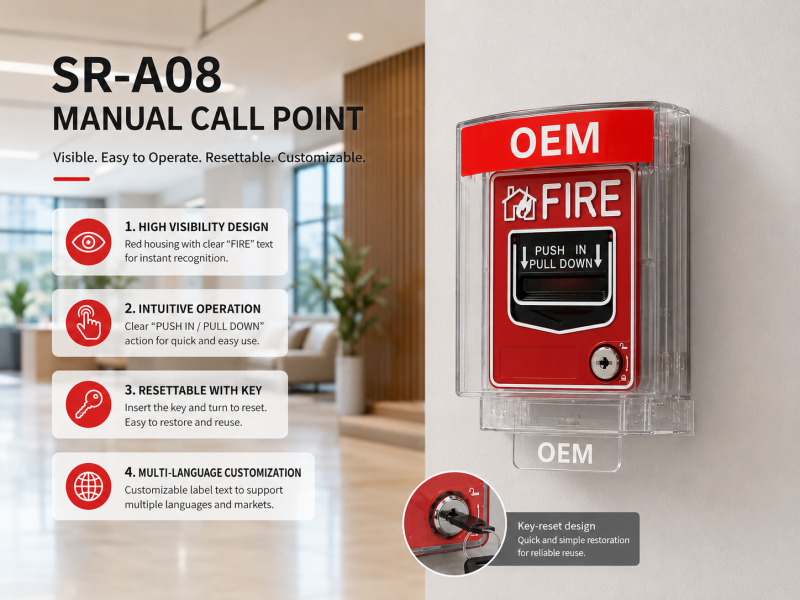
A modern manual call point uses a non-destructive trigger mechanism.
Activation is achieved via push or pull, and reset is done using a key.
Advantages:
- Reusable design
- Lower long-term maintenance cost
- Safer operation (no broken glass)
- Suitable for frequent testing environments
This type is widely used in commercial, industrial, and public buildings.
Human Behavior Engineering in Manual Call Point Design
Fire emergencies significantly reduce human reaction speed. Therefore, manual call point design follows strict human-factor engineering principles.
1. Instant Recognition
Bright red housing ensures immediate visual identification.
2. Minimal Cognitive Load
Simple actions like “PUSH IN” or “PULL DOWN” reduce confusion during panic.
3. High Accessibility
Installed at 1.3–1.5 meters height for fast reach.
4. Clear Fire Labeling
Large “FIRE” text ensures universal understanding.
The goal is simple: zero learning required in an emergency.
Multilingual Safety Communication in Manual Call Points
In global environments such as airports, hotels, factories, and logistics hubs, language diversity is a key challenge.
To ensure universal usability, modern manual call point devices support:
- English
- Spanish
- Arabic
- French
- German
- Custom symbols or icons
This eliminates language barriers and ensures correct emergency response worldwide.
Safety Standards and Compliance Requirements
A manual call point is a life safety device and must comply with strict international standards.
Key certifications include:
- ISO 9001 Quality Management System
- CE Certification (EU safety compliance)
- RoHS Environmental Safety
- EN54 Fire Detection Standards
Environmental reliability testing includes:
- Temperature range: -10°C to +55°C
- Humidity resistance
- Mechanical durability cycles
- Electrical contact stability
These ensure the manual call point works reliably in real fire conditions.
How to Properly Use a Manual Call Point?
Correct use of a manual call point is simple:
- Confirm visible fire or smoke
- Activate nearest manual call point immediately
- Evacuate using nearest exit
- Do not delay for confirmation
- Report to emergency responders
Speed is critical—every second matters.
Why Manual Call Points Are Critical in Fire Safety Systems?
The manual call point provides:
- Instant human-triggered alarm activation
- Backup for automatic detection systems
- Faster evacuation initiation
- Higher system reliability
- Low-cost but high-impact safety layer
It is one of the most cost-effective life-saving devices in any building.
FAQ:
1. What is a manual call point used for?
It is used to manually trigger a fire alarm in emergencies.
2. Where should a manual call point be installed?
Near exits, stairways, corridors, and evacuation routes.
3. How does a manual call point work?
It sends a signal to the fire alarm control panel when activated.
4. What is the difference between break glass and resettable types?
Break glass requires replacement; resettable can be reused.
5. Does a manual call point activate sprinklers?
No, it only triggers the alarm system.
6. Can it be tested safely?
Yes, under maintenance procedures.
7. What height should a manual call point be installed?
Typically 1.3–1.5 meters above ground.
8. Why is it important in fire safety systems?
It provides instant human activation of emergency alarms.
If your building’s fire safety system does not clearly include or properly maintain manual call point devices, now is the time to upgrade. Safety is not optional—it is a responsibility.
? Looking for reliable fire safety solutions and certified manual call point systems? Contact us today to upgrade your protection with professional-grade fire alarm devices.