
How Is the Intelligent Fire Protection System Transforming Global Safety?
The Intelligent Fire Protection System is an AI-powered, IoT-connected fire safety framework that integrates smoke detectors, gas sensors, alarms, and automated control systems to enable proactive detection, intelligent decision-making, and coordinated emergency response.
Global Fire Safety Is Entering an AI-Driven Transformation Era
The global fire safety industry is undergoing a major technological shift as artificial intelligence, smart IoT infrastructure, and advanced sensing technologies converge into a unified protection ecosystem. Market analysts project steady expansion at a compound annual growth rate (CAGR) of approximately 7.1% through 2035, driven by increasing demand for intelligent building infrastructure, industrial safety upgrades, and data center protection systems.
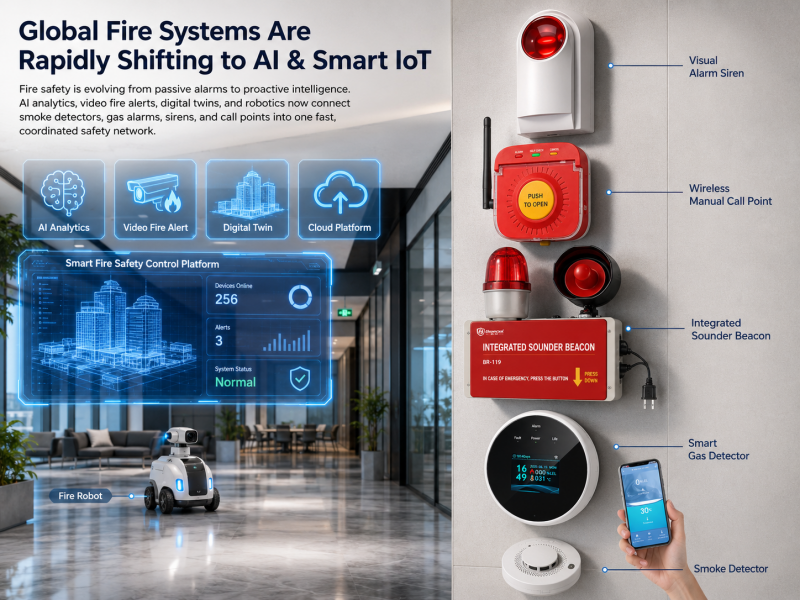
At the center of this transformation is the Intelligent Fire Protection System, which is redefining how fire hazards are detected, analyzed, and managed. Instead of relying on isolated devices reacting after danger occurs, modern systems now operate as interconnected networks capable of real-time perception, prediction, and coordinated response.
This evolution marks a fundamental shift from passive alarm mechanisms to proactive, AI-driven safety intelligence.
From Passive Alarming to Proactive Intelligence
Traditional fire alarm systems were designed with a simple principle: detect danger and trigger an alert. However, this reactive model often suffers from delayed response times, false alarms, and fragmented system coordination.
The Intelligent Fire Protection System changes this paradigm completely by introducing multimodal AI foundation models that process multiple data streams simultaneously, including:
- Video flame pattern recognition
- Thermal anomaly detection
- Smoke particle optical analysis
- Gas concentration and environmental sensing
By combining these inputs, the system achieves a significantly higher level of accuracy, reducing false alarms caused by steam, dust, or cooking fumes.
In real-world applications, alarm accuracy can exceed 95%, ensuring that every warning signal is meaningful and actionable. This improvement restores trust in fire alarm systems and eliminates the “false alarm fatigue” that often leads users to disable safety devices.
Ending the False Alarm Challenge with Multimodal AI
One of the most critical problems in fire safety has always been false alarms. In residential kitchens, industrial workshops, and commercial buildings, non-fire conditions frequently trigger traditional smoke detectors.
The Intelligent Fire Protection System solves this issue by using AI-based cross-validation. Instead of relying on a single sensor input, it evaluates multiple environmental signals at once:
- Temperature spikes
- Visual flame movement
- Smoke density characteristics
- Gas composition anomalies
For example, cooking vapor may trigger a smoke sensor, but the absence of flame signatures and abnormal heat patterns allows the system to classify it as non-dangerous.
This intelligent filtering dramatically reduces unnecessary evacuations and ensures that when alarms activate, occupants respond immediately with full confidence.
Sub-Second Fire Detection and Early Intervention Capability
Speed is the most critical factor in fire safety. Even a delay of a few seconds can determine whether a fire is contained or becomes catastrophic.
Advanced video-based detection integrated into the Intelligent Fire Protection System enables ultra-fast identification of ignition events. In industrial environments such as manufacturing plants and logistics warehouses, AI vision models can detect subtle smoke or flame indicators within 0.3 to 3 seconds.
This capability transforms fire response from reactive containment to early-stage prevention.
Key benefits include:
- Instant alerts via mobile and on-site alarms
- Early suppression during smoldering phases
- Protection for unattended environments
- Reduced property damage and operational downtime
Whether deployed in residential buildings, data centers, or unmanned substations, this rapid detection capability ensures continuous protection even without human monitoring.
Fully Automated Fire Response and System Coordination
A defining feature of the Intelligent Fire Protection System is its ability to coordinate multiple building subsystems automatically during emergencies.
Once a fire event is confirmed, the system activates a multi-layer response sequence:
- Fire verification using surveillance robots
- Real-time fire mapping via digital twin platforms
- Zoned evacuation instructions through voice and visual alarms
- Automatic elevator recall to ground floor
- Door access unlocking for evacuation routes
- Smoke extraction fan activation at full capacity
This level of automation ensures that emergency response is not fragmented but fully synchronized.
For gas leak scenarios, the system can immediately:
- Shut off solenoid valves
- Activate exhaust ventilation systems
- Trigger localized alarms
- Prevent explosion risks within milliseconds
By integrating building infrastructure into a unified safety network, the Intelligent Fire Protection System eliminates delays caused by human intervention.
AI Voice Intelligence Enhancing Emergency Reporting
Another major advancement lies in emergency communication. Modern systems now incorporate AI-powered voice interaction platforms that significantly improve emergency reporting efficiency.
Users can simply describe an incident using natural speech, and the system automatically:
- Filters background noise
- Extracts key incident details
- Identifies precise geographic location
- Routes information to emergency dispatch centers
This reduces response time and allows fire departments and rescue teams to act faster and with higher accuracy.
By improving communication clarity, the Intelligent Fire Protection System enhances coordination between civilians and emergency responders.
Core Problems Solved by Intelligent Fire Protection Systems
The evolution of the Intelligent Fire Protection System addresses three long-standing industry challenges:
1. False Alarm Distrust
Multimodal AI improves detection reliability above 95%, ensuring alarms are meaningful and trustworthy.
2. Delayed Emergency Response
Sub-second detection and instant notifications allow fires to be addressed in their earliest stages.
3. Fragmented System Coordination
Integrated control ensures alarms, ventilation systems, elevators, and access control work together seamlessly.
This creates a unified safety ecosystem rather than disconnected devices operating independently.
Real-World Benefits for Everyday Life
Beyond industrial applications, the Intelligent Fire Protection System brings tangible improvements to daily living:
- Reduced anxiety caused by false alarms
- Clear evacuation instructions during emergencies
- Automatic gas shutoff during leaks
- Faster emergency dispatch response
- Continuous protection during sleep or absence
In essence, safety becomes invisible yet always active, embedded into everyday environments without requiring user intervention.
This represents a major shift toward human-centric safety design, where technology silently protects lives in the background.
The Future of Smart Fire Safety Ecosystems
As AI models continue to evolve, the Intelligent Fire Protection System will become even more adaptive and predictive. Future systems are expected to:
- Predict fire risks before ignition occurs
- Simulate fire spread using digital twins
- Coordinate autonomous firefighting robots
- Integrate city-wide emergency response networks
This will transform fire safety from building-level protection into interconnected smart city infrastructure.
FAQ:
1. What is an Intelligent Fire Protection System?
It is an AI-driven fire safety system that integrates sensors, alarms, and automation for proactive fire detection and response.
2. How does AI improve fire detection accuracy?
AI analyzes multiple signals such as video, temperature, smoke, and gas data to reduce false alarms.
3. Can the system prevent false alarms completely?
While not 100% elimination, it significantly reduces false alarms by over 95% accuracy in detection.
4. How fast can the system detect a fire?
Advanced systems can detect early fire signs within 0.3 to 3 seconds.
5. Does it work in residential buildings?
Yes, it is widely used in homes, apartments, warehouses, and commercial facilities.
6. What happens during a confirmed fire event?
The system triggers alarms, activates evacuation guidance, and controls building systems automatically.
7. Can it integrate with gas leak detection systems?
Yes, it can shut off gas valves and activate ventilation systems automatically.
8. Is human intervention still required?
Human intervention is minimized but still important for oversight and maintenance.
Conclusion
The Intelligent Fire Protection System represents a major leap forward in global fire safety technology. By combining AI, IoT, video analytics, and automated control systems, it replaces outdated reactive models with proactive, intelligent, and fully coordinated protection networks.
If you are looking for intelligent fire protection solutions, you may also consider Sumring’s SR-119W WiFi One-Touch Audio-Visual Alarm, designed to bring faster response, clearer alerts, and smarter connectivity to modern fire safety systems.