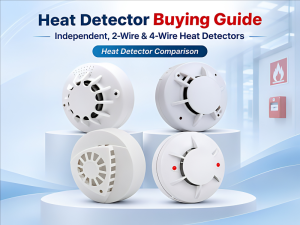
2 Wire Heat Detector: Working Principles, Wiring and B2B Selection Guide
How Does a 2 wire heat detector Work with a Conventional Fire Panel?
A 2 wire heat detector is a panel-connected fire detection device that monitors temperature and reports an alarm through a compatible two-conductor initiating circuit. Unlike an independent alarm, it relies on a compatible control panel to operate notification equipment. For B2B buyers, the key question is not whether it has two terminals. It is whether its sensing method, electrical behavior, and approval documentation suit the intended system.
Why Is Heat Detection Used in Conventional Systems?
Heat sensing helps where steam, dust, or cooking particles make smoke detection unsuitable. It responds to a temperature condition rather than smoke particles, which can reduce nuisance activations when correctly specified.
However, a 2 wire heat detector cannot replace smoke detection wherever early smoke warning is required. Smoke and toxic gases can develop before a heat alarm. Designers must assess occupancy, risk, code, and required coverage.
Fixed Temperature, Rate of Rise, or Combined Detection?
Fixed-temperature detection activates when the sensing element reaches its specified temperature threshold. It may suit variable ambient conditions if the threshold meets project requirements.
Rate-of-rise detection responds when temperature increases unusually quickly. A rate of rise heat detector for fire alarm panels can respond earlier to rapid heating, but non-fire temperature changes matter.
Combined detection uses fixed-temperature and rate-of-rise principles, where both are explicitly supported by the selected model. It can address different heating patterns without making any detector universally suitable.
Both wiring arrangements may use these principles. The name 2 wire heat detector describes a connection arrangement; it does not establish a temperature rating, detection algorithm, or certification. Obtain model-specific evidence rather than assigning general performance claims to an unverified product.
What Happens on the Two-Wire Zone Circuit?
In a typical compatible arrangement, the same detector-zone pair provides electrical power and carries the detector’s alarm condition back to the control panel. Under normal conditions, the panel monitors the circuit according to its design. When the detector operates, its electrical state changes in a way that the panel can recognize as an alarm.
The control panel then identifies the affected zone and activates configured outputs, which may include bells, sounders, strobes, or monitored interfaces. On a conventional panel, the displayed information is generally the zone, not the exact identity of the detector.
A 4-, 8-, or 16-zone conventional panel may be considered, provided the specific detector-to-zone interface is verified.
A 2 wire heat detector must be assessed within the complete circuit. Contact-type heat devices may simply change a supervised zone state without drawing detector power. Neither design is automatically interchangeable with smoke or addressable sensors.

What Should Contractors Verify Before Installation?
Start with conventional fire alarm heat detector wiring documents supplied for both the detector and panel. Review the approved connection diagram, detector base, supply voltage, standby current, alarm current, alarm recognition method, and reset behavior.
Next, confirm the control panel’s zone capacity and whether the circuit supervises open or short conditions. End-of-line components must follow panel instructions. Cable length and voltage drop also matter when multiple devices share a circuit.
For 2 wire heat detector compatibility with conventional fire panels, ask the supplier to identify the exact panel and detector variants tested together. A matching nominal voltage alone does not prove that the panel will distinguish normal, fault, and alarm conditions correctly.
SUMRING’s conventional fire alarm control panel overview is a useful starting point for reviewing zone functions. This resource does not, by itself, verify that a specific heat detector is approved for connection.
Where Can Heat Detectors Be Applied?
Potential locations include commercial kitchen support areas, plant rooms, workshops, storage spaces, and service rooms where ambient conditions can challenge smoke sensing. A fixed temperature heat detector for commercial kitchens must still be checked against actual temperatures, steam exposure, ventilation, and local fire protection requirements.
A 2 wire heat detector should not be selected solely because the application is described as a kitchen or warehouse. Ceiling height, beams, air movement, mounting position, maintenance access, and the detector’s listed spacing may change the required layout.
Heat devices are usually one part of a coordinated system, not a substitute for required smoke alarms or other life-safety measures. The final selection must follow the approved project design.
How Is a Two-Wire Detector Different from a Four-Wire Model?
In many electronic two-wire detectors, power and alarm signaling share the same pair. Four-wire detector arrangements generally use a separate power pair and alarm-contact connections, although exact designs vary. This affects supervision, reset, and panel programming.
For a retrofit, do not assume that replacing a four-wire model with a 2 wire heat detector automatically reduces installation cost. Check whether the existing panel supports the replacement’s signaling method and whether the current base, circuit supervision, and cable arrangement can remain in service.
A two-wire detector is also different from a two-wire system that shares circuits with compatible sounders.
How Should B2B Buyers Evaluate Samples and OEM Supply?
An RFQ should identify the country, code, panel, room conditions, quantities, bases, and required documents. Ask for the electrical datasheet, installation instructions, compatibility declaration or test record, and any model-specific approvals.
Samples should be checked for normal indication, approved heat activation, panel display, output operation, faults, and reset. Record results using the actual control panel and intended circuit components. Installation and testing should be handled by competent personnel.
For repeat orders, compare traceability, spare bases, instructions, and delivery. SUMRING can discuss OEM branding and ODM project requirements, subject to the confirmed technical configuration and applicable approvals. Custom labels or packaging must not imply certifications that have not been obtained.
FAQ
1. Does a 2 wire heat detector work with any conventional fire alarm panel?
No. Compatibility depends on zone electrical characteristics, signaling thresholds, permitted device types, and supervision. Verify with documentation and functional testing.
2. Which heat detection method is best?
There is no universal best choice. Fixed-temperature, rate-of-rise, and combined methods suit different ambient conditions and fire risk assessments. Select from verified product options.
3. Does a conventional heat detector have its own audible alarm?
Not necessarily. A panel-connected detector commonly relies on the control panel and separate notification appliances. A standalone heat alarm is a different product category.
4. Can heat detectors and sounders use the same two wires?
Only in a system specifically designed and approved for that architecture. Standard conventional systems often have separate detection and notification circuits.
5. Is the operating temperature the same as the alarm temperature?
No. The allowed ambient operating range and the temperature threshold for alarm are different specifications. Both should be reviewed for the room.
6. What approvals should overseas buyers request?
Request documentation for the exact ordered detector and the destination’s requirements. Relevant standards may include EN 54-5 or other locally applicable product standards; do not assume approval from a manufacturer’s general certificate. For US requirements, consult NFPA 72, National Fire Alarm and Signaling Code.
7. How should installers test a wired heat detector?
Follow the manufacturer’s approved functional test method, verify panel response and notification outputs, and restore the system correctly. Do not apply uncontrolled heat or damage a sensing element.
Conclusion
A 2 wire heat detector can provide practical, temperature-based detection within a compatible conventional fire alarm system. Its value comes from the correct sensing principle, appropriate location, verified panel behavior, and documented commissioning—not from conductor count alone.
For distributors, contractors, and OEM/ODM buyers, share your control panel model, project country, application, and expected quantity with SUMRING to evaluate a suitable specification before bulk purchasing.