Home CO Detector: 7 Essential Winter Safety Checks for Residential Properties
Why Should You Check a Home CO Detector Before Winter?
A home co detector is a residential safety alarm that monitors carbon monoxide (CO) in indoor air and warns occupants when its programmed concentration-and-exposure criteria are met. Unlike smoke, carbon monoxide cannot be recognized by sight or smell. An operating alarm therefore provides an essential warning when heating appliances or other combustion equipment malfunction.
Cold weather increases reliance on furnaces, fireplaces, water heaters, and other fuel-burning devices. For landlords, property managers, distributors, and residential contractors, a home co detector is not simply an item to purchase; it is part of an ongoing safety responsibility. SUMRING’s original message was to check alarms before winter; the B2B priority is making those checks repeatable.
Why Does Winter Make Carbon Monoxide Prevention More Important?
Carbon monoxide can be generated when fuel does not burn completely. Problems involving a poorly maintained heater, blocked flue, faulty exhaust system, or vehicle running in an attached garage can allow CO to enter occupied rooms. Risk may increase when homes are closed for warmth and heating equipment operates for longer periods.
Nighttime exposure is particularly concerning: headache, dizziness, and nausea resemble common illnesses, and sleeping occupants may miss early symptoms. A home co detector helps provide an audible warning, but it cannot repair a defective appliance or replace professional heating-system maintenance.
For a residential building operator, a winter carbon monoxide safety checklist should therefore cover both the alarm and the equipment that could create exposure.

What Seven Checks Should Be Completed Before Heating Season?
1. Verify Every Required Alarm Location
Inspect each floor and the areas near bedrooms, taking account of local regulations and the installation manual. An alarm placed only by the front entrance may not be audible from every sleeping area. Review SUMRING’s carbon monoxide detector placement guide for a room-by-room explanation. Do not assume one home co detector covers an entire multi-level property.
2. Confirm That Power Is Available
For battery models, check battery condition, polarity, and low-battery signals. For plug-in or wired alarms, verify their permitted supply arrangement and backup provisions. Never remove an alarm’s batteries for another household device. A home co detector without a reliable power source cannot deliver the intended warning.
3. Perform the Manufacturer’s Functional Test
Use the designated test control at the intervals stated in the manual and investigate abnormal indications. A button test generally checks some alarm functions, not sensor accuracy. Record failures and replacements.
4. Check the Manufacture Date and Replacement Guidance
CO sensing elements and complete alarms have finite service lives. Compare the product label and manual with property records, and replace units when their stated service period ends or an end-of-life indication appears. For a home co detector used in rental accommodation, a documented replacement schedule is more dependable than waiting for a complaint.
5. Look for Obstruction or Environmental Damage
Check that furniture, curtains, dust, renovation debris, or paint have not covered the sensing openings. Confirm that steam, strong airflow, and nearby combustion appliances do not conflict with the product’s location instructions. Cleaning should follow the manufacturer’s guidance; do not expose the sensor to unapproved cleaning chemicals.
6. Arrange Qualified Heating-Equipment Inspections
An alarm is the final warning layer, not the only preventive measure. Qualified professionals should inspect relevant heaters, chimneys, flues, and fuel-burning appliances. Occupants should never use outdoor cooking equipment or portable generators indoors. The alarm complements these precautions rather than substituting for them.
7. Make the Response Plan Understandable
Tell occupants what the alarm sounds and indicator signals mean. If a CO alarm sounds, everyone should leave for fresh air immediately and contact emergency services from outside. Do not re-enter until responders say it is safe. In managed housing, make sure new tenants and maintenance staff receive the same instructions.

Who Is Responsible in Rental Homes and Apartments?
Responsibilities vary with local housing law, lease arrangements, and building classification. Owners and property managers should verify the installation requirements, arrange professional servicing, maintain replacement records, and provide clear occupant instructions. Tenants should report faults promptly and should not disable an alarm.
For a portfolio of properties, the operational issue is consistency. Use a register identifying each home co detector, its location, power type, installation date, inspection history, and scheduled replacement. The register supports staff handovers and avoids overlooked apartments. A carbon monoxide detector for rental properties should fit an inspection process that can be sustained after the original installation.
What Can Buyers Learn from a Battery-Powered Example?
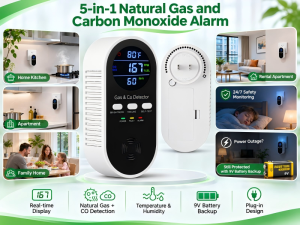
The original SUMRING article featured the SR-907-2, a battery-operated model. SUMRING’s published product information specifies an electrochemical sensor, an LCD, three 1.5 V AA batteries, an 85 dB alarm at one meter, LED indicators, and a low-battery warning. The older article also described snap-on battery access; verify that feature on current samples. A battery operated carbon monoxide alarm for home use can simplify retrofits without convenient wiring.
However, a home co detector should never be selected on battery convenience alone. Buyers must confirm the current datasheet, mounting instructions, required approvals, expected service life, and the suitability of the exact product version. Product descriptions do not establish certification.
What Should International Distributors Request Before Ordering?
Wholesale buyers and an OEM carbon monoxide detector supplier should agree on the intended country, applicable product standard, documentation, language requirements, and installation environment before confirming a purchase. UL 2034 and EN 50291-1 are examples of standards relevant to different markets; compliance must be verified for the exact model and destination.
Request samples, model-specific test documents, current manuals, maintenance instructions, and replacement terms. An effective home co detector program combines appropriate equipment with reliable guidance for the end user, especially for private-label and rental-housing projects.
For independent guidance, the U.S. Consumer Product Safety Commission’s carbon monoxide fact sheet explains alarm coverage, maintenance, and emergency response.
FAQ
1. Is a CO Alarm Necessary if a Home Has a Smoke Alarm?
Yes. Standard smoke alarms detect smoke rather than carbon monoxide. A combination unit must explicitly support both detection functions; one technology should not be assumed to replace the other.
2. How Many CO Alarms Should a Multi-Story Home Have?
Safety authorities recommend coverage on every level and outside sleeping areas. Additional alarms may be required by local code, building layout, or the product’s instructions.
3. Can Landlords Rely on Tenants to Maintain the Alarm?
Not without checking local requirements. Legal duties vary. Owners and managers should establish clear responsibility for installation, periodic checks, records, and replacement, while occupants promptly report problems.
4. Does Pressing the Test Button Verify CO Sensor Accuracy?
No. The test control generally checks specified alarm functions, not a complete calibration of the sensing element. Follow the manufacturer’s testing and replacement instructions.
5. Is a Battery-Powered CO Alarm Suitable for an Apartment Retrofit?
It can be practical where wiring access is limited, provided the specific model, mounting location, power arrangement, and applicable certification meet the project requirements.
6. What Should Residents Do When a CO Alarm Sounds?
Leave the building immediately, call emergency services from outdoors, and remain outside until authorized responders confirm it is safe to return. Never dismiss an alarm as a nuisance.
7. Can SUMRING Support Private-Label CO Alarm Projects?
SUMRING discusses OEM/ODM requirements such as branding, labeling, packaging, and manuals. Buyers should confirm model availability, quantities, technical documents, and market-specific certification before placing orders.
Conclusion
Winter carbon monoxide protection requires more than installing an alarm once. Building owners should check coverage, power, service life, appliance maintenance, and occupant instructions before the heating season. For distributors and contractors, selecting a home co detector is only the first step; documented inspections and verified market compliance make the safety program workable year after year.
SUMRING welcomes inquiries from residential project buyers, distributors, and OEM/ODM partners seeking suitable CO alarm configurations and product information.