2026 Fire Safety Trends: How Smart Technologies Are Evolving?
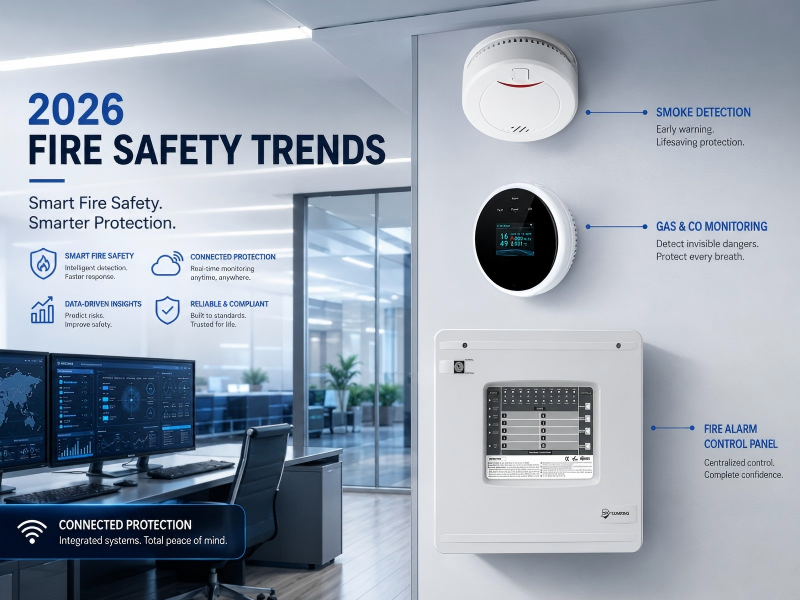
2026 Fire Safety Trends describe the shift toward connected detection, data-assisted decisions, lower false-alarm rates, battery-risk monitoring, and more efficient fire system maintenance.
Fire safety technology in 2026 is not replacing proven smoke detectors, alarm panels, sounders, manual call points, or suppression systems. Instead, manufacturers and facility operators are adding connectivity, improved sensor processing, remote visibility, and specialized detection for emerging risks.
These developments should be viewed realistically. Adoption still depends on local fire codes, project budgets, building conditions, product certification, system compatibility, cybersecurity requirements, and approval by the relevant authority.
Connected Fire Safety Expands System Visibility
One of the clearest 2026 Fire Safety Trends is the continued development of connected fire alarm systems.
Cloud platforms can provide remote panel access, device status, fault information, maintenance records, and multi-site monitoring. Honeywell, for example, highlights remote fire panel visibility and the ability to identify system issues before a technician arrives. Siemens’ fire notification technology announced in June 2026 also emphasizes individual device monitoring, remote testing, cloud connectivity, and predictive maintenance.
Cloud access does not replace required local alarm functions, physical inspections, or emergency procedures. It is mainly an additional management layer that can help facility teams locate faults, review system status, and organize maintenance more efficiently.
AI Assists Detection but Does Not Replace Human Oversight
AI fire detection is receiving greater attention for analyzing sensor readings, thermal images, video, and changing fire conditions.
The National Institute of Standards and Technology is researching artificial intelligence and machine-learning methods for real-time forecasting and improved situational awareness, including work related to flashover prediction. NIST also published implementation considerations in 2025 covering risk management, validation, standards development, and the responsible use of AI in electronic safety equipment.
The realistic position in 2026 is that AI remains an assistance technology. Its effectiveness depends on data quality, proper testing, environmental suitability, understandable system behavior, and reliable fallback functions.
AI should not be treated as a universal replacement for certified fire detectors, alarm panels, trained installers, facility personnel, or firefighters.
Multi-Criteria Sensors Target Nuisance Alarms
False alarms remain a practical concern in kitchens, hospitals, hotels, factories, and other locations where steam, dust, aerosols, cigarette smoke, or temperature changes may affect detection.
Newer multi-criteria fire detectors can combine optical and thermal sensing with intelligent signal processing. Some current systems also include detector self-supervision, remote health monitoring, blocked-entry alerts, and automated testing functions designed to reduce unnecessary interruption.
These technologies may improve reliability, but correct detector selection and placement remain essential. Smart processing cannot compensate for poor installation, blocked smoke entry, inadequate maintenance, unsuitable environmental conditions, or use outside the detector’s approved application.
Lithium-Ion Battery Safety Becomes a Specialized Priority
Lithium-ion batteries are increasingly used in battery energy storage systems, data centers, electric mobility products, warehouses, charging stations, and backup power systems. This is creating demand for more specialized fire-risk controls.
FM research has examined off-gas detection as a possible early-warning method before lithium-ion battery thermal runaway. In its laboratory scenarios, the interval between detected off-gassing and thermal runaway ranged from approximately five to twenty minutes. However, actual performance can vary according to battery chemistry, ventilation, enclosure design, detector placement, and incident conditions.
UL Solutions also introduced testing and certification programs in 2025 for battery containment enclosures and micromobility charging equipment. These programs address risks associated with thermal runaway, fire, gases, explosion, and charging infrastructure.
The wider trend is toward layered protection that may include certified charging equipment, battery monitoring, ventilation, physical separation, off-gas detection, suppression systems, emergency planning, and code-compliant installation.
Digital Maintenance Makes Cybersecurity More Important
Remote inspections, automated device tests, digital reports, and predictive maintenance can reduce manual work and improve documentation.
These tools may be particularly useful for hospitals, hotels, commercial buildings, factories, campuses, warehouses, and multi-site property portfolios where traditional testing can require significant time or interrupt normal operations.
However, every connected safety device also becomes part of an Internet of Things environment. NIST’s IoT cybersecurity program supports risk-based standards and guidance for connected products and the environments in which they operate.
Fire safety projects should therefore consider:
- User access control
- Secure data communication
- Software and firmware updates
- Network separation
- Backup and offline operation
- Data ownership
- Maintenance responsibility
Connectivity should improve fire safety management without weakening the reliability of local alarms.
What Should B2B Buyers and Project Contractors Check?
The best procurement decision is not simply to select the product with the largest number of smart features.
Buyers should verify product certifications, sensor type, alarm thresholds, communication protocols, power supply, backup power, environmental rating, system compatibility, maintenance requirements, cybersecurity provisions, and local code acceptance.
A smart fire safety system should strengthen the basic life-safety function without creating unnecessary complexity. For many commercial projects, reliable local alarms combined with optional remote monitoring may offer a practical balance between safety, maintenance efficiency, and cost.
FAQ:
1. What is the main fire safety technology trend in 2026?
The main trend is the integration of proven alarm devices with cloud monitoring, digital maintenance, multi-sensor processing, and data-assisted decision support.
2. Can AI replace smoke detectors or fire alarm panels?
No. AI can support analysis and early warning, but certified detectors, alarm panels, correct installation, regular testing, and human response remain essential.
3. Why is lithium-ion battery detection becoming important?
Battery thermal runaway can produce intense heat, fire, flammable gases, toxic smoke, and explosion risks. Higher-risk locations may therefore require specialized monitoring and protection.
4. Are cloud-connected fire alarm systems reliable?
They can improve visibility and maintenance efficiency, but reliability depends on product design, certification, network security, backup operation, commissioning, and ongoing maintenance.
5. What should project buyers confirm before purchasing?
Buyers should confirm certifications, applicable standards, sensor specifications, communication methods, environmental ratings, integration requirements, warranty, after-sales support, and customization options.
Conclusion
2026 Fire Safety Trends show an industry moving toward earlier risk recognition, smarter monitoring, lower disruption, and more efficient maintenance without abandoning traditional fire safety fundamentals.
For distributors, wholesalers, and project contractors evaluating smoke alarms, gas detectors, manual call point accessories, fire alarm sounders, or connected alarm products, Sumring can help match product functions, communication options, and OEM/ODM requirements to specific fire safety projects.