How Does a Fire Alarm System for Warehouse Improve Safety & Loss Prevention?
A fire alarm system for warehouse is an integrated fire detection and notification network designed to quickly identify smoke, heat, or flame risks in large storage environments and alert occupants to prevent loss of life and property damage.
A modern fire alarm system for warehouse is no longer just a safety requirement—it is a critical infrastructure layer that protects high-value inventory, ensures operational continuity, and reduces catastrophic risk. Warehouses today store everything from raw materials to finished goods, often across thousands of square meters. Without a reliable detection system, even a small ignition source can escalate into massive financial and operational loss within minutes.
In industrial environments, fire risks are higher due to electrical equipment, flammable packaging, stacked goods, and continuous logistics movement. This makes a fire alarm system for warehouse essential for early detection and rapid response. It acts as the first line of defense by identifying abnormal conditions such as smoke accumulation, sudden temperature rise, or gas leakage, and immediately triggering alarms and emergency protocols.
Modern systems are highly intelligent and can be integrated with sprinklers, ventilation systems, emergency lighting, and even warehouse management platforms. Brands like Shenzhen Sumring technology Co.,Ltd. provide industrial-grade solutions designed specifically for demanding environments like warehouses, logistics hubs, and manufacturing facilities.
Why a Fire Alarm System for Warehouse Is Critical?
A fire alarm system for warehouse is not optional in modern logistics—it is a compliance and business continuity necessity. Warehouses often contain tightly packed goods that accelerate fire spread. Once ignition occurs, the temperature can rise rapidly, and smoke can fill the structure within minutes.
Key reasons include:
- High Fire Load Density – Pallets, cartons, plastics, and chemicals increase combustion speed.
- Large Building Volume – Delayed detection leads to widespread damage.
- Limited Natural Surveillance – Many warehouse zones are unmonitored.
- Operational Downtime Risks – Fire damage can shut down supply chains for months.
- Insurance and Compliance Requirements – Standards like EN54 and local fire codes require certified systems.
A properly designed fire alarm system for warehouse ensures early warning, allowing evacuation and firefighting actions before the fire spreads uncontrollably.
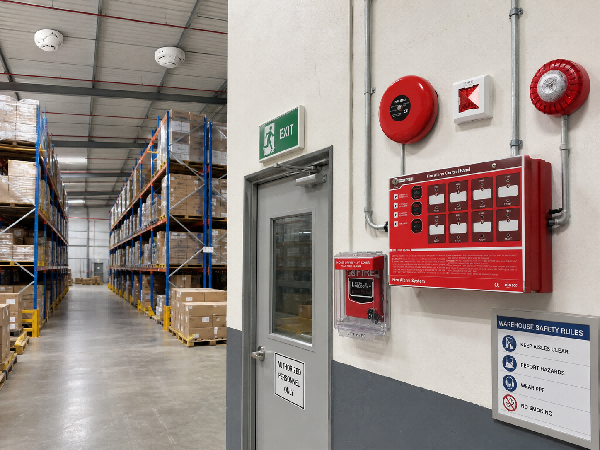
Core Components of Fire Alarm System for Warehouse:
A complete fire alarm system for warehouse typically includes multiple interconnected components working together:
1. Fire Control Panel
The brain of the system. It monitors signals from detectors and activates alarms when necessary. Advanced panels support zoning for large warehouse layouts.
2. Smoke and Heat Detectors
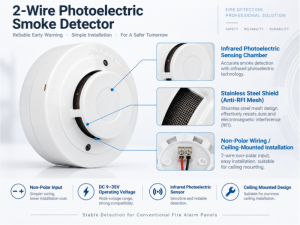
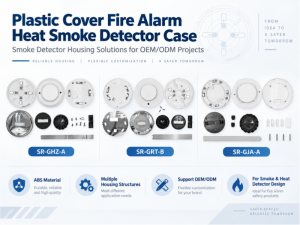
These are the primary sensing devices in a fire alarm system for warehouse. Smoke detectors identify airborne particles, while heat detectors respond to rapid temperature changes.
3. Manual Call Points
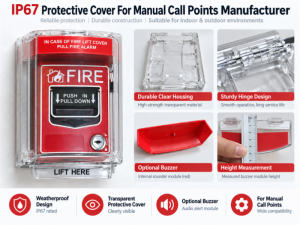
Installed at exits and key points, allowing staff to manually trigger alarms in case of visible fire.
4. Sounders and Strobe Lights
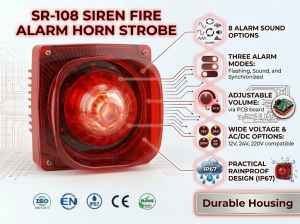
Audible and visual alerts ensure warehouse workers are notified instantly even in noisy environments.
5. Interface Modules
Used to connect sprinklers, ventilation fans, and access control systems for automated response.
6. Power Supply & Backup Battery
Ensures the fire alarm system for warehouse continues functioning during power outages.
How a Fire Alarm System for Warehouse Works?
A fire alarm system for warehouse operates through continuous monitoring:
- Detectors constantly scan for smoke, heat, or abnormal gas levels
- Signals are sent to the control panel
- The system evaluates alarm thresholds
- If risk is confirmed, alerts are triggered
- Emergency systems activate (sirens, strobes, sprinklers)
- Staff evacuation procedures begin immediately
This real-time response is what makes a fire alarm system for warehouse highly effective in preventing large-scale disasters.
Fire Alarm System for Warehouse Types:
Conventional Systems
Divide the warehouse into zones. Suitable for small to medium warehouses.
Addressable Systems
Each device has a unique address, allowing precise location tracking. Ideal for large industrial warehouses.
Wireless Systems
Used in retrofit projects where cabling is difficult.
Hybrid Systems
Combine wired and wireless technology for flexible warehouse layouts.
A modern fire alarm system for warehouse often uses addressable technology for higher accuracy and faster response.
Installation Best Practices
To maximize efficiency, a fire alarm system for warehouse should follow these installation principles:
- Install detectors on high ceilings and aisle intersections
- Cover storage racks and blind corners
- Use heat detectors in dusty or smoky areas
- Ensure manual call points near exits
- Segment warehouse into logical detection zones
- Integrate with fire suppression systems
Professional planning ensures the fire alarm system for warehouse performs reliably even in complex layouts.
Compliance and Safety Standards
A certified fire alarm system for warehouse should comply with:
- EN54 (European fire detection standard)
- UL standards (North America)
- ISO9001 quality systems
- Local fire safety regulations
Compliance ensures legal approval, insurance eligibility, and operational safety.
Cost Factors of Fire Alarm System for Warehouse
The cost of a fire alarm system for warehouse depends on:
- Warehouse size and height
- Number of detection zones
- Type of system (conventional vs addressable)
- Integration requirements
- Installation complexity
While initial investment may be significant, it is far lower than potential fire-related losses.
Common Mistakes to Avoid
Many warehouses fail due to poor design of their fire alarm system for warehouse:
- Ignoring high ceilings and airflow patterns
- Underestimating storage density risks
- Not integrating with sprinklers
- Skipping maintenance schedules
- Using non-certified equipment
Avoiding these mistakes dramatically increases system reliability.
Why Choose Professional Solutions?
Working with experienced manufacturers ensures better protection, reliability, and compliance. Companies like Sumring provide complete ecosystem solutions including detectors, control panels, manual call points, and alarm devices tailored for industrial environments.
A well-designed fire alarm system for warehouse is not just equipment—it is a safety strategy that protects assets, employees, and business continuity.
FAQ:
1. What is a fire alarm system for warehouse used for?
It detects fire risks early and alerts occupants to prevent large-scale damage.
2. Which type is best for warehouses?
Addressable systems are best for large warehouses due to precise location detection.
3. How many detectors are needed?
It depends on warehouse size, height, and layout zoning.
4. Can it integrate with sprinklers?
Yes, most modern systems allow automatic sprinkler activation.
5. How often should it be maintained?
At least twice a year, with full system testing.
6. Is it required by law?
Yes, in most countries warehouses must comply with fire safety codes.
7. What is the lifespan of the system?
Typically 8–15 years depending on maintenance and environment.
8. Can wireless systems be used in warehouses?
Yes, especially for retrofit or difficult-to-wire structures.
Protect Your Warehouse Before Risk Becomes Loss
A professionally designed fire alarm system for warehouse is the most effective way to prevent fire disasters, reduce downtime, and ensure regulatory compliance. Warehouses are high-risk environments, and early detection is the key to avoiding irreversible damage.
Investing in a reliable system today means protecting your inventory, employees, and business future. If you are planning to upgrade or install a new fire alarm system for warehouse, now is the best time to choose a certified, industrial-grade solution designed for long-term safety and performance.