Why Do Outdoor Fire Alarm Buttons Need an IP67 Call Point Cover?
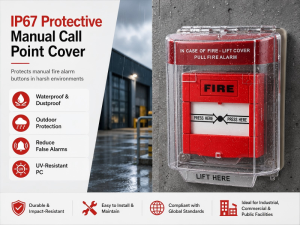
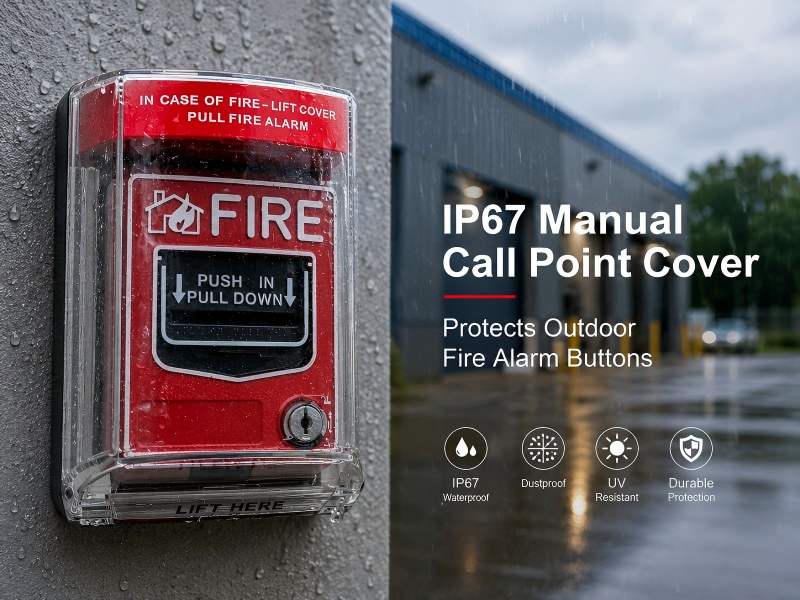
An IP67 manual call point cover is a sealed enclosure that protects an outdoor fire alarm button from dust, water, impact, tampering, and accidental activation while keeping it visible and accessible.
Outdoor fire alarm buttons face rain, wind-blown dust, cleaning water, insects, public contact, and equipment impact. A correctly selected IP67 manual call point cover adds environmental and physical protection without replacing the call point itself. For contractors, distributors, and facility managers, it can reduce avoidable service calls, false alarms,
What Does IP67 Mean?
IEC 60529 uses the IP code to classify enclosure protection against solids and water. The first digit “6” indicates dust-tight protection, while “7” indicates protection against temporary immersion under defined test conditions.
IP67 does not mean permanent underwater use or resistance to every high-pressure washdown. Buyers should request applicable test evidence for the exact model before approving it for a project.
The complete installation still depends on correct mounting, seals, cable entries, wall conditions, and compatibility between the cover and the fire alarm button.
7 Reasons Outdoor Fire Alarm Buttons Need an IP67 Manual Call Point Cover
1. Protection From Rain and Moisture
Outdoor call points may face direct rain, condensation, humidity, or water from routine cleaning. Moisture can increase maintenance requirements around terminals, operating parts, and reset mechanisms.
A properly fitted IP67 manual call point cover creates an additional barrier around the device. It is especially useful on exterior walls, loading bays, car parks, outdoor corridors, and utility buildings.
2. Dust and Debris Control
Factories, warehouses, construction sites, and logistics centers often contain airborne dust. Fine particles can collect around the call point housing, labels, hinges, and operating surface.
A dust-tight cover helps keep the protected area cleaner. It does not remove the need for scheduled inspection, but it can reduce direct exposure and simplify routine maintenance.
3. Lower Risk of Accidental Activation
Manual call points must be easy to find and reach. That accessibility also exposes them to bags, carts, ladders, tools, pallets, and cleaning equipment.
A transparent hinged cover adds a deliberate action before the button can be operated. Fire Industry Association guidance reports that protective covers were associated with a 16% reduction in false alarms in the cited research. The guidance also explains that fitting a hinged cover does not automatically change a Type A call point into a Type B device. Local regulations and authority requirements must still be followed.
4. Better Impact and Tamper Protection
Outdoor public areas and industrial sites carry a higher risk of knocks, vandalism, and unauthorized handling. A strong polycarbonate enclosure can absorb everyday contact before it reaches the alarm button.
Where repeated misuse is a concern, buyers may consider a manual call point cover with alarm. Its local warning sound can discourage casual lifting, but the power source, sound level, reset method, and local approval requirements should be checked.
5. Clear Emergency Visibility
Protection must not make an emergency device difficult to identify. A transparent IP67 manual call point cover keeps the red call point, operating instructions, and status indicators visible.
The cover should open smoothly and must not be hidden behind doors, shelves, pipes, signs, or stored goods. Visibility and access are more important than making the installation look perfectly symmetrical.
6. Lower Lifecycle Cost
A damaged call point creates more than a replacement cost. It may require technician travel, access permits, system isolation, testing, and updated maintenance records.
By reducing direct environmental and physical exposure, an IP67 manual call point cover may help extend the service life of the protected installation. For project buyers, lower maintenance frequency and predictable lifecycle cost usually matter more than the lowest unit price.
7. Practical Retrofit Protection
Many existing fire alarm systems use working call points that do not need replacement. Adding a compatible cover can be a practical retrofit when a site has problems with rain, dust, false activation, or physical impact.
Before ordering, compare the internal dimensions, mounting depth, hinge clearance, cable route, reset-key access, and wall-fixing method. Sumring’s manual call point cover product page provides a useful starting point for model evaluation.
Where Should the Cover Be Used?
Typical locations include:
- Factory exterior walls and loading bays
- Car parks and semi-outdoor corridors
- Open-air warehouses and logistics centers
- Construction sites and temporary facilities
- Coastal buildings, marinas, and ports
- Transport platforms and outdoor stations
- Equipment rooms and utility buildings
- Campus walkways and public access areas
The cover may also be useful in busy indoor locations exposed to dust, impact, or unwanted activation. However, an IP rating does not replace proper fire alarm design. The call point must remain visible, reachable, and positioned according to local fire regulations.
EN 54-11 specifies requirements and test methods for manual call points used in fire detection and fire alarm systems. Compliance still depends on the approved call point, complete fire alarm system, installation method, and local project requirements.
B2B Purchasing Checklist
When sourcing an IP67 manual call point cover, procurement teams should confirm:
- IP test information for the exact model
- Internal dimensions and call point compatibility
- Polycarbonate transparency and impact performance
- UV resistance for long-term outdoor installation
- Seal design, cable entry, and mounting method
- Easy emergency opening and reset-key access
- Standard or local-alarm version
- Drawings, samples, packaging, and batch consistency
- OEM/ODM options for logos, languages, labels, and cartons
- Production lead time, warranty, spare parts, and after-sales support
Do not assume that the cover’s documentation certifies the manual call point or the entire fire alarm system. The complete assembly should be reviewed by the contractor, fire consultant, or approving authority.
FAQ:
1. Can an IP67 manual call point cover be installed outdoors?
Yes. It is suitable for outdoor and semi-outdoor locations when the exact model, mounting method, and complete assembly match the environmental conditions.
2. Does IP67 mean the cover is permanently waterproof?
No. IP67 normally refers to dust-tight protection and temporary immersion under defined tests. It does not automatically include permanent submersion or high-pressure water jets.
3. Will the cover delay fire alarm activation?
A well-designed cover should lift quickly and keep the call point clearly visible. The installation must still comply with local accessibility and fire alarm requirements.
4. Can the cover reduce false alarms?
Yes. The physical barrier can reduce accidental contact and discourage casual or unauthorized operation.
5. Is polycarbonate suitable for outdoor applications?
Polycarbonate is commonly used because of its transparency and impact resistance. Buyers should also confirm UV resistance, anti-yellowing performance, and material suitability for the installation environment.
6. Can one cover fit every manual call point?
No. Call point dimensions, depth, reset access, mounting position, and cable layout vary between models and brands.
7. Should buyers choose a standard or alarmed cover?
Choose a standard cover for environmental and impact protection. Consider an alarmed version where tampering or repeated unwanted operation is a documented risk.
8. What documents should B2B buyers request?
Request a datasheet, dimension drawing, material details, applicable IP test evidence, installation guide, sample approval record, packaging information, and warranty terms.
Conclusion
Outdoor fire alarm buttons face rain, dust, impact, cleaning water, and public contact. These conditions can increase faults, false alarms, and maintenance work. A correctly matched IP67 manual call point cover protects the device while preserving visibility and emergency access.
For wholesalers, contractors, and system integrators, the best cover is not simply the cheapest option. It is the model that fits correctly, has verifiable documentation, installs cleanly, remains easy to operate, and can be supplied consistently throughout the project lifecycle.