How to Select Fire Alarm Manual Call Points for Projects?
Fire alarm manual call points are manual initiating devices used to trigger a fire alarm when an emergency is identified. For commercial projects, selecting the right model requires more than comparing appearance and price.
Contractors, distributors, and system integrators should evaluate system compatibility, electrical contacts, operating method, environmental conditions, project compliance, mounting requirements, and maintenance needs before bulk purchasing.
This guide explains how to select the best fire alarm manual call points for commercial projects and how to reduce compatibility risks before sample approval and mass ordering.
1. Check Fire Alarm System Compatibility
First, confirm what system the call point will connect to.
A conventional fire alarm system normally uses zone circuits. An addressable system uses devices that communicate with a compatible control panel. These system types should not be treated as interchangeable.
Before sending an inquiry, confirm:
- Conventional or addressable system
- Fire alarm control panel brand and model
- Zone or loop requirements
- Required interface or module
- Existing wiring method
For addressable projects, protocol compatibility is especially important. A device may fit mechanically but still be incompatible with the panel.
B2B tip: Send the panel datasheet, wiring diagram, or existing call point model before approving a replacement.
2. Confirm Electrical and Contact Requirements
Many project errors start with incomplete electrical information.
A buyer may ask for a “24 V manual call point,” while the real requirement is a specific contact arrangement or signal method. Therefore, confirm how the panel expects to receive the alarm signal.
Check the required normally open or normally closed contact, voltage and current limits, resistor requirements, terminals, cable size, and wiring space.
Do not rely only on the maximum switch rating shown on a datasheet. The complete interface must match the panel design.
For retrofit work, compare the existing wiring with the proposed replacement before ordering in volume.
3. Choose the Operating Method
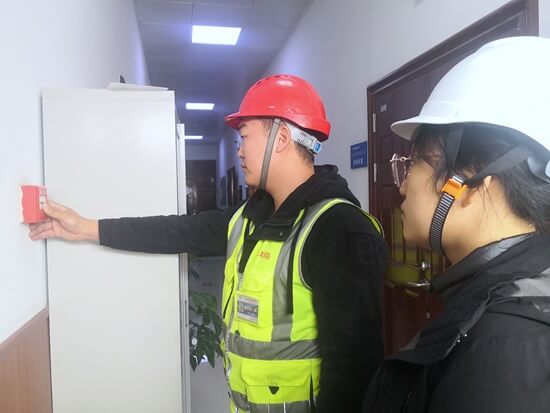
Fire alarm manual call points use different activation methods. Common options include frangible-element, resettable-element, push-button, and pull-station designs.
The best option depends on the project specification, local practice, maintenance process, and end-user preference.
A resettable design may reduce replacement parts during routine testing. A frangible element gives a clear physical indication after operation. Some projects may specify a particular style.
Also ask whether:
- A reset key is included
- Spare elements are available
- Testing can be completed without damaging parts
- Replacement accessories can be reordered
These details matter when hundreds of devices must be maintained.
4. Match the Operating Environment
An indoor office does not have the same requirements as a factory, parking area, warehouse, or exposed outdoor site.
Before selecting fire alarm manual call points, define the actual operating conditions.
Consider:
- Indoor, sheltered, or outdoor use
- Dust and moisture exposure
- Temperature range
- Risk of impact or tampering
- Corrosive or high-humidity conditions
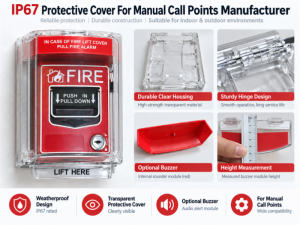
If the call point itself does not provide the required environmental protection, a compatible protective cover may be evaluated separately.
However, a protective cover should not be used to assume that the call point itself has the same IP rating.
That distinction is important in project documentation.
5. Check Mounting, Back Box, and Wiring Space
A technically compatible call point can still create problems if it does not fit the wall box or cable entry.
Before sample approval, check:
- Surface or flush mounting
- Back-box dimensions
- Fixing-hole positions
- Cable entry
- Terminal access
- Overall depth
- Space for conduits or glands
For retrofit projects, drawings and site photos are often more useful than a simple dimension list.
A small mechanical difference may add installation time across a large commercial project.
6. Verify Project Compliance
Commercial fire alarm projects often have defined approval requirements. These may come from the consultant, local authority, tender specification, distributor, or target market.
Ask the supplier to confirm:
- Applicable product standard
- Certificate or test report
- Certificate holder
- Exact model covered
- Current document status
- Limits on configuration or accessories
Do not assume that one certificate covers every model in a product family.
Ask for the actual document and verify that the required model is included.
For OEM projects, also confirm whether custom branding, colors, labels, or structural changes affect the approved configuration.
This is especially important when fire alarm manual call points are supplied for regulated commercial or public projects.
7. Evaluate Total Project Cost
Unit price is only one part of the purchasing decision.
A lower-cost device can become expensive if installers need extra wiring work, spare parts are difficult to obtain, or product specifications change between batches.
Commercial buyers should compare:
- Product cost
- Installation time
- Testing process
- Spare parts
- Reset tools
- Packaging
- Warranty
- Technical support
- Reorder consistency
For distributors, model continuity also matters.
A stable product is easier to stock, support, quote, and resell over a longer period.
8. Test Samples Before Bulk Ordering
Sample approval is one of the most useful ways to reduce procurement risk.
Before placing a volume order for fire alarm manual call points, test the proposed device with the actual control panel or a representative system.
Check:
- Mechanical fit
- Terminal connection
- Alarm activation
- Reset process
- Panel response
- Accessory compatibility
- Label and language requirements
- Packaging and product identification
For larger projects, record the approved model, wiring method, and sample version.
This creates a clear reference for purchasing, installation, inspection, and future reorders.
What Should Be Included in a Manual Call Point RFQ?
A complete RFQ helps suppliers recommend the right product faster.
Include:
- Project country and quantity
- Conventional or addressable system
- Control panel brand and model
- Contact or interface requirement
- Operating method
- Indoor or outdoor environment
- Compliance requirement
- Mounting type
- Logo, language, or packaging requirements
- Sample quantity
- Target delivery schedule
For replacement projects, also provide photos, dimensions, wiring diagrams, and the current model number.
More complete information usually means fewer technical questions and a faster quotation process.
What Should B2B Buyers Prioritize?
A practical selection order is:
System compatibility → compliance → electrical interface → operating method → environment → mechanical fit → maintenance → price
This sequence prevents price from driving the purchasing decision before technical requirements are clear.
For distributors, contractors, and system integrators, suitable fire alarm manual call points should be easy to specify, test, install, service, and reorder.
A structured process also makes supplier comparison more objective.
FAQ
1. Can one manual call point work with every fire alarm panel?
No. Compatibility depends on system architecture, interface, wiring, protocol, and panel requirements. Always confirm the control panel model before ordering.
2. What is the difference between conventional and addressable manual call points?
Conventional devices normally connect to a zone circuit. Addressable devices communicate through a compatible loop or interface and require correct protocol matching.
3. Should I choose a resettable or frangible manual call point?
Choose according to the project specification, local requirements, testing routine, and maintenance preference. Neither design is automatically suitable for every project.
4. Do outdoor projects always need an IP-rated manual call point?
The required protection depends on the actual environment and project specification. Confirm the call point rating and any protective accessory separately.
5. What information should I send for a replacement project?
Send the existing call point model, panel model, wiring diagram, dimensions, installation photos, required quantity, and compliance target.
6. Why should commercial buyers approve a sample first?
A sample allows buyers to check mechanical fit, wiring, operation, panel response, accessories, and labeling before committing to a bulk order.
7. Can manual call points be customized for OEM or ODM projects?
Customization may include branding, text, color, and packaging. However, any change should be reviewed against project approval and certification requirements.
8. What is the best way to compare manual call point suppliers?
Compare documented compatibility, compliance, product consistency, technical support, spare parts, delivery time, and total project cost instead of unit price alone.
Conclusion
Selecting fire alarm manual call points for a commercial project starts with technical compatibility, not appearance.
First, confirm the control panel and system architecture. Then verify the electrical interface, operating method, environment, approvals, mounting details, and maintenance requirements before comparing quotations.
For a distributor order, retrofit project, or commercial fire alarm specification, provide the panel model, existing device information, required quantity, destination market, and certification requirements.
Sumring can review your project information and help identify a suitable manual call point configuration before sample approval and bulk production.