What Are 7 Proven Ways to Reduce Carbon Monoxide Risk in Commercial Buildings?
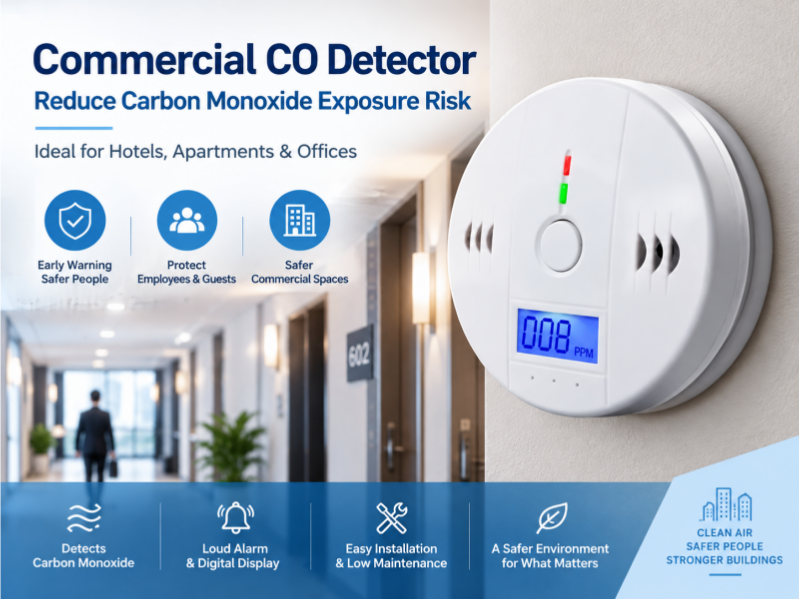
A commercial CO detector provides early warning of carbon monoxide in buildings where heating equipment, generators, vehicle exhaust, or other combustion sources may create a potential risk.
For hotels, apartments, offices, and other commercial properties, effective CO risk reduction requires more than simply installing an alarm. Project planners should evaluate potential sources, building layouts, detector specifications, placement requirements, maintenance plans, and applicable local regulations.
The following 7 practical considerations can help distributors, contractors, property managers, and system integrators develop a more suitable CO detection strategy for commercial projects.
Why Is CO Risk Different in Commercial Buildings?
Commercial properties often have more complex layouts than homes.
Hotels may include guest rooms, kitchens, boiler equipment, parking areas, and service spaces. Apartments may share mechanical rooms and enclosed garages. Offices, warehouses, restaurants, and mixed-use buildings can also have different combustion sources and ventilation conditions.
Therefore, buyers should not select a detector only by appearance or unit price.
First identify where CO could be generated, where people spend time, and which project requirements apply. A commercial CO detector should be considered one part of the building’s wider safety strategy.
Where Should a Commercial CO Risk Assessment Start?
Start with the building layout and equipment.
Review areas containing boilers, heaters, generators, cooking equipment, vehicle traffic, or other combustion sources.
Next, consider occupancy. Guest rooms, apartments, staff areas, and dormitories may require a different detection strategy from plant rooms or service areas.
Finally, check local codes, approved drawings, project specifications, and manufacturer instructions before confirming detector placement.
This process avoids a common project mistake: choosing the detector first and planning the installation later.
How Should You Select a Commercial CO Detector?
The correct device depends on the application.
A stand-alone unit may suit a simple indoor project when permitted by the project specification. Buildings that require centralized supervision or external equipment control may instead need relay output or another system connection.
Power supply also matters.
Battery-powered, AC-powered, and low-voltage DC models serve different requirements. Buyers should confirm the power source before approving a bulk order.
Next, compare:
sensor technology, operating environment, expected service life, fault indication, alarm method, maintenance method, and required certification.
Depending on the project, users may need sound alarms, indicator lights, digital displays, voice prompts, or a combination of these functions.
The goal is not to select the detector with the most features. It is to select the commercial CO detector that best matches the project specification.
CO-Only or Multi-Gas Detection: Which Is Better?
A CO-only detector is designed specifically for carbon monoxide monitoring.
It may be suitable when carbon monoxide is the main identified gas hazard.
A multi-gas detector can make sense where both CO and combustible gas risks are present. For example, some projects may require monitoring of carbon monoxide together with natural gas or LPG.
However, more functions do not automatically mean a better solution.
B2B buyers should compare the target gas, sensor type, alarm logic, power supply, output functions, and installation environment before selecting a model.
Which Commercial Applications Need Special Attention?
Hotels and serviced apartments often require consistent specifications across many rooms or floors. Property teams also need clear maintenance and replacement records.
Commercial kitchens can contain fuel-burning equipment, while parking structures may have vehicle-related CO sources.
Boiler rooms, plant rooms, warehouses, and generator areas also require application-specific assessment.
Each environment should be evaluated separately. Ventilation, occupancy, operating conditions, system integration, and maintenance access can all affect the final detector specification.
This is particularly important for contractors handling different building zones within the same project.
How Can Buyers Avoid Incorrect Detector Placement?
Do not use one universal mounting rule for every product and every country.
Placement should follow approved project drawings, applicable regulations, manufacturer instructions, building layout, combustion sources, airflow, and occupancy patterns. Buyers can also review our carbon monoxide detector placement guide before preparing the project layout.
What Should B2B Buyers Confirm Before Bulk Ordering?
When practical, review a technical sample before placing a large order.
Check housing quality, alarm indication, display readability, installation method, power configuration, labeling, and packaging.
Documentation is equally important.
Confirm the datasheet, user manual, product markings, required certification status for the target market, warranty terms, and available technical support.
OEM or ODM requirements should also be discussed before mass production. Branding, packaging, language, power configuration, and output functions can affect both approval and lead time.
Use this project checklist before confirming an order:
| Project Check | Question to Confirm |
|---|---|
| Application | Where will the detector be used? |
| Gas Risk | CO only or CO plus combustible gas? |
| Power | Battery, AC, or DC? |
| Output | Stand-alone, relay, or system connection? |
| Indication | Sound, light, display, or voice? |
| Compliance | Which local approval is required? |
| Customization | Is OEM branding or packaging needed? |
| Quantity | Sample, trial order, or bulk project? |
How Should Facility Managers Maintain CO Detection?
Installation is only the beginning.
Commercial properties should include detectors in a planned inspection and maintenance program.
Follow the product manual for testing, cleaning, battery replacement where applicable, fault handling, and end-of-life replacement.
Maintenance records should show where each detector is installed and when it was inspected or replaced.
For hotel groups, apartment operators, and multi-site property companies, standardized records can simplify maintenance and help teams manage large numbers of devices more consistently.
Why Does Early CO Detection Matter?
Carbon monoxide cannot be reliably identified by sight or smell.
A suitable detector provides an early warning when its alarm conditions are reached, helping occupants and building operators respond sooner.
However, a commercial CO detector does not replace equipment maintenance, ventilation design, emergency procedures, or professional medical evaluation after suspected exposure.
A stronger project strategy uses several layers:
reduce likely CO sources, maintain combustion equipment, manage ventilation, install appropriate detection, and establish clear response procedures.
This approach focuses on risk reduction instead of relying on one device alone.
How Can Distributors Build a Better CO Detector Product Range?
Distributors should avoid offering every customer the same model.
One market may need simple stand-alone detection, while another may prefer combined CO and combustible-gas monitoring.
Contractors may require relay outputs, low-voltage power, digital displays, or specific technical documentation.
Before quoting, collect the customer’s:
application, target market, required functions, certification expectations, estimated quantity, and customization requirements.
This gives the supplier enough information to recommend a more appropriate solution and reduces specification errors.
It can also make quotations more relevant to wholesalers, project contractors, property companies, and system integrators.
FAQ
What is a commercial CO detector?
A commercial CO detector is a carbon monoxide warning device selected for applications such as hotels, apartments, offices, restaurants, and other commercial projects. Product selection should follow the actual project requirements.
Can one CO detector model be used for every commercial building?
No. Building layout, fuel sources, occupancy, power supply, environmental conditions, and local requirements can differ significantly between projects.
Should I choose a CO-only detector or a CO and gas detector?
Choose according to the identified hazard. A combined detector may be considered when combustible gas is also part of the project’s defined monitoring requirement.
What information should I send a CO detector supplier?
Provide the target country, application, building type, gas detection requirement, power supply, output functions, certification needs, quantity, and customization requirements.
Do commercial CO detectors need regular maintenance?
Yes. Testing, cleaning, battery service where applicable, fault checks, and replacement should follow the manufacturer’s instructions and project maintenance plan.
Can a commercial CO detector connect to external equipment?
Some models support relay outputs or other system connections, while others operate independently. Confirm the required interface before placing an order.
Is a digital display necessary for every project?
Not always. The project specification should determine whether concentration display, status indication, voice alerts, or other visual information is required.
Can Sumring Support OEM or ODM CO Detector Projects?
Yes. Sumring supports OEM and ODM discussions for gas detection projects. Buyers can provide their target market, quantity, required functions, branding, packaging, and documentation needs for evaluation.
Conclusion
Reducing carbon monoxide exposure risk in commercial buildings starts with understanding the site, not selecting a model from a catalogue.
Identify potential CO sources, define the installation environment, confirm project requirements, and then choose a suitable commercial CO detector.
For distributors, contractors, and system integrators, this approach can reduce specification mistakes and improve quotation accuracy.
If you are sourcing CO detection products for hotels, apartments, commercial facilities, or distribution channels, send Sumring your application, target market, quantity, power requirement, and required functions.
Our team can evaluate a suitable OEM, ODM, or project supply solution for your market.