
EN54 vs UL difference: What is the real difference in fire alarm systems?
EN54 vs UL difference refers to the comparison between European fire alarm certification standard EN54 and United States UL standards, which define how fire detection and alarm products are tested, approved, and applied in different regulatory markets.
Why EN54 vs UL difference matters globally?
In the global fire safety industry, understanding the EN54 vs UL difference is essential for manufacturers, engineers, distributors, and building safety consultants. These two certification systems determine whether a fire alarm product can legally be installed and used in Europe or North America.
For companies like Shenzhen Sumring Technology Co., Ltd., which export fire alarm systems worldwide, mastering both standards is not optional—it is a core requirement for global market access.
The EN54 vs UL difference affects everything: product design, testing procedures, system architecture, installation rules, and even marketing strategy.
What is EN54?
EN54 is a European standard series for fire detection and fire alarm systems. It is widely required under the EU Construction Products Regulation (CPR).
Key characteristics of EN54:
- Mandatory for fire alarm system products in most EU countries
- Focuses on system-level performance (detectors + control panels + alarms)
- Requires long-duration environmental testing
- Emphasizes reliability under harsh conditions
- Common parts include EN54-2 (control panels) and EN54-7 (smoke detectors)
When analyzing EN54 vs UL difference, EN54 is generally considered more system-integrated and environment-focused.
What is UL?
UL (Underwriters Laboratories) is a US-based safety certification system widely used in North America.
Key UL fire alarm standards include:
- UL 268 (smoke detectors)
- UL 864 (fire alarm control units)
- UL 521 (heat detectors)
UL certification focuses on:
- Electrical safety
- Product performance under test conditions
- Component-level compliance
- Compatibility with US fire codes (NFPA standards)
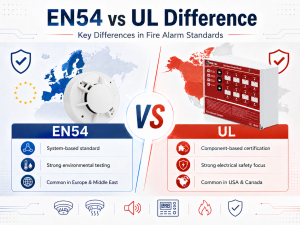
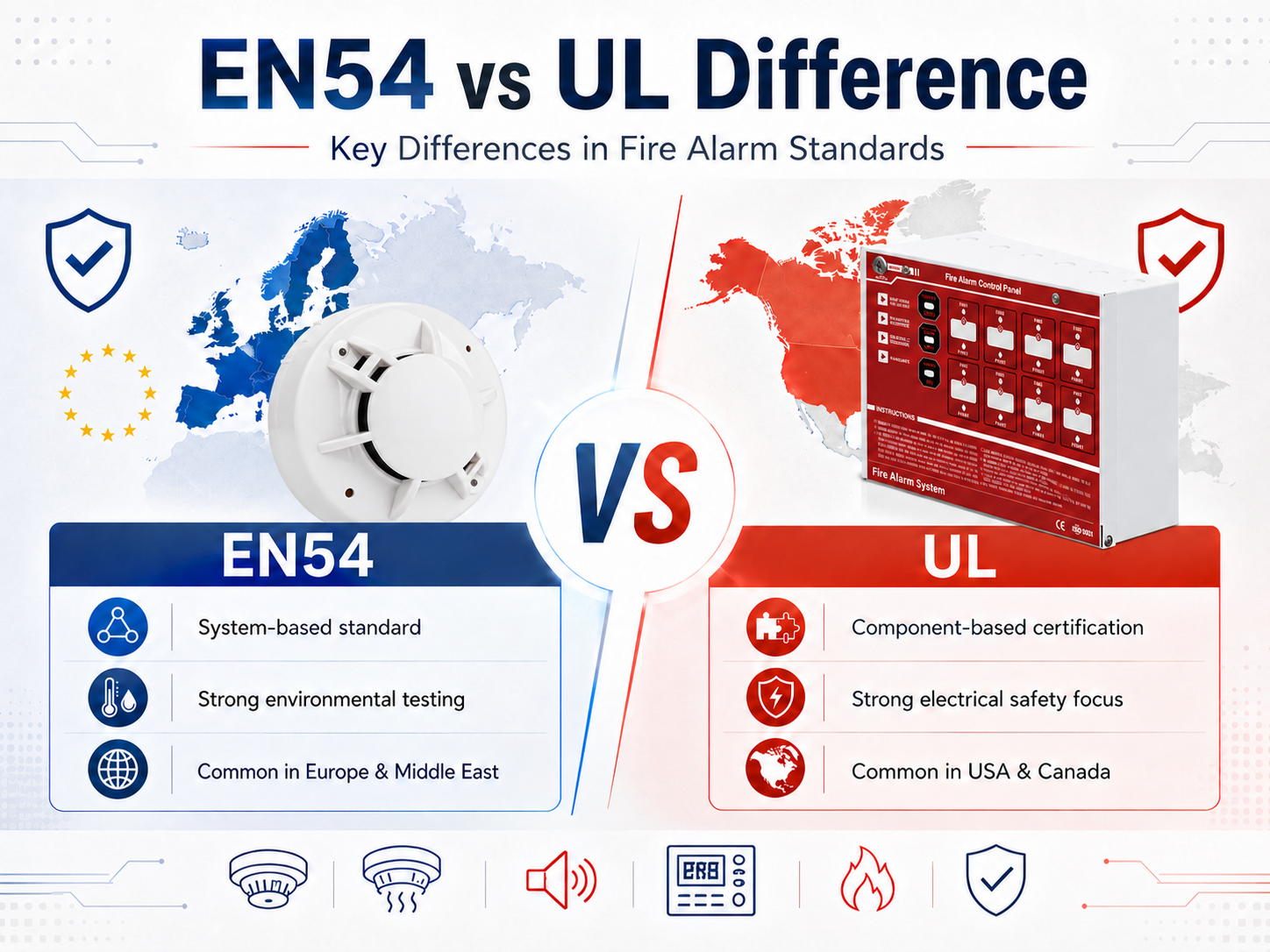
The EN54 vs UL difference becomes clear here: UL is more component-based and code-driven, while EN54 is more system-based.
EN54 vs UL difference: Core comparison
Understanding the EN54 vs UL difference requires breaking down the key aspects:
1) Regulatory structure
- EN54: European harmonized standard under CPR
- UL: Private certification aligned with US fire codes (NFPA)
2) Testing philosophy
- EN54: Long-term environmental stress testing
- UL: Electrical safety + performance compliance
3) System approach
- EN54: Entire fire alarm system certification
- UL: Individual product certification
4) Market application
- EN54: Europe, Middle East, Africa, parts of Asia
- UL: United States, Canada
5) Installation rules
- EN54: Integrated system compliance required
- UL: Local fire code compliance (NFPA 72, etc.)
This is the foundation of the EN54 vs UL difference in practical engineering terms.
Testing differences between EN54 and UL
A deeper look into EN54 vs UL difference shows major variations in testing methodology.
EN54 testing includes:
- High humidity exposure
- Temperature cycling
- Vibration resistance
- Long-term aging tests
- False alarm immunity evaluation
UL testing includes:
- Electrical overload tests
- Fire simulation response time
- Component failure safety
- Wiring and insulation safety
- Compatibility with control panels
EN54 tends to simulate real environmental conditions more extensively, while UL emphasizes electrical safety and standardized fire response.
Certification scope difference
One of the most important parts of the EN54 vs UL difference is scope.
- EN54 certifies a complete fire detection system
- UL certifies individual devices or components
For example:
- A smoke detector may need EN54 certification as part of a full system
- The same detector may need UL 268 certification independently
This means manufacturers must often design dual-compliant products for global distribution.
Why EN54 vs UL difference matters for manufacturers?
For global manufacturers like Sumring, the EN54 vs UL difference directly impacts:
- Product design architecture
- PCB and firmware development
- Sensor calibration methods
- Housing and material selection
- Certification cost and time
- Export strategy
A product designed only for UL markets may fail EN54 requirements, and vice versa.
That is why companies like Shenzhen Sumring Technology Co., Ltd. develop dual-certified fire alarm products such as:
- Smoke detectors
- Heat detectors
- CO + smoke combination alarms
- Manual call point systems
- Fire alarm control panels
Application impact: EN54 vs UL in real projects
Understanding EN54 vs UL difference is critical in real-world installation:
EN54 projects:
- Commercial buildings in Europe
- Airports and metro systems
- Industrial facilities in GCC countries
- High-rise residential systems
UL projects:
- US residential housing
- Commercial offices in North America
- Warehouses and logistics centers
- Code-driven municipal installations
Each market strictly requires compliance with its own standard, making the EN54 vs UL difference a legal requirement, not just technical preference.
Common misconceptions about EN54 vs UL difference
Many people misunderstand the EN54 vs UL difference:
Misconception 1: They are interchangeable
Wrong. They are independent certification systems.
Misconception 2: UL is stricter than EN54
Not necessarily. EN54 often requires more environmental endurance testing.
Misconception 3: One product can automatically pass both
False. Dual compliance requires specific redesign and retesting.
How to choose between EN54 and UL systems?
When evaluating EN54 vs UL difference, selection depends on:
- Target market region
- Project regulatory requirements
- Client engineering specification
- Insurance and compliance needs
- System integration requirements
Manufacturers must often support both standards to remain globally competitive.
Industry trend: Dual certification is becoming standard
The modern fire safety industry is moving toward dual compliance. The EN54 vs UL difference is still significant, but global procurement trends are pushing manufacturers to achieve both certifications.
Reasons include:
- International construction projects
- Cross-border engineering firms
- Unified safety procurement standards
- Smart building integration systems
This is why companies like Sumring invest heavily in multi-standard R&D.
Conclusion: EN54 vs UL difference defines global fire safety strategy
The EN54 vs UL difference is not just a technical comparison—it defines how fire alarm systems are designed, certified, and deployed across global markets.
EN54 focuses on system-level environmental resilience, while UL emphasizes component-level electrical safety and compliance with US fire codes.
For manufacturers and engineers, understanding this difference is essential to ensure compliance, avoid project rejection, and successfully enter international markets.
As global fire safety standards continue to evolve, companies that master both systems—like Sumring—will hold a clear competitive advantage.
FAQ:
1. What is the main EN54 vs UL difference?
EN54 is a European system-level standard, while UL is a US component-based certification system.
2. Is EN54 stricter than UL?
Not strictly. EN54 focuses more on environmental testing, while UL focuses on electrical safety.
3. Can a product be both EN54 and UL certified?
Yes, but it requires separate design adjustments and dual testing processes.
4. Where is EN54 required?
EN54 is mainly required in Europe, Middle East, and many international infrastructure projects.
5. Where is UL required?
UL is primarily required in the United States and Canada.
6. Does EN54 vs UL difference affect installation?
Yes, installation rules differ based on regional fire codes and system architecture.
7. Why do manufacturers care about EN54 vs UL difference?
Because it determines product design, certification cost, and export market access.
8. Which is better, EN54 or UL?
Neither is better; they serve different markets and regulatory systems.
If your project requires compliance with both EN54 and UL standards, choosing the right manufacturer is critical. Explore certified multi-standard fire alarm solutions from Sumring to ensure global compliance.