
Why Smart Gas Safety Is Becoming Important for Modern Buildings?
A modern building can control lighting, air conditioning, access doors, elevators, and energy consumption from a central system. Yet there is one question building designers are being asked more often: what about gas leaks?
That question is becoming harder to ignore.
In 2026, smart gas safety is moving further into discussions about residential buildings, hotels, commercial facilities, apartment projects, kitchens, boiler rooms, and mixed-use developments. The reason is simple. A gas leak may develop quietly, while the consequences can become serious very quickly.
The U.S. National Transportation Safety Board (NTSB) updated its natural gas alarm safety information in April 2026, stressing that early detection is critical and continuing to recommend natural gas alarms that meet NFPA 715 requirements in buildings where gas leaks could affect occupants.
Meanwhile, smart building technology is becoming more connected. Sensors, building controls, software, and IoT devices increasingly work together rather than as isolated pieces of equipment. ASHRAE has highlighted the growing role of connected sensor systems, building management software, fault detection, and intelligent building controls.
Put those trends together and a clear picture appears: gas detection is becoming part of the wider smart-building safety conversation.
Smart Gas Safety Starts With Earlier Detection
Smart gas safety means using gas detection devices together with local alarms, digital notifications, monitoring functions, or connected control equipment to identify a potentially dangerous gas condition and communicate it quickly.
That last word matters: quickly.
Natural gas is naturally colorless and odorless. Odorants are normally added so people can notice a leak, but smell alone has limitations.
The NTSB points out that occupants may be asleep, away from the room where gas accumulates, unable to smell the odorant, or unfamiliar with what the smell means. Gas migrating through soil can also lose some of its odor before entering a building.
A detector does not get distracted. It does not leave the kitchen for a meeting. It does not go to sleep.
It keeps monitoring.
That makes automatic detection an important additional safety layer rather than a replacement for correct gas-system design, inspection, maintenance, or emergency procedures.
Why Is Smart Gas Safety Getting More Attention Now?
Several trends are meeting at roughly the same time.
Buildings contain more connected devices. Facility managers expect faster information. Property owners want clearer maintenance records. Remote management has become common. Meanwhile, safety authorities continue to examine how methane and fuel-gas detection can provide earlier warning.
NFPA 715 addresses fuel-gas detection and warning equipment used in buildings and structures, covering areas such as selection, installation, location, inspection, testing, and maintenance. The 2026 edition is now listed among NFPA’s available publications.
The NTSB has gone further in its advocacy. Its 2026 natural gas alarm recommendations call for requirements covering natural gas alarms in businesses, residences, and other buildings where people gather and could be affected by a leak.
This does not mean every country or every building is suddenly required to install the same detector.
Local codes still matter enormously.
But the direction is worth watching—especially for developers, fire-safety contractors, distributors, MEP engineers, and gas alarm wholesalers planning products several years ahead.
A Local Alarm Is Useful. A Connected Alarm Can Do More
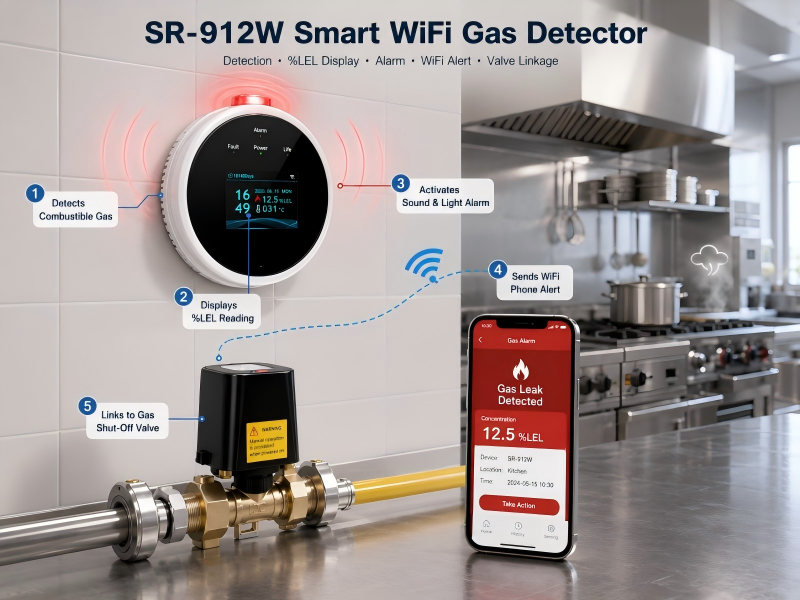
Picture a detector installed in a small restaurant kitchen.
If it detects combustible gas, a traditional unit may activate a buzzer and warning light. That can be very effective when somebody is nearby.
But what if the leak starts after closing time?
This is where smart gas safety changes the conversation.
Depending on the system design, a connected gas detector may provide:
- Audible and visual warning at the site
- Gas concentration information
- Remote mobile notifications
- WiFi or network communication
- Relay output to external equipment
- Connection with a gas shut-off valve
- Connection with ventilation or exhaust equipment
- Fault or device-status information
Not every project needs every function. In fact, stuffing unnecessary features into a specification can make a project harder, not safer.
The key is matching the detector and control method to the actual risk.
For a small apartment, a simple local alarm may be suitable. A hotel kitchen, central boiler room, apartment complex, or managed commercial building may require a different approach.
That’s why smart gas safety is increasingly a system question rather than just a product question.
Building Managers Want Information, Not Just Noise
An alarm that sounds is valuable.
An alarm that also tells responsible personnel where something happened can be even more useful in larger facilities.
Think about a property manager responsible for several buildings. Walking around each room checking detectors manually isn’t exactly anyone’s idea of an efficient Monday morning.
Connected gas detection may make it easier to identify alarm conditions or device status from another location. Depending on the architecture, this information could be presented through an app, control panel, gateway, or building-management interface.
This reflects a much wider smart-building trend.
ASHRAE notes that increasingly sophisticated sensor networks, internet connectivity, data collection, and building-management software are creating new possibilities for building controls and fault detection.
Gas safety naturally fits into that broader movement.
Still, there’s an important caution: connectivity should complement the primary safety function. A gas detector should not become dependent on a phone notification alone. Local warning, correct sensor performance, suitable installation, and appropriate system design remain fundamental.
The Next Step: Detection Plus Action
Here’s where things get interesting.
Some smart gas safety systems can do more than detect a condition. They may also provide signals that support another safety action.
For example, properly designed equipment may be connected to a compatible shut-off valve or ventilation system.
Conceptually, the sequence can look like this:
Gas detected → local alarm → remote notification → control signal → safety response
That can shorten the gap between detection and action.
NFPA documentation also recognizes fuel-gas detectors as equipment that may operate with control units and associated equipment, while relevant gas detector standards cover certain equipment designed for connection to systems such as ventilation or shut-off devices.
However, automatic control must be engineered carefully. Valve type, relay rating, fail-safe behavior, power supply, local regulations, gas type, installation position, and system reset logic all matter.
A specification sheet alone does not design a building.
For B2B projects, qualified engineers and applicable local codes should determine the final system architecture.
Methane Monitoring Is Part of a Bigger Global Trend
There is also a wider environmental story behind gas monitoring.
Governments are paying greater attention to methane detection and leak management across the energy sector. The International Energy Agency’s Global Methane Tracker 2026 reports continued expansion of methane measurement, leak-detection, reporting, and repair policies in multiple markets.
These rules mainly address energy-sector emissions rather than ordinary building gas alarms, so the two should not be confused.
Yet they reveal something important.
Gas that cannot be measured is difficult to manage.
That principle applies surprisingly well inside buildings too.
More precise sensing, better monitoring, and faster reporting are becoming common expectations across many areas of infrastructure. Building safety is following a similar path.
What Should Project Engineers Look for in a Smart Gas Detector?
For wholesalers and project contractors, selecting a device based only on its WiFi logo is risky.
A sensible smart gas safety specification starts with the application.
First, determine the target gas. Natural gas is mainly associated with methane, while LPG commonly contains propane or butane. Their physical behavior differs, which affects detector positioning.
Then consider the installation environment.
A residential kitchen and a commercial boiler room are not the same job. Required power supply, relay function, alarm output, network method, operating temperature, housing design, and certification requirements may all differ.
Engineers should also review:
- Target gas and detection range
- Alarm threshold
- Sensor technology
- Local sound and light warning
- Power supply
- Relay or valve output
- Communication protocol
- Remote notification requirements
- Sensor service life
- Test and maintenance method
- Applicable certifications
- Compatibility with the wider safety system
There’s no magic detector for every building.
And that’s actually good news. Proper project matching is far more useful than a giant feature list.
For B2B Buyers, Compatibility Is Becoming a Purchasing Issue
Wholesale buyers once focused heavily on price, voltage, packaging, and delivery time.
Those points still matter, of course.
But connected products create additional questions.
Can the detector operate independently if the network goes down? Does it provide a dry-contact relay output? Can it connect to the specified valve? Which gas does the sensor detect? What app or network architecture is required? Can branding, housing, packaging, plug type, or alarm language be customized for the target market?
These details affect installation costs later.
For project engineers, confirming them before ordering can save a lot of uncomfortable conversations on the jobsite.
This is another reason smart gas safety is becoming important: purchasing decisions increasingly involve both hardware and system compatibility.
Smart Buildings Need Smarter Safety Layers
Modern buildings are not becoming intelligent simply because everything connects to WiFi.
Real intelligence comes from getting useful information to the right person—or the right system—when it matters.
Gas detection is a good example.
A well-designed smart gas safety system can combine continuous sensing, local warning, remote information, and compatible external control while still preserving the fundamental role of reliable on-site detection.
Standards activity is also worth watching. NFPA’s ongoing work around fuel-gas detection and the NTSB’s continued recommendations show that methane alarms are receiving more formal attention in building-safety discussions.
For developers, wholesalers, engineering contractors, and fire-and-gas safety suppliers, that makes this more than another IoT trend.
It is becoming a design question:
If a building can tell us when a door opens, a room gets too warm, or an HVAC unit develops a fault, shouldn’t it also be able to provide earlier warning when combustible gas begins accumulating?